

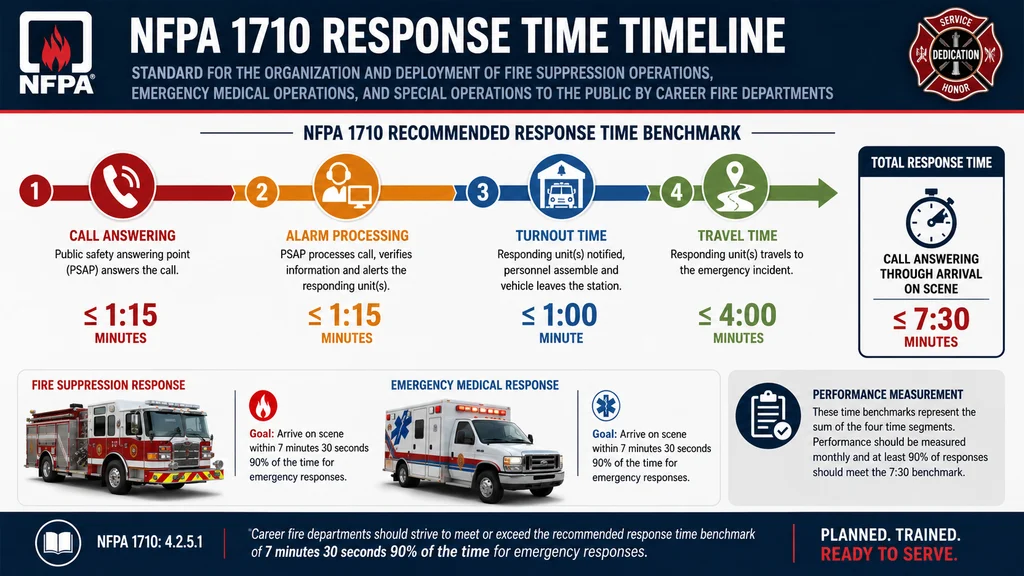
NFPA 1710 response times establish critical benchmarks for career fire departments to ensure public safety. Key standards include an 80-second turnout time for fire and special operations (60 seconds for EMS), 4-minute travel time for the first arriving engine, and 8-minute travel time for a full alarm assignment, all measured at a 90% compliance level . Top alternatives: Fire response time standards, Emergency response benchmarks, NFPA deployment guidelines, Turnout and travel time requirements, and Fire service performance objectives.Every second matters when lives are on the line. In the fire and emergency services world, NFPA 1710 response times aren’t just arbitrary numbers, they’re the framework that determines whether help arrives in time to make a difference. Whether you’re a fire chief trying to justify staffing levels, a municipal leader evaluating department performance, or a community member wondering what to expect when you call 911, understanding these standards is essential.
The reality is, when a fire breaks out or someone goes into cardiac arrest, the clock starts ticking immediately. NFPA 1710 provides career fire departments with clear benchmarks for alarm answering, turnout time, and travel time to ensure communities receive the protection they deserve . These standards help fire departments optimize their deployment strategies and ultimately save more lives.
Alarm Handling and Dispatch Responses
1. NFPA 1710 requires a dispatch processing time of 64 seconds or less at 90% compliance
Example: Use this when evaluating your department’s call center efficiency.
Meaning: Sets the benchmark for how quickly dispatch processes emergency calls .
2. Alarm answering time begins when the call is received and ends when it’s acknowledged
Example: Use this to understand the first component of the total response time.
Meaning: Defines the start of the response timeline .
3. Alarm processing time ends when response information is transmitted to emergency units
Example: Use this when analyzing your dispatch center performance.
Meaning: Measures the efficiency of information relay to responders .
4. The 2020 edition of NFPA 1710 includes updated alarm handling requirements
Example: Use this to ensure your department follows the latest standards.
Meaning: Keeps departments current with evolving best practices .
5. Dispatch centers should aim for 60 seconds or less for high acuity call processing
Example: Use this for EMS calls requiring immediate attention.
Meaning: Prioritizes faster processing for critical emergencies .
6. Efficient alarm handling is the foundation of meeting NFPA 1710 response time objectives
Example: Use this when explaining why dispatch matters.
Meaning: Recognizes that response times start before units leave the station.
7. Alarm answering time performance objectives must be met by specific deadlines
Example: Use this when implementing compliance timelines.
Meaning: Requires departments to work toward specific targets .
8. NFPA 1710 requires 90% of alarms to meet all time performance objectives
Example: Use this as the standard compliance metric.
Meaning: Establishes the reliability threshold for response .
9. Alarm processing is the time from acknowledgment to transmittal of response information
Example: Use this to clarify the dispatch process flow.
Meaning: Defines the middle step in the alarm handling sequence .
10. The alarm answering process includes receiving and acknowledging emergency signals
Example: Use this for training new dispatchers.
Meaning: Outlines the initial steps of emergency response .
11. NFPA 1710 coordinates with NFPA 1221 for alarm processing standards
Example: Use this when referencing related standards.
Meaning: Shows how NFPA standards work together .
12. Emergency call handling directly impacts overall NFPA 1710 response times
Example: Use this when improving dispatch operations.
Meaning: Emphasizes the ripple effect of dispatch efficiency.
Turnout Time Responses
1. NFPA 1710 requires 80 seconds or less for fire and special operations turnout time
Example: Use this as the benchmark for fire response readiness.
Meaning: Sets the standard for how quickly firefighters must be en route .
2. EMS turnout time is 60 seconds or less under NFPA 1710 standards
Example: Use this for evaluating emergency medical response.
Meaning: Faster turnout for medical emergencies reflects their urgency .
3. Turnout time begins when units are notified and ends when apparatus are responding
Example: Use this to clearly define the measurement period.
Meaning: Provides a consistent definition for performance tracking .
4. The 2020 edition increased fire turnout time from 60 to 80 seconds for safety reasons
Example: Use this when explaining why the standard changed.
Meaning: Prioritizes firefighter safety while maintaining effective response .
5. Turnout time is completely within the fire department’s control
Example: Use this when developing improvement strategies.
Meaning: Identifies an area where departments can directly influence performance .
6. NFPA 1710 requires 90% compliance for all turnout time objectives
Example: Use this as the reliability standard for departments.
Meaning: Establishes the performance threshold for measuring success .
7. Career fire departments must meet the 80-second turnout benchmark for fire responses
Example: Use this when comparing department performance.
Meaning: Defines the expectation for professional fire services .
8. Turnout time includes preparation and safe egress from the station
Example: Use this when designing station layouts or procedures.
Meaning: Considers the practical aspects of responding safely .
9. Reducing turnout time requires efficient station design and alerting systems
Example: Use this when planning facility improvements.
Meaning: Identifies factors that can improve performance.
10. EMS and fire response have different NFPA 1710 turnout time requirements
Example: Use this when training personnel on response protocols.
Meaning: Recognizes different urgency levels for different call types.
11. The 60-second EMS turnout standard reflects the urgency of medical emergencies
Example: Use this to justify rapid EMS response protocols.
Meaning: Emphasizes the importance of quick medical response.
12. Turnout time compliance is tracked through computer-aided dispatch data
Example: Use this when implementing performance monitoring systems.
Meaning: Shows how compliance is measured and verified .
Travel Time Responses
1. NFPA 1710 requires 240 seconds (4 minutes) or less travel time for the first arriving engine
Example: Use this as the primary travel time benchmark for fire response.
Meaning: Defines the maximum expected travel time for initial response .
2. The 4-minute travel time applies to the first arriving fire company at a fire suppression incident
Example: Use this when assessing fire station coverage.
Meaning: Establishes the expectation for the first unit to arrive on scene .
3. NFPA 1710 mandates 480 seconds (8 minutes) or less travel time for a full alarm assignment
Example: Use this for evaluating overall fire response capability.
Meaning: Ensures sufficient resources arrive within a reasonable timeframe .
4. High-rise fire incidents require 610 seconds or less travel time for a full alarm assignment
Example: Use this when planning urban fire protection.
Meaning: Accounts for the challenges of high-rise response .
5. Travel time begins when the unit leaves the station and ends when it arrives on scene
Example: Use this to establish consistent measurement definitions.
Meaning: Provides a clear definition for tracking purposes .
6. The 90% compliance requirement applies to all travel time objectives
Example: Use this as the department’s performance target.
Meaning: Requires reliable performance, not just occasional success .
7. Travel time depends on traffic conditions, weather, and call volume
Example: Use this when explaining response time variability.
Meaning: Recognizes external factors beyond department control .
8. NFPA 1710 travel time for EMS first responder with AED is 240 seconds or less
Example: Use this for basic life support response planning.
Meaning: Extends the 4-minute standard to medical first response .
9. ALS unit travel time is 480 seconds if a BLS unit arrived within 240 seconds
Example: Use this for tiered EMS response planning.
Meaning: Allows additional time for advanced care given earlier basic response .
10. The 4-minute travel standard helps communities evaluate fire station coverage
Example: Use this when planning new station locations.
Meaning: Provides a practical tool for community planning.
11. NFPA 1710 travel time standards are considered industry best practices
Example: Use this when discussing departmental goals.
Meaning: Recognizes the standards as the accepted professional benchmark .
12. Only 5.48% of some service areas currently meet the 4-minute travel time standard
Example: Use this when highlighting coverage challenges.
Meaning: Shows the gap between current performance and the ideal standard .
Total Response Time Responses
1. NFPA 1710 total response time combines turnout and travel time components
Example: Use this when explaining the full response timeline.
Meaning: Shows how total response time is calculated .
2. The first fire unit response time benchmark is 5 minutes and 20 seconds total
Example: Use this as the complete response window expectation.
Meaning: Provides the combined target for initial response .
3. Full alarm assignment response time is 9 minutes and 20 seconds under NFPA 1710
Example: Use this when evaluating comprehensive fire response.
Meaning: Provides the total time for full resource deployment .
4. EMS response time targets range from 5 to 9 minutes depending on the level of care
Example: Use this for EMS deployment planning.
Meaning: Addresses different medical response scenarios .
5. The 90% performance objective applies to total response time, not just individual components
Example: Use this to emphasize the importance of consistent performance.
Meaning: Requires reliable performance across all calls .
6. Total response time includes call processing, turnout, and travel time
Example: Use this for a complete understanding of response performance.
Meaning: Acknowledges all phases of the emergency response chain .
7. NFPA 1710 benchmarks help departments set realistic performance goals
Example: Use this when developing departmental objectives.
Meaning: Provides a framework for performance improvement.
8. The total response time standard reflects the time from alarm to arrival
Example: Use this for community education and transparency.
Meaning: Defines the complete response experience from the public’s perspective.
9. Career fire departments use NFPA 1710 to establish service level goals
Example: Use this when setting department priorities.
Meaning: Guides strategic planning and resource allocation .
10. Response time includes the time to evaluate and commence intervention after arrival
Example: Use this for comprehensive service delivery planning.
Meaning: Recognizes that arrival is not the only factor in effective response .
11. NFPA 1710 response times are measured at the 90th percentile of all calls
Example: Use this when interpreting performance data.
Meaning: Explains how response time statistics are calculated.
12. Meeting NFPA 1710 response times requires efficient dispatch, turnout, and travel
Example: Use this when developing comprehensive improvement plans.
Meaning: Emphasizes the need for excellence across all response phases.
Equipment and Staffing Responses
1. NFPA 1710 sets minimum staffing levels for career fire departments
Example: Use this when determining appropriate staffing resources.
Meaning: Establishes the personnel needed for effective response .
2. Departments must ensure appropriate staffing to meet NFPA 1710 response time goals
Example: Use this when justifying budget requests.
Meaning: Links staffing decisions directly to response performance.
3. NFPA 1710 includes deployment requirements for fire suppression and EMS operations
Example: Use this when planning departmental structure.
Meaning: Guides how resources should be organized .
4. Staffing levels affect the ability to meet NFPA 1710 response time objectives
Example: Use this when evaluating resource allocation.
Meaning: Shows the direct impact of staffing on performance.
5. Career fire departments must comply with NFPA 1710 deployment capabilities
Example: Use this to ensure organizational compliance.
Meaning: Defines what is expected of professional departments .
6. The standard includes requirements for mobile water supply operations
Example: Use this for departments serving rural or remote areas.
Meaning: Addresses specialized operational needs .
7. NFPA 1710 covers organization and deployment of special operations units
Example: Use this for technical rescue and hazardous materials planning.
Meaning: Extends standards beyond routine fire and EMS .
8. Incident safety officer deployment and training is addressed in NFPA 1710
Example: Use this when implementing safety protocols.
Meaning: Prioritizes responder safety during operations .
9. Apparatus type and capabilities affect NFPA 1710 response time performance
Example: Use this when making equipment purchasing decisions.
Meaning: Considers how vehicles impact response effectiveness.
10. The standard requires a minimum number of personnel for each type of response
Example: Use this for staffing and shift planning.
Meaning: Ensures adequate personnel for safe and effective operations.
11. NFPA 1710 applies to career fire departments with paid, non-volunteer personnel
Example: Use this to determine which standard applies to your department.
Meaning: Clarifies the scope of the standard .
12. Equipment maintenance and readiness directly impacts turnout time compliance
Example: Use this when implementing station procedures.
Meaning: Recognizes the importance of operational readiness.
Implementation and Compliance Responses
1. NFPA 1710 is not a legal requirement but serves as a benchmark for best practices
Example: Use this when discussing the standard’s role.
Meaning: Clarifies that it is a voluntary consensus standard .
2. Many jurisdictions use NFPA 1710 response times as contractual or policy requirements
Example: Use this when negotiating labor agreements.
Meaning: Shows the standard’s practical impact despite being voluntary.
3. Compliance with NFPA 1710 is often used in evaluating fire department performance
Example: Use this when setting department goals.
Meaning: Establishes the standard’s role in performance assessment.
4. The 90% performance objective means departments must meet the standard on 9 out of 10 calls
Example: Use this to explain the compliance metric.
Meaning: Clarifies the practical meaning of the 90% threshold.
5. NFPA 1710 compliance is often a factor in ISO ratings for fire insurance purposes
Example: Use this when discussing the standard’s broader impact.
Meaning: Shows how compliance affects community ratings.
6. The 2020 edition of NFPA 1710 includes significant updates from previous versions
Example: Use this to ensure departments are following current standards.
Meaning: Highlights the importance of using the latest edition .
7. Mutual aid units must meet NFPA 1710 standards to count toward compliance
Example: Use this when establishing mutual aid agreements.
Meaning: Ensures consistency in response capabilities .
8. Non-compliance with NFPA 1710 can lead to legal or political consequences
Example: Use this when emphasizing the importance of meeting standards.
Meaning: Highlights potential accountability issues .
9. NFPA 1710 establishes the framework for career fire department deployment
Example: Use this when explaining the standard’s purpose.
Meaning: Defines the standard’s foundational role .
10. Compliance timelines may be phased in over several years
Example: Use this when planning implementation strategies.
Meaning: Allows departments to work toward compliance gradually .
11. IAFF conducts compliance analysis using public GIS and dispatch data
Example: Use this to understand how compliance is verified.
Meaning: Shows the methodology for compliance assessment .
12. NFPA 1710 provides a methodology for evaluating community risk and resource needs
Example: Use this when making strategic deployment decisions.
Meaning: Guides departments in matching resources to community needs.
Training and Education Responses
1. Firefighters should be trained on NFPA 1710 response time objectives and requirements
Example: Use this when developing training programs.
Meaning: Ensures personnel understand the performance standards they must meet.
2. Understanding NFPA 1710 response times is essential for fire service professionals
Example: Use this for leadership development and fire officer training.
Meaning: Emphasizes the importance of the standard for career advancement.
3. Training on proper turnout procedures helps departments meet NFPA 1710 time standards
Example: Use this when implementing turnout drills.
Meaning: Links specific training to performance improvement.
4. Dispatchers must understand NFPA 1710 alarm handling requirements
Example: Use this for communications center training.
Meaning: Ensures call center personnel understand their role in meeting response times.
5. NFPA 1710 training should include all phases of emergency response
Example: Use this for comprehensive department training.
Meaning: Covers the full response cycle from dispatch to arrival.
6. Leadership education on NFPA 1710 helps justify resource allocation decisions
Example: Use this for chief officer development.
Meaning: Empowers leaders to advocate for necessary resources.
7. Firefighters should understand how staffing affects NFPA 1710 response times
Example: Use this when discussing departmental operations.
Meaning: Connects individual roles to broader department performance.
8. NFPA 1710 standards are incorporated into many fire service professional development programs
Example: Use this when designing career progression paths.
Meaning: Shows the standard’s integration into professional development.
9. Regular training and drills help maintain NFPA 1710 response time compliance
Example: Use this when scheduling department activities.
Meaning: Emphasizes the importance of ongoing practice.
10. Incident commanders must understand NFPA 1710 response expectations
Example: Use this for leadership training.
Meaning: Ensures leaders understand performance requirements.
11. NFPA 1710 should be included in fire department orientation for new hires
Example: Use this for onboarding programs.
Meaning: Ensures new personnel understand performance expectations.
12. The standard helps shape fire service educational curricula
Example: Use this when developing training programs.
Meaning: Shows the standard’s broader educational impact.
Comparison to Other Standards Responses
1. NFPA 1710 applies to career fire departments while NFPA 1720 covers volunteer departments
Example: Use this when explaining which standard applies to your department.
Meaning: Distinguishes between the two related standards .
2. Response time recommendations in building codes often reference NFPA 1710
Example: Use this when discussing building design requirements.
Meaning: Shows the standard’s impact on other regulations .
3. ISO uses NFPA 1710 as a reference for evaluating fire department deployment
Example: Use this when preparing for insurance evaluations.
Meaning: Explains the connection between NFPA standards and insurance ratings .
4. NFPA 1710 differs from NFPA 1720 in staffing and deployment requirements
Example: Use this when determining appropriate standards for your department.
Meaning: Clarifies key differences between the two standards.
5. The standard is referenced in Canadian building codes for limiting distance calculations
Example: Use this for cross-border compliance discussions.
Meaning: Shows the international impact of the standard .
6. NFPA 1710 establishes more rigorous response time requirements than NFPA 1720
Example: Use this when comparing standards for different department types.
Meaning: Reflects the resources available to career departments.
7. NFPA 1710 is considered the industry best practice for career fire departments
Example: Use this when justifying adoption of the standard.
Meaning: Supports the standard’s authority in the field .
8. The 90% performance objective is consistent across both NFPA 1710 and 1720
Example: Use this when explaining the reliability standard.
Meaning: Shows consistency in performance expectations.
9. Building code limiting distance requirements use the NFPA 1710 reliability standard
Example: Use this in building code compliance discussions.
Meaning: Shows practical application of the standard .
10. NFPA 1710 focuses on urban and suburban career departments with dense populations
Example: Use this to understand the standard’s intended application.
Meaning: Clarifies the context for which the standard was developed.
11. The standard coordinates with NFPA 1221 for communications requirements
Example: Use this for comprehensive compliance planning.
Meaning: Shows how NFPA standards interrelate.
12. NFPA 1710 response times influence emergency services planning and zoning decisions
Example: Use this when participating in community planning.
Meaning: Highlights the standard’s impact beyond the fire department.
Community Protection Responses
1. NFPA 1710 response times ensure communities receive timely emergency protection
Example: Use this when explaining the standard’s value to the public.
Meaning: Links the standard to community safety outcomes.
2. The 4-minute travel standard helps communities assess fire station coverage
Example: Use this when evaluating fire station locations.
Meaning: Provides a practical tool for community planning .
3. Meeting NFPA 1710 response times is essential for protecting both lives and property
Example: Use this when justifying department resources to city officials.
Meaning: Connects performance to community outcomes.
4. Communities with NFPA 1710 compliance often benefit from better insurance ratings
Example: Use this when discussing the economic benefits of compliance.
Meaning: Shows how the standard benefits the entire community.
5. NFPA 1710 deployment standards ensure equitable protection across all neighborhoods
Example: Use this when addressing coverage concerns.
Meaning: Supports the standard’s role in promoting fairness.
6. The reliability requirement of 90% ensures consistent protection over time
Example: Use this when explaining the importance of consistent performance.
Meaning: Shows why reliability matters to communities.
7. NFPA 1710 recognizes different protection needs through various response benchmarks
Example: Use this when discussing tailored protection strategies.
Meaning: Shows the standard’s flexibility in addressing different needs.
8. Achieving NFPA 1710 response times can reduce property loss from fires
Example: Use this when making the economic case for compliance.
Meaning: Connects the standard to measurable outcomes.
9. The standard helps communities evaluate the effectiveness of their fire protection
Example: Use this for departmental self-assessment.
Meaning: Provides a framework for performance evaluation.
10. NFPA 1710 response time objectives support improved patient outcomes for EMS calls
Example: Use this when advocating for EMS resources.
Meaning: Connects faster response to better medical outcomes.
11. Communities should expect their career fire department to meet NFPA 1710 standards
Example: Use this when addressing community concerns.
Meaning: Sets community expectations based on professional standards.
12. The standard helps communities plan for growth and new development
Example: Use this for long-term community planning.
Meaning: Supports sustainable community development.
Challenges and Solutions Responses
1. Many career fire departments struggle to meet NFPA 1710 response times due to budget constraints
Example: Use this when discussing implementation challenges.
Meaning: Acknowledges practical barriers to compliance.
2. Traffic congestion and road conditions make NFPA 1710 travel times challenging in urban areas
Example: Use this when explaining response time variability.
Meaning: Recognizes real-world challenges.
3. Improving NFPA 1710 compliance often requires additional fire stations or apparatus
Example: Use this when developing improvement strategies.
Meaning: Identifies potential solutions to compliance challenges .
4. Technology solutions like GPS and advanced dispatch can help meet NFPA 1710 times
Example: Use this when considering modernization investments.
Meaning: Shows how technology can improve performance.
5. The 80-second turnout standard was increased from 60 seconds to improve safety
Example: Use this when explaining the evolution of the standard.
Meaning: Shows responsiveness to real-world conditions .
6. Only a small percentage of some service areas currently meet NFPA 1710 travel times
Example: Use this when assessing the scale of the challenge.
Meaning: Shows the gap between current and desired performance .
7. Mutual aid arrangements can help departments meet NFPA 1710 response time objectives
Example: Use this when developing interdepartmental relationships.
Meaning: Shows how collaboration can improve performance .
8. Phased implementation timelines allow departments to work toward NFPA 1710 compliance
Example: Use this when planning long-term strategies.
Meaning: Acknowledges the need for realistic implementation schedules .
9. Data from computer-aided dispatch helps identify NFPA 1710 compliance gaps
Example: Use this when analyzing department performance.
Meaning: Shows how data supports improvement.
10. Communities may need to fund additional fire stations to meet NFPA 1710 standards
Example: Use this when presenting funding requests.
Meaning: Identifies infrastructure solutions.
11. Emergency vehicle routing and traffic signal technology can improve NFPA 1710 travel times
Example: Use this when considering transportation improvements.
Meaning: Shows how cooperation with other agencies helps.
12. Continuous improvement in all response phases is necessary for NFPA 1710 compliance
Example: Use this when setting departmental goals.
Meaning: Emphasizes the need for ongoing effort.
FAQs
What does NFPA 1710 response times refer to?
NFPA 1710 response times are the time objectives established by the National Fire Protection Association for career fire departments. The standards cover alarm answering, turnout time, and travel time for both fire and EMS responses, with a required 90% compliance rate.
What is the NFPA 1710 standard for fire response times?
The standard requires 80 seconds or less for turnout time, 240 seconds (4 minutes) or less travel time for the first arriving engine, and 480 seconds (8 minutes) or less travel time for a full alarm assignment, all at 90% compliance .
What is the NFPA 1710 standard for EMS response times?
EMS response standards include 60 seconds or less for turnout time, 240 seconds (4 minutes) or less for a first responder with AED, and 480 seconds (8 minutes) or less for an advanced life support unit arriving within 90% of calls .
Who does NFPA 1710 apply to?
NFPA 1710 applies to career fire departments with paid, non-volunteer personnel. Volunteer or combination departments typically follow NFPA 1720 .
What is the response time benchmark for NFPA 1710?
The benchmark for the first arriving engine is 5 minutes and 20 seconds total (80 seconds turnout + 240 seconds travel). For a full alarm assignment, the total benchmark is 9 minutes and 20 seconds (80 seconds turnout + 480 seconds travel), with 90% of calls meeting this standard .
What is the turnout time in NFPA 1710?
Turnout time is the interval from when units are notified to when apparatus are responding. NFPA 1710 requires 80 seconds or less for fire and special operations, and 60 seconds or less for EMS response .
What is the 4-minute travel time in NFPA 1710?
The 4-minute (240 second) travel time is the NFPA 1710 benchmark for the first arriving engine company at a fire suppression incident. This applies to 90% of calls and is considered an industry best practice .
What happens if a fire department doesn’t meet NFPA 1710 response times?
While NFPA 1710 is a voluntary standard, many jurisdictions use it as a contractual requirement. Non-compliance can lead to legal action, political consequences, and potentially higher insurance costs for the community .
Conclusion
NFPA 1710 response times aren’t just about numbers on paper. They represent a commitment to excellence in protecting lives and property. Understanding these standards, the 80-second turnout time, the 4-minute first arrival, and the 90% reliability requirement, is essential for anyone involved in emergency services.
Whether you’re a fire chief working to improve department performance, a municipal leader allocating resources, or a community member wanting to understand what to expect, this guide gives you the foundation you need. The standards exist to help departments serve their communities better and to keep firefighters safe while doing it.
So take this knowledge and put it to work. Evaluate your department’s performance against these benchmarks. Advocate for the resources needed to meet them. And remember, every second saved in response time is a second that can make the difference between tragedy and survival. Stay prepared, stay professional, and keep protecting your community.







10 thoughts on “200+ Essential NFPA 1710 Response Times Explained for Fire and EMS Professionals For 2026”