

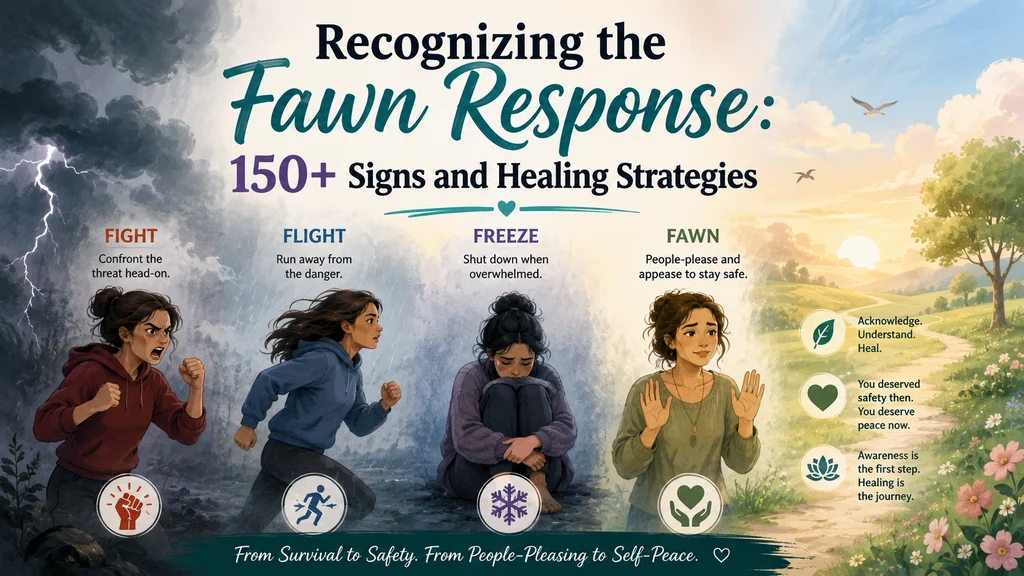
The fawn response to stress is a trauma reaction where you try to please others to avoid conflict and stay safe. It often shows up as people-pleasing, difficulty saying no, and ignoring your own needs. Top signs include over-apologizing, trouble setting boundaries, and feeling anxious when others are upset.Have you ever found yourself saying “yes” when every cell in your body was screaming “no”? Or apologizing for things that weren’t even your fault? Maybe you’ve noticed that you’re constantly reading the room, making sure everyone else is comfortable while your own needs take a backseat.
If any of this sounds familiar, you might be experiencing something called the fawn response to stress. Most of us know about fight, flight, and freeze. But there’s a fourth response that doesn’t get nearly enough attention. The fawn response is when your nervous system decides the safest thing to do is to appease, please, and keep everyone around you happy.
The fawn response to stress isn’t a personality flaw. It’s not you being “too nice” or “too sensitive.” It’s actually a survival strategy that your brain and body learned to protect you, usually during childhood or in situations where you felt powerless. The tricky part is that this response can stick around long after the original threat is gone, showing up in your relationships, at work, and in everyday interactions.
This guide covers 150+ signs, examples, and responses to the fawn stress response. Whether you’re just starting to notice these patterns in yourself or you’re looking for ways to break free from people-pleasing, we’ve got you covered. Let’s get into it.
Recognizing the Fawn Response to Stress
1. You say yes when you really want to say no
Example: You agree to take on extra work even though you’re already overwhelmed and exhausted.
Meaning: Your nervous system is prioritizing others’ approval over your own limits and needs.
2. You over-apologize for things that aren’t your fault
Example: You say sorry when someone bumps into you or when you express a valid concern.
Meaning: Apologizing becomes an automatic reflex to defuse tension and keep others comfortable.
3. You have trouble setting boundaries
Example: You let people call you late at night or drop by unannounced even when it disrupts your peace.
Meaning: You fear that asserting boundaries will lead to rejection or conflict.
4. You feel anxious when others are upset
Example: You can’t focus on anything else until you’ve “fixed” the mood of the person who’s angry or sad.
Meaning: You’ve learned that others’ emotional states feel like a threat to your safety.
5. You constantly monitor other people’s moods
Example: You can tell the moment someone’s energy shifts and adjust your behavior to accommodate them.
Meaning: Hypervigilance keeps you scanning for signs of displeasure or danger.
6. You minimize your own needs to focus on others
Example: You skip meals or ignore your exhaustion to make sure everyone else is taken care of first.
Meaning: Your own wellbeing feels less important than keeping the peace.
7. You change your preferences to match others
Example: You agree to eat at a restaurant you don’t like or watch a movie you’re not interested in to avoid conflict.
Meaning: Authentic self-expression feels too risky to show.
8. You feel guilty for resting or taking time for yourself
Example: You can’t relax without feeling like you should be doing something for someone else.
Meaning: Your worth feels tied to being productive and helpful.
9. You find it hard to identify your own feelings
Example: When someone asks how you’re feeling, your mind goes blank.
Meaning: You’ve spent so much time focusing on others that you’ve lost touch with your own emotions.
10. You avoid conflict at all costs
Example: You stay silent even when something bothers you deeply because speaking up feels terrifying.
Meaning: Conflict is perceived as a direct threat to your safety.
Signs of Fawning in Relationships
1. You feel responsible for other people’s emotions
Example: When your partner is stressed, you immediately feel like it’s your job to fix it, even if it has nothing to do with you.
Meaning: You’ve taken on an unhealthy sense of responsibility for others’ wellbeing.
2. You have difficulty saying no to requests
Example: You agree to favors you don’t have time for because saying no feels like letting someone down.
Meaning: Saying no feels like a rejection of the relationship itself.
3. You feel guilty when you’re angry at others
Example: You apologize for your anger before the other person even responds.
Meaning: Expressing negative emotions feels dangerous and wrong.
4. You are attracted to emotionally unavailable people
Example: You repeatedly end up in relationships where your needs aren’t met.
Meaning: This dynamic feels familiar and reinforces the pattern of chasing approval.
5. You overpour affection and flattery
Example: You compliment and praise others excessively, even when it doesn’t feel genuine.
Meaning: You’re trying to earn safety through excessive approval-seeking.
6. You stay in relationships that don’t fulfill you
Example: You keep giving to someone who never gives back because leaving feels impossible.
Meaning: You’re afraid that if you stop serving, you’ll be abandoned.
7. You fix and rescue others from their problems
Example: You spend all your energy solving your friend’s problems instead of dealing with your own.
Meaning: You feel valuable when you’re needed by others.
8. You have trouble expressing your own preferences
Example: You consistently let others choose the movie, restaurant, or activity to avoid disagreement.
Meaning: Your opinion feels less important than maintaining harmony.
9. You feel like you need to earn love
Example: You believe that love is conditional on being helpful, agreeable, and never causing problems.
Meaning: You internalized that you must “pay” for relationships.
10. You feel empty when you’re not helping someone
Example: When things are calm and no one needs you, you feel lost.
Meaning: Your sense of identity is built around serving others.
Fawn Response at Work
1. You take on excessive workloads
Example: You say yes to every project because you’re afraid saying no will harm your career.
Meaning: Your self-worth at work depends on being indispensable.
2. You constantly compliment your manager
Example: You praise your boss’s decisions even when you disagree with them.
Meaning: You’re trying to ensure your safety through appeasement.
3. You avoid sharing your own ideas
Example: You stay quiet in meetings, convinced your thoughts aren’t valuable enough.
Meaning: Visibility feels unsafe, and you’d rather not be noticed.
4. You apologize for mistakes that aren’t your fault
Example: You say sorry when a project fails even when it was someone else’s responsibility.
Meaning: Apologizing feels like the safest way to avoid blame.
5. You feel anxious about performance reviews
Example: You dread feedback because you perceive it as criticism of your worth as a person.
Meaning: Your nervous system equates evaluation with danger.
6. You never ask for help or support
Example: You struggle through tasks alone rather than admitting you need assistance.
Meaning: Asking for help feels like admitting failure.
7. You follow others’ lead to know how to feel
Example: You mirror your coworkers’ reactions to know if a situation is good or bad.
Meaning: You don’t trust your own perception of situations.
8. You work late to prove your value
Example: You stay long after everyone else leaves, even when there’s nothing urgent.
Meaning: Your worth feels tied to your output and productivity.
9. You feel guilty for taking breaks
Example: You eat lunch at your desk or skip breaks to avoid being seen as lazy.
Meaning: Rest feels like a threat to your professional safety.
10. You change your opinions to align with colleagues
Example: You agree with the group consensus even when you privately disagree.
Meaning: Having a different opinion feels dangerous.
Physical Signs of the Fawn Response
1. You hold your breath unconsciously
Example: You catch yourself taking shallow breaths or holding your breath in conversations.
Meaning: Your body is bracing for potential conflict.
2. You feel tightness in your jaw or chest
Example: You notice your jaw clenching during difficult conversations or meetings.
Meaning: Tension is held in the body from chronic stress.
3. You smile when you’re actually uncomfortable
Example: You find yourself smiling during arguments or when receiving criticism.
Meaning: Smiling becomes an automatic appeasement behavior.
4. You feel frozen or dissociated during conflict
Example: During an argument, you feel like you’re floating outside your body.
Meaning: Dissociation is a freeze response to overwhelming situations.
5. You experience chronic fatigue
Example: You’re tired all the time, even when you’ve had enough sleep.
Meaning: Sustained hypervigilance is metabolically exhausting.
6. You have unexplained physical aches
Example: You often have headaches, stomachaches, or muscle tension with no clear cause.
Meaning: Stress and suppressed emotions manifest in the body.
7. You dissociate in social situations
Example: When you’re overwhelmed, you feel disconnected from yourself and others.
Meaning: Your nervous system is trying to protect you by disconnecting.
8. You experience panic or anxiety
Example: Your heart races and you feel short of breath when someone is upset.
Meaning: Others’ emotions trigger your own stress response.
9. You feel numbness in your body
Example: You notice you don’t feel sensations clearly or fully.
Meaning: Your body has learned to block out feelings to cope.
10. You have difficulty relaxing
Example: Even when you’re “resting,” your mind is racing and your body is tense.
Meaning: Your nervous system stays in “alert” mode, unable to fully settle.
Emotional Signs of Fawning
1. You constantly feel guilty
Example: You feel guilty for your feelings, for saying no, and for having needs.
Meaning: Guilt is a learned response to any self-advocacy.
2. You feel depressed or hopeless
Example: You have a persistent sense that you can’t change your patterns.
Meaning: The fawn response is linked to depression and feelings of powerlessness.
3. You feel angry but don’t express it
Example: You feel resentment building but you push it down and try to be nice.
Meaning: Suppressed anger is a sign of fawning.
4. You feel like you’re not enough
Example: No matter what you do, you feel like you should do more.
Meaning: You’ve internalized the belief that your value is conditional.
5. You feel disconnected from your true self
Example: You’re not sure what you actually want or like.
Meaning: You’ve lost touch with your own identity through years of pleasing others.
6. You feel responsible for everyone’s happiness
Example: If someone around you is sad, you feel like you’ve failed.
Meaning: You’ve taken on an impossible burden of emotional responsibility.
7. You feel like a burden
Example: You apologize for taking up space, asking questions, or needing support.
Meaning: You believe your very existence inconveniences others.
8. You feel numb or disconnected
Example: You go through life feeling like you’re watching from the outside.
Meaning: Emotional numbness is a defense against overwhelming feelings.
9. You feel anxious when you’re not pleasing
Example: When you’re not actively serving someone, you feel restless.
Meaning: Your sense of safety depends on being perceived as useful.
10. You feel like you can’t say no without consequences
Example: You believe that saying no will lead to rejection or abandonment.
Meaning: Past experiences taught you that your safety depends on compliance.
Behavioral Signs of Fawning
1. You avoid being yourself
Example: You show different versions of yourself to different people.
Meaning: Authenticity feels unsafe, so you adapt to fit in.
2. You feel the need to be perfect
Example: You beat yourself up over tiny mistakes and feel like you’ve failed.
Meaning: You believe perfection will protect you from criticism.
3. You neglect healthy relationships
Example: You pour all your energy into difficult people and neglect those who treat you well.
Meaning: Unhealthy dynamics feel familiar and reinforce your patterns.
4. You follow others’ lead to feel safe
Example: You look to others to know how to feel or what to do.
Meaning: You distrust your own judgment.
5. You try to control others’ choices
Example: You try to prevent people from making decisions that might upset you.
Meaning: You’re trying to create safety by managing others’ behavior.
6. You deny your own discomfort
Example: You tell yourself you’re fine when you’re clearly not.
Meaning: You’ve learned to ignore your own internal signals.
7. You overexplain yourself
Example: You give long justifications for simple decisions.
Meaning: You feel like you need to earn the right to your choices.
8. You fly under the radar
Example: You avoid attention and try not to stand out.
Meaning: Being noticed feels dangerous.
9. You have trouble making decisions
Example: You can’t choose a restaurant, a movie, or even what you want to do with your day.
Meaning: You’ve lost touch with your own preferences.
10. You try to make everyone happy
Example: You attempt to please everyone, often at your own expense.
Meaning: You’re terrified of being the cause of anyone’s discomfort.
Fawn Response in Childhood
1. You were overly worried about your caregiver’s wellbeing
Example: As a child, you constantly checked on your parent’s mood and emotions.
Meaning: You learned that your safety depended on your caregiver’s emotional state.
2. You were known as “the easy one” in the family
Example: You were praised for being quiet, helpful, and never causing problems.
Meaning: Being “easy” was your survival strategy.
3. You took on adult responsibilities too early
Example: You parented siblings or emotionally cared for your parents.
Meaning: Parentification is a common origin of the fawn response.
4. You learned to suppress your needs
Example: You stopped asking for things because it upset your caregivers.
Meaning: You learned that your needs were a problem.
5. You spent a lot of time trying to keep the peace
Example: You mediated conflicts between adults and tried to prevent arguments.
Meaning: You took on the burden of maintaining emotional safety.
6. You felt responsible for fixing your family’s problems
Example: You believed that if you were good enough, everything would be okay.
Meaning: You internalized the belief that you were responsible for everyone’s happiness.
7. You were afraid of being a burden
Example: You learned to make yourself small and require very little.
Meaning: You believed you had to earn the right to take up space.
8. You learned that your feelings didn’t matter
Example: Your emotions were dismissed or punished, so you stopped expressing them.
Meaning: You learned that your emotional needs were unimportant.
9. You developed codependent patterns early
Example: You learned to merge your identity with others to feel safe.
Meaning: Codependency is a common outcome of childhood fawning.
10. You felt responsible for your caregiver’s happiness
Example: You believed that if you were perfect, your caregiver would be happy.
Meaning: You learned that your behavior controlled others’ emotions.
How the Fawn Response Affects Mental Health
1. You experience chronic anxiety
Example: You constantly feel worried about what others think of you.
Meaning: Your nervous system is stuck in a state of hypervigilance.
2. You struggle with low self-esteem
Example: You don’t feel like you’re worthy of love or respect.
Meaning: Your self-worth has been conditioned to be contingent on others’ approval.
3. You have difficulty regulating emotions
Example: Your emotions feel overwhelming and out of control.
Meaning: You’ve suppressed your feelings for so long that you’ve lost the ability to process them.
4. You experience burnout
Example: You’re exhausted from constantly trying to please others.
Meaning: The fawn response is energetically expensive and leads to depletion.
5. You feel like you don’t have an identity
Example: You’re not sure who you are when no one else is around.
Meaning: You’ve suppressed your own identity in favor of serving others.
6. You struggle with perfectionism
Example: You hold yourself to impossible standards and feel like a failure when you don’t meet them.
Meaning: You believe perfection will protect you from rejection.
7. You feel resentment building
Example: You’re angry at people but you can’t express it, so it turns inward.
Meaning: Suppressed anger is a sign that your boundaries have been violated.
8. You have difficulty maintaining relationships
Example: Your relationships feel one-sided and unsatisfying.
Meaning: Fawning prevents authentic connection.
9. You feel like you’re not good enough
Example: No matter what you do, you feel like you should be doing more.
Meaning: You’ve internalized the belief that your value depends on your output.
10. You experience depression
Example: You feel hopeless and stuck in your patterns.
Meaning: The fawn response is linked to depression and feelings of powerlessness.
Healing the Fawn Response: Awareness
1. Ask yourself: “What am I feeling right now?”
Example: In moments of stress, pause and check in with yourself.
Meaning: Reconnect with your internal experience.
2. Notice when you’re trying to please someone
Example: Pay attention to when you say yes when you mean no.
Meaning: Awareness is the first step to change.
3. Journal about your patterns
Example: Write down situations where you fawned and how you felt.
Meaning: Journaling supports cognitive processing and awareness.
4. Ask: “Am I doing this to avoid conflict?”
Example: Check in with yourself before you agree to something.
Meaning: Understand the motivation behind your behavior.
5. Check in with your values
Example: Ask yourself if your actions align with what matters to you.
Meaning: Reconnect with your authentic self.
6. Practice observing without judging
Example: Notice your patterns without criticizing yourself for them.
Meaning: Self-compassion is key to healing.
7. Pay attention to your body
Example: Notice physical tension, holding your breath, or dissociation.
Meaning: Your body tells you what you’re feeling.
8. Notice when you feel resentful
Example: Resentment is a sign that your boundaries have been crossed.
Meaning: Honor your feelings as information.
9. Ask yourself: “What do I really need right now?”
Example: Check in with yourself before you respond to others.
Meaning: Reconnect with your own needs.
10. Notice when you feel anxious about others’ emotions
Example: Pay attention to when someone’s mood affects you strongly.
Meaning: Recognize that others’ feelings aren’t yours to manage.
Healing the Fawn Response: Action
1. Practice saying no
Example: Start with small things, like declining a social invitation you’re not excited about.
Meaning: Saying no is a powerful boundary exercise.
2. Set small boundaries
Example: Tell someone you need space or that you can’t take on extra work.
Meaning: Boundaries are protective, not rude.
3. Prioritize yourself
Example: Take time for self-care, hobbies, and rest without guilt.
Meaning: Your needs matter as much as others’.
4. Advocate for yourself
Example: Express your opinion even when it differs from the group.
Meaning: Your voice deserves to be heard.
5. Practice tolerating others’ discomfort
Example: Allow someone to be upset without trying to fix it.
Meaning: You’re not responsible for everyone’s happiness.
6. Ask for help
Example: Reach out when you need support.
Meaning: You’re not weak for needing others.
7. Practice authentic self-expression
Example: Share your true thoughts and feelings, even when it’s hard.
Meaning: You have the right to be seen.
8. Give yourself permission to make mistakes
Example: Stop striving for perfection.
Meaning: You don’t have to earn your worth.
9. Spend time alone
Example: Get to know yourself without others’ influence.
Meaning: Reconnect with your authentic identity.
10. Speak up when something bothers you
Example: Express your concerns calmly and directly.
Meaning: Your feelings deserve to be acknowledged.
Healing the Fawn Response: Self-Connection
1. Explore your own interests
Example: Try hobbies and activities without considering what anyone else likes.
Meaning: Discover what you actually enjoy.
2. Reconnect with your values
Example: Ask yourself what’s truly important to you.
Meaning: Your values guide authentic choices.
3. Practice self-compassion
Example: Talk to yourself with kindness and understanding.
Meaning: You deserve the same compassion you give to others.
4. Ask yourself: “What do I want?”
Example: Start with small things like food and clothing preferences.
Meaning: Reconnect with your desires.
5. Make a list of your positive traits
Example: Include traits that aren’t about helping others.
Meaning: Recognize your inherent worth.
6. Practice grounding exercises
Example: Press a hand to your chest and take slow breaths.
Meaning: Grounding helps you reconnect with yourself.
7. Give yourself permission to rest
Example: Take breaks without guilt.
Meaning: Rest is a need, not a reward.
8. Honor your feelings
Example: Allow yourself to feel anger, sadness, and frustration.
Meaning: All feelings are valid.
9. Make choices based on your own preferences
Example: Choose what you want without considering others’ opinions.
Meaning: Your preferences matter.
10. Celebrate your progress
Example: Acknowledge every small step toward healing.
Meaning: You’re making progress even when it’s slow.
Fawn Response and Relationships
1. Notice unequal giving
Example: Pay attention to whether your relationships are reciprocal.
Meaning: Healthy relationships involve mutual care.
2. Practice taking up space
Example: Express your needs and opinions without apologizing.
Meaning: You deserve to be seen and heard.
3. Allow yourself to receive
Example: Accept help, compliments, and love from others.
Meaning: You don’t have to earn everything.
4. Build relationships with mutual giving
Example: Choose people who give back as much as you do.
Meaning: You deserve balanced relationships.
5. Practice tolerating others’ disappointment
Example: Allow someone to be upset without changing your boundary.
Meaning: You can’t control others’ reactions.
6. Set boundaries with people-pleasing tendencies
Example: Notice when you’re fawning in relationships and pause.
Meaning: Breaking patterns requires conscious effort.
7. Learn to accept authentic connection
Example: Allow people to see the real you.
Meaning: Authentic connection is deeper than people-pleasing.
8. Let go of controlling others’ emotions
Example: Accept that you can’t make everyone happy.
Meaning: Others’ feelings are not your responsibility.
9. Practice being imperfect
Example: Let people see your flaws and messy sides.
Meaning: Perfection isn’t required for love.
10. Choose people who see you
Example: Invest in relationships where you can be your true self.
Meaning: You deserve to be known and loved authentically.
Professional Help for the Fawn Response
1. Consider trauma therapy
Example: Work with a therapist trained in trauma and nervous system regulation.
Meaning: Professional support can help you heal deep patterns.
2. Seek out complex trauma specialists
Example: Find therapists who understand the 4F trauma responses.
Meaning: Specialized support addresses the root of fawning.
3. Explore somatic experiencing
Example: Work with body-based therapy approaches.
Meaning: The fawn response lives in the body as well as the mind.
4. Consider EMDR therapy
Example: EMDR helps process traumatic memories.
Meaning: Processing trauma can reduce the fawn response.
5. Join support groups
Example: Connect with others on similar healing journeys.
Meaning: You’re not alone in this.
6. Learn about complex trauma
Example: Educate yourself about CPTSD and its effects.
Meaning: Understanding your patterns is empowering.
7. Work with a therapist on boundaries
Example: Get professional support in setting and maintaining boundaries.
Meaning: Boundaries are a skill that can be learned.
8. Practice grounding in therapy
Example: Work on staying present when you feel triggered.
Meaning: Grounding helps you stay connected to yourself.
9. Explore attachment theory
Example: Understand how your attachment style affects your relationships.
Meaning: Fawning is often linked to anxious-insecure attachment.
10. Commit to ongoing healing
Example: Recognize that healing is a process, not a destination.
Meaning: Be patient and compassionate with yourself.
FAQs
What is the fawn response to stress?
The fawn response is a trauma reaction where you respond to stress by trying to please, appease, or serve the source of the threat. It’s the lesser-known fourth response alongside fight, flight, and freeze. It involves suppressing your own needs to make others comfortable and is often linked to childhood trauma.
Is fawning just being “too nice”?
No. While it looks like niceness on the surface, fawning is actually a survival strategy. It’s an automatic nervous system response to perceived danger. If someone is fawning, they’re not choosing to be nice. They’re trying to keep themselves safe.
How do I know if I’m fawning?
You might be fawning if you over-apologize, have trouble saying no, feel responsible for others’ emotions, or constantly change yourself to fit others’ expectations. These are signs that you’re using appeasement as a way to feel safe.
Can the fawn response be healed?
Yes. Healing the fawn response involves increasing your self-awareness, learning to set boundaries, reconnecting with your own needs, and getting support from a therapist who understands trauma responses. It takes time and patience.
Is the fawn response a sign of weakness?
Not at all. It’s a sign that your nervous system learned an effective survival strategy in a difficult environment. Recognizing it in yourself is actually a sign of strength and self-awareness.
Conclusion
Recognizing the fawn response to stress is often the hardest step, and you’ve already taken it. If you see yourself in these patterns, it’s important to know that this isn’t a personality flaw or a sign of weakness. It’s proof that your nervous system learned to protect you in an environment where that was necessary.
The good news is that you can heal. It starts with awareness, continues with small changes, and deepens with self-compassion. Every time you say no, set a boundary, or choose yourself, you’re teaching your nervous system a new way to respond. You’re proving to yourself that you’re safe enough to have needs and express them.
Take it slow. Be gentle with yourself. Celebrate every small step. And remember, you deserve to be seen for who you really are, not just for how well you can please others. You’ve got this.








6 thoughts on “150+ Signs and Responses to the Fawn Response to Stress A Complete Guide For 2026”