

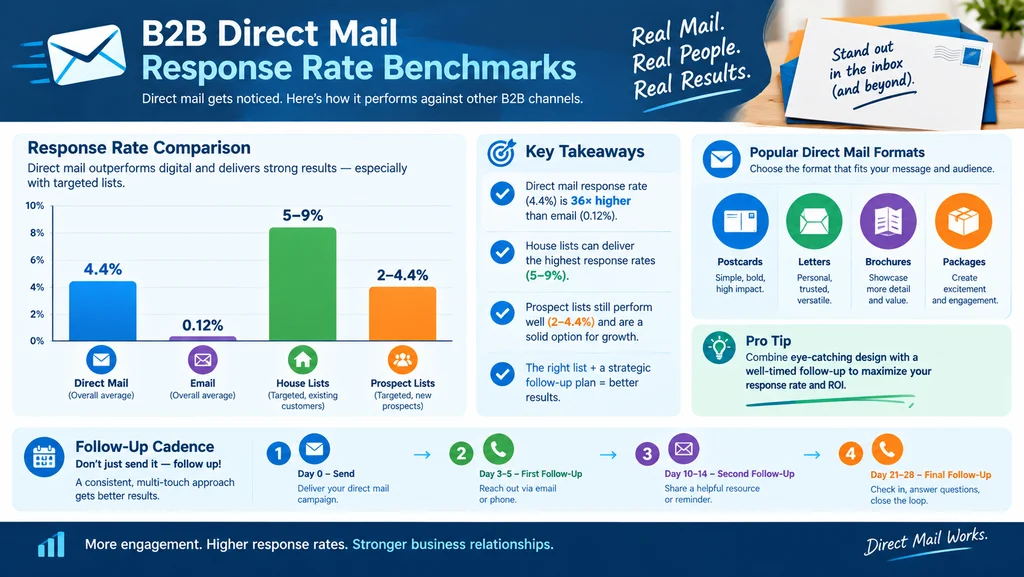
The average B2B direct mail response rate is 4.4% according to the 2025 ANA/DMA Response Rate Report, which is significantly higher than email’s 0.12% average. House lists perform even better at 5% to 9%, while cold prospect lists range from 2% to 4.4%. Top alternatives: 4.4% industry benchmark, 2-4.4% prospect list rate, 5-9% house list performance, 63% lift with digital integration, and 10-15 touch follow cadence.
You’ve just spent thousands on a direct mail campaign. Beautiful postcards, premium paper stock, personalized messaging. Now you’re staring at your dashboard waiting for the leads to roll in. But here’s the question every B2B marketer eventually faces: what actually counts as a good B2B direct mail response rate?
If you’ve been comparing your numbers to email campaigns, you might be underselling yourself. Direct mail response rates consistently outperform digital channels, and understanding the real benchmarks changes everything. The 2025 ANA/DMA Response Rate Report puts the average at 4.4% across all industries, but that single number hides a much richer story .
Whether you’re targeting enterprise accounts, mid-market prospects, or your existing customer base, knowing the B2B direct mail response rates that matter can transform how you allocate budget, design campaigns, and measure success. Let’s break down every benchmark, factor, and strategy you need.
Industry Benchmark Responses
1. The average B2B direct mail response rate is 4.4% across all industries
Example: Use this when setting baseline expectations for a new campaign.
Meaning: This blended average from the 2025 ANA/DMA report includes all mail types and industries .
2. House lists achieve 5% to 9% response rates
Example: Use this when mailing to existing customers or past buyers.
Meaning: People who already know your brand respond at much higher rates than cold prospects .
3. Prospect lists deliver 2% to 4.4% response rates
Example: Use this when targeting new B2B accounts.
Meaning: Cold outreach through mail still outperforms cold email significantly .
4. Email’s average response rate is just 0.12%
Example: Use this when justifying direct mail investment to stakeholders.
Meaning: Direct mail outperforms email by roughly 37 times on average .
5. Healthcare leads industry response rates at 4.09%
Example: Use this when benchmarking healthcare campaigns.
Meaning: Considered purchases respond well to physical mail .
6. Financial services follow closely at 3.95%
Example: Use this when planning financial services campaigns.
Meaning: Trust and tangibility matter in financial decision-making .
7. Automotive industry achieves 3.84% response rates
Example: Use this when targeting automotive B2B buyers.
Meaning: High-consideration purchases benefit from direct mail .
8. Saturation mail to full carrier routes performs under 1%
Example: Use this when comparing targeted versus untargeted campaigns.
Meaning: Precision targeting dramatically improves response .
9. B2B response rates peak in Q2 as budgets are allocated
Example: Use this when timing your campaign calendar.
Meaning: Budget cycles influence purchasing decisions .
10. Personalized direct mail delivers higher response rates
Example: Use this when designing campaigns for executives.
Meaning: Speaking to specific KPIs and initiatives increases engagement .
11. Postcards generate 4% to 5% for house lists
Example: Use this when choosing mail formats.
Meaning: Postcards offer instant visibility with no envelope to open .
12. Oversized postcards outperform standard sizes
Example: Use this when designing mail pieces.
Meaning: 6×9 or larger cards are harder to miss in the mailbox .
Measurement and Tracking Responses
1. Response rate = (responses ÷ delivered pieces) × 100
Example: Use this formula for every campaign.
Meaning: The standard calculation for measuring direct mail effectiveness .
2. Count website visits, calls, scans, and form fills as responses
Example: Use this when defining what counts as a response.
Meaning: Any action tied to your mail piece is a response .
3. Use personalized URLs to track individual responses
Example: Use this when measuring digital engagement from mail.
Meaning: PURLs let you identify exactly who responded .
4. Dedicated phone numbers provide offline response tracking
Example: Use this when your audience prefers calling.
Meaning: Unique numbers tie calls directly to mail campaigns .
5. QR codes bridge physical mail and digital tracking
Example: Use this when targeting mobile-savvy recipients.
Meaning: Scans open unique URLs for measurement .
6. Campaign codes and coupon codes track redemptions
Example: Use this when offering discounts or promotions.
Meaning: Unique codes match transactions to mail pieces .
7. Without identifiers, you cannot accurately tie responses to mail
Example: Use this when designing tracking mechanisms.
Meaning: Every mail piece needs a unique response channel .
8. Track reply rate, meeting rate, and opportunity creation
Example: Use this when measuring B2B campaign success.
Meaning: These metrics connect mail to pipeline impact .
9. Use CRM attribution to tie outcomes to specific sends
Example: Use this when reporting to leadership.
Meaning: Clear attribution shows which mailers drive results .
10. A/B test offers, formats, and messaging within campaigns
Example: Use this when optimizing for better performance.
Meaning: Testing reveals what resonates with your audience .
11. Track completion rates and touch-level performance
Example: Use this when managing follow-up cadences.
Meaning: Data-driven optimization beats guessing .
12. Measure response rates by persona and industry segment
Example: Use this when refining targeting strategies.
Meaning: Different audiences respond to different approaches .
B2B Follow-Up Cadence Responses
1. Execute 8-15 touches over 2-4 weeks after a mailer
Example: Use this when planning post-mail outreach.
Meaning: Structured follow-up dramatically improves response .
2. Begin outreach 2-5 business days after shipping
Example: Use this when timing your first follow-up call.
Meaning: Starting too early causes confusion about mail arrival .
3. Reference the mailed item in every follow-up touch
Example: Use this when scripting sales outreach.
Meaning: Contextual references make outreach warmer and more relevant .
4. Mix calls, emails, and social touches in your cadence
Example: Use this when coordinating multi-channel follow-up.
Meaning: Consistent narratives across channels improve recall .
5. A 10-15 touch sequence over 3-4 weeks is sufficient
Example: Use this when designing follow-up workflows.
Meaning: Prospects feel pursued but not harassed .
6. Prioritize high-impact calls over noisy daily touches
Example: Use this when allocating sales resources.
Meaning: Quality of contact matters more than quantity .
7. Align marketing and sales on follow-up timing
Example: Use this when coordinating teams.
Meaning: Misalignment weakens impact and hurts conversion .
8. Tier-1 ABM accounts benefit most from follow cadences
Example: Use this when targeting enterprise prospects.
Meaning: High-value accounts justify structured outreach .
9. Personalized packages break through gatekeepers
Example: Use this when targeting C-level executives.
Meaning: Physical mail opens doors digital can’t .
10. Tailor follow-up scripts to prospect role and industry
Example: Use this when customizing outreach sequences.
Meaning: Relevance drives response .
11. Track meeting rate and opportunity creation by variant
Example: Use this when optimizing cadence performance.
Meaning: Double down on combinations that convert best .
12. Limit cadence length for most B2B motions
Example: Use this when preventing prospect fatigue.
Meaning: Focused sequences outperform endless outreach .
Format and Design Responses
1. Postcards carry the highest response per dollar
Example: Use this when choosing cost-effective formats.
Meaning: Simple, visible mailers deliver strong ROI .
2. Heavier paper stock gets kept instead of tossed
Example: Use this when designing premium mailers.
Meaning: Quality materials signal importance .
3. Dimensional packages stand out from flat mail
Example: Use this when targeting high-value accounts.
Meaning: Unusual formats demand attention .
4. Physical mailers are expensive compared to email
Example: Use this when justifying budget allocation.
Meaning: Higher cost requires higher expected returns .
5. Reserve direct mail for accounts with strong ICP fit
Example: Use this when qualifying prospects.
Meaning: Precision targeting maximizes ROI .
6. Clear calls to action drive measurable responses
Example: Use this when designing mail pieces.
Meaning: Define exactly what you want recipients to do .
7. Unique landing pages improve tracking accuracy
Example: Use this when measuring digital responses.
Meaning: Redirecting to campaign-specific pages shows engagement .
8. QR codes make mobile response effortless
Example: Use this when targeting smartphone users.
Meaning: One scan connects physical to digital .
9. Personalized URLs grab attention and track responses
Example: Use this when personalizing mail at scale.
Meaning: PURLs leverage names for engagement and measurement .
10. Promotional URLs with UTM parameters track traffic sources
Example: Use this when analyzing campaign performance.
Meaning: UTMs show which mail pieces drive website visits .
11. Reply forms and business reply mail quantify offline responses
Example: Use this when targeting audiences that prefer mail responses.
Meaning: Traditional methods still work for certain segments .
12. Match mail cost and format to expected deal value
Example: Use this when allocating campaign budgets.
Meaning: High-value deals justify premium formats .
List and Targeting Responses
1. Mailing list quality determines 40% of campaign success
Example: Use this when prioritizing list selection.
Meaning: Data is the foundation of direct mail performance .
2. Current, clean, and segmented lists outperform stale data
Example: Use this when auditing your mailing lists.
Meaning: Accurate addresses prevent waste .
3. House lists consistently beat prospect lists
Example: Use this when planning retention versus acquisition.
Meaning: Existing customers already trust your brand .
4. Personalized mail requires accurate contact roles
Example: Use this when targeting specific decision-makers.
Meaning: Wrong names waste expensive mailers .
5. B2B direct mail works best for high-value accounts
Example: Use this when qualifying campaign targets.
Meaning: Deal size justifies premium outreach .
6. ICP fit and intent signals guide targeting decisions
Example: Use this when segmenting your audience.
Meaning: Strategic value determines mail investment .
7. Company addresses must be verified before mailing
Example: Use this when cleaning your data.
Meaning: Returned mail wastes budget and misses opportunities .
8. Buying committees respond to consistent multi-channel narratives
Example: Use this when coordinating ABM campaigns.
Meaning: Recognition across channels builds trust .
9. Executive personas respond to highly tailored packages
Example: Use this when targeting VP and C-level contacts.
Meaning: Personalization breaks through gatekeepers .
10. Mid-market companies can use lighter-weight mailers
Example: Use this when scaling campaigns efficiently.
Meaning: Match mail cost to expected deal value .
11. High-intent or high-LTV prospects justify shorter cadences
Example: Use this when prioritizing outreach resources.
Meaning: Focus intense effort where conversion is likely .
12. Segment-specific cadences outperform generic playbooks
Example: Use this when optimizing by persona and industry.
Meaning: Different audiences need different approaches .
Digital Integration Responses
1. Combining mail with digital lifts response by up to 63%
Example: Use this when designing integrated campaigns.
Meaning: Multi-channel strategies outperform single-channel .
2. Direct mail outperforms stand-alone digital channels
Example: Use this when comparing channel effectiveness.
Meaning: Physical mail stands out from digital noise .
3. Coupling mail with structured follow-up boosts responses
Example: Use this when planning post-mail outreach.
Meaning: The mail opens the door; follow-up walks through it .
4. Consistent narratives across channels improve recall
Example: Use this when coordinating messaging.
Meaning: Prospects see your brand everywhere they look .
5. SDRs referencing mailed items increase meeting rates
Example: Use this when scripting sales outreach.
Meaning: Context makes cold outreach warmer .
6. Direct mail warms up cold conversations
Example: Use this when targeting unresponsive accounts.
Meaning: Tangible pieces create recognition .
7. Email click-through rates are 1% to 2%
Example: Use this when comparing digital performance.
Meaning: Even email’s CTR is far below mail response .
8. Paid social generates 0.5% to 1.5% click-through
Example: Use this when benchmarking social campaigns.
Meaning: Direct mail outperforms most digital channels .
9. Display ads generate below 0.1% click-through
Example: Use this when justifying mail investment.
Meaning: Banner blindness is real; mail gets noticed .
10. Physical mail and digital touches create one coherent experience
Example: Use this when designing multi-channel journeys.
Meaning: Prospects see consistent messaging everywhere .
11. Modern technology platforms execute direct mail campaigns
Example: Use this when scaling personalization.
Meaning: Only 40% of marketers use these tools, creating advantage .
12. Multi-channel attribution connects mail to pipeline
Example: Use this when reporting campaign ROI.
Meaning: Tag campaigns and use unique URLs for tracking .
Campaign Optimization Responses
1. Track response rates by campaign for comparison
Example: Use this when evaluating performance across sends.
Meaning: Response rate distills campaign success into one metric .
2. Define your call to action before mailing
Example: Use this when planning campaign goals.
Meaning: Clear CTAs make response measurement possible .
3. Use unique mechanisms to tie responses to mail pieces
Example: Use this when designing tracking systems.
Meaning: Without identifiers, attribution is impossible .
4. Analyze meeting rates by segment and persona
Example: Use this when refining targeting.
Meaning: Data reveals where to invest more .
5. A/B test mail formats and offers
Example: Use this when optimizing future campaigns.
Meaning: Testing reveals what resonates .
6. Review cadence performance by industry
Example: Use this when tailoring outreach.
Meaning: Different verticals respond differently .
7. Connect mail pieces to replies, meetings, and pipeline
Example: Use this when proving campaign value.
Meaning: Attribution shows which mailers drive revenue .
8. Leadership scrutinizes direct mail spend
Example: Use this when preparing budget requests.
Meaning: Prove ROI with clear metrics .
9. Maximize ROI of each expensive mailer
Example: Use this when justifying premium formats.
Meaning: Every piece should receive thoughtful follow-up .
10. Reduce waste on uncontacted or under-contacted recipients
Example: Use this when enforcing follow-up discipline.
Meaning: Cadence completion prevents missed opportunities .
11. Use campaign tags and unique URLs for attribution
Example: Use this when setting up tracking infrastructure.
Meaning: Clean data enables optimization .
12. Double down on combinations that consistently convert
Example: Use this when scaling successful campaigns.
Meaning: Replicate what works for your ICP .
FAQ
What is the average B2B direct mail response rate?
The average is 4.4% according to the 2025 ANA/DMA Response Rate Report. However, this varies significantly by list type, with house lists achieving 5% to 9% and prospect lists ranging from 2% to 4.4% .
How does direct mail compare to email for B2B?
Direct mail averages 4.4% response while email averages just 0.12%. That’s roughly a 37x advantage for physical mail .
What’s a good response rate for B2B direct mail?
For house lists, anything above 5% is solid, with top performers hitting 9% or higher. For prospect lists, 2% to 5% is strong .
How do I measure direct mail response rates?
Use the formula: (responses ÷ delivered pieces) × 100. Count any action as a response, including website visits, calls, QR code scans, and form fills. Use unique tracking mechanisms like PURLs, dedicated phone numbers, or campaign codes .
Does direct mail work for B2B?
Yes. Direct mail consistently delivers higher response rates than cold email alone in B2B contexts. Combining mail with structured follow-up cadences of 8-15 touches over 2-4 weeks maximizes impact .
Conclusion
B2B direct mail response rates tell a compelling story. At 4.4% average and up to 9% for house lists, physical mail consistently outperforms digital channels by dramatic margins . The data is clear: tangible, well-targeted mailers cut through the noise in ways email simply cannot.
But the number that matters most is the one you achieve. Your list quality, targeting precision, format choices, and follow-up discipline determine whether you hit the benchmark or exceed it. The 63% lift from digital integration shows that multi-channel strategies amplify results .
Save this guide, share it with your marketing team, and use these benchmarks to set realistic expectations for your next campaign. Whether you’re mailing postcards to prospects or dimensional packages to enterprise accounts, knowing the numbers empowers better decisions. Now go make your mailbox work harder







7 thoughts on “ 200+ Best B2B Direct Mail Response Rates Data and Strategies for 2026”