

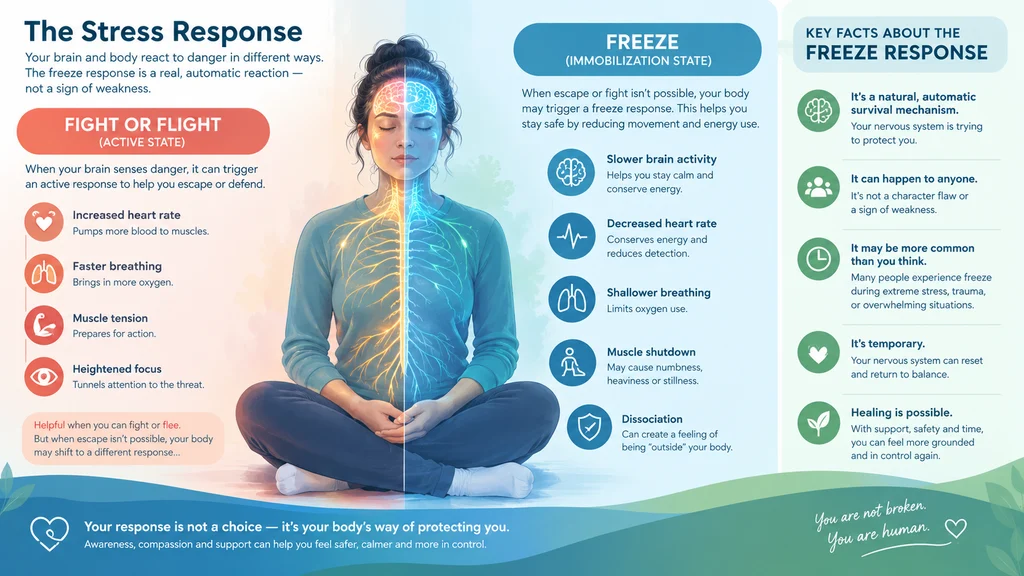
The PTSD freeze response is an involuntary survival reaction where the nervous system shuts down when fight or flight isn't possible. It's not a choice or character flaw, but a biological protective mechanism that takes verbal and movement centers offline. Top alternatives: trauma shutdown, dissociative freeze, tonic immobility, nervous system paralysis, and defensive immobilization.You’re in the middle of an argument, and suddenly your mind goes blank. The words you wanted to say vanish. Your body feels heavy, disconnected, like you’re watching yourself from far away. You want to respond, to defend yourself, to say anything, but nothing comes out. Later, you replay the moment and wonder why you froze.
If this sounds familiar, you’re not alone. The PTSD freeze response is one of the most misunderstood trauma reactions. Unlike fight or flight, which are visibly active, freezing looks like silence, stillness, and shutdown. It’s the nervous system’s way of saying “if I don’t move, maybe the threat will pass.” Understanding this response can help you recognize it, work with it, and eventually build capacity to respond differently.
Core Definition Responses
1. The freeze response is a survival strategy where the nervous system shuts down movement and speech
Example: Use this when explaining why someone goes silent during conflict.
Meaning: The body immobilizes as a protective mechanism when fight or flight aren’t options.
2. PTSD freeze happens when the brain perceives no escape and no ability to fight
Example: Use this when someone wonders why they “couldn’t do anything” during trauma.
Meaning: Freeze is an involuntary response when other survival options seem impossible.
3. Tonic immobility is a form of freeze where the body goes completely still
Example: Use this when discussing sexual assault survivors who couldn’t move.
Meaning: The body enters a paralyzed state as a last-resort survival mechanism .
4. Freeze is not a choice, it’s a nervous system response
Example: Use this when someone feels shame about freezing during a traumatic event.
Meaning: The response is automatic and biological, not a failure of willpower.
5. The freeze response takes language centers offline during threat
Example: Use this when explaining why someone can’t speak during conflict.
Meaning: The brain prioritizes survival over verbal communication .
6. About 70 percent of sexual assault survivors experience the freeze response
Example: Use this when normalizing freeze reactions for survivors.
Meaning: Freezing is extremely common during traumatic events .
7. Freeze can look like high-functioning compliance
Example: Use this when someone says “it’s fine” while clearly distressed.
Meaning: The person may be going through motions while disconnected inside .
8. The freeze response is the parasympathetic system’s emergency brake
Example: Use this when explaining the physiology of shutdown.
Meaning: After sympathetic activation fails, the parasympathetic system triggers shutdown .
9. Freeze is a stalling tactic while the brain assesses threat
Example: Use this when explaining why someone goes still before reacting.
Meaning: The brain pauses to determine the safest response .
10. PTSD freeze differs from “paralyzing doubt” or indecision
Example: Use this when distinguishing freeze from overthinking.
Meaning: Freeze is a dissociative nervous system response, not cognitive hesitation .
11. The freeze response is an evolutionary adaptation that kept ancestors alive
Example: Use this when framing freeze as protective rather than pathological.
Meaning: It’s a survival mechanism that has served humans for thousands of years .
12. Freeze responses can persist long after the original threat has passed
Example: Use this when explaining why someone still freezes in safe situations.
Meaning: The nervous system remains on high alert for similar triggers.
Emotional Responses
1. You feel stuck and unable to take action
Example: Use this when you notice yourself procrastinating or feeling paralyzed.
Meaning: The freeze response creates a sense of physical and mental immobility.
2. You go numb and disconnect from your emotions
Example: Use this when you realize you’re not feeling anything in stressful moments.
Meaning: Numbing protects from overwhelming feelings during freeze.
3. You may dissociate or “space out” during conflict
Example: Use this when you lose time or don’t remember conversations.
Meaning: Dissociation is a form of freeze that creates emotional distance.
4. Your mind goes blank when you need to speak up
Example: Use this when you can’t find words during arguments.
Meaning: Language centers shut down during freeze responses .
5. You feel ashamed for not fighting back or running away
Example: Use this when processing trauma and questioning your reactions.
Meaning: Survivors often blame themselves for freezing during assault .
6. You replay situations later and know exactly what you should have said
Example: Use this when frustrated by delayed processing.
Meaning: The nervous system returns online after the threat has passed .
7. You feel disconnected from your body
Example: Use this when you realize you’re not noticing physical sensations.
Meaning: Freeze includes a mind-body disconnect as a protective mechanism.
8. You withdraw from relationships when stressed
Example: Use this when you pull away from people you love.
Meaning: Isolation feels safer than connection during nervous system overwhelm.
9. You feel exhausted without clear cause
Example: Use this when chronic fatigue sets in after periods of stress.
Meaning: Freeze responses consume energy through constant vigilance.
10. You struggle to express emotions even when you feel them deeply
Example: Use this when you want to share but can’t find the words.
Meaning: Freeze includes emotional shutdown and verbal inhibition.
11. You may feel “frozen in time” around certain triggers
Example: Use this when specific situations make you feel stuck.
Meaning: Trauma triggers can reactivate the original freeze response.
12. You feel guilty for needing space
Example: Use this when you require alone time to regulate.
Meaning: The need for space is valid and part of nervous system recovery.
Relationship Responses
1. Your partner may see your freeze as rejection or coldness
Example: Use this when explaining relationship dynamics to a therapist.
Meaning: Freeze can look like emotional withdrawal to loved ones.
2. Shutting down during conflict is a biological response, not a choice
Example: Use this when you need to explain your silence to a partner.
Meaning: The nervous system takes over when it perceives relationship conflict as threat .
3. Pushing for answers during a freeze makes it worse
Example: Use this when asking a partner to give you space.
Meaning: Pressure signals more danger to an already overwhelmed nervous system .
4. Co-regulation with a calm partner can help you thaw
Example: Use this when describing what helps during a freeze episode.
Meaning: A steady, grounded presence signals safety to the nervous system .
5. You need to communicate your capacity before conversations get heated
Example: Use this when setting up relationship agreements.
Meaning: Saying “I might need a pause” reduces pressure during conflict .
6. A shared language for shutdown makes it less scary for both partners
Example: Use this when building relationship tools with a partner.
Meaning: Simple phrases like “I’m overwhelmed” help both people understand what’s happening .
7. Non-threatening physical presence helps more than words
Example: Use this when asking a partner to support you during a freeze.
Meaning: Quiet companionship signals safety without demands .
8. Your freeze isn’t about the person you’re with
Example: Use this when a partner takes your shutdown personally.
Meaning: The response is wired from past trauma, not current rejection .
9. Space can be a form of connection when offered with patience
Example: Use this when explaining why you need alone time.
Meaning: Respecting boundaries during freeze builds trust .
10. You can practice difficult conversations in low-stakes moments
Example: Use this when working on building capacity for conflict.
Meaning: Gradual exposure helps expand your window of tolerance .
11. Returning to hard conversations after regulation builds confidence
Example: Use this when establishing relationship rhythms.
Meaning: Pausing and re-engaging creates safety for both partners .
12. You deserve a partner who understands nervous system responses
Example: Use this when evaluating relationship compatibility.
Meaning: A supportive partner makes healing possible .
Professional and Workplace Responses
1. Freezing during meetings or presentations can happen to anyone
Example: Use this when you blank during a work moment.
Meaning: High-stakes professional situations can trigger freeze responses.
2. You might say “yes” to everything to avoid conflict at work
Example: Use this when you notice people-pleasing patterns professionally.
Meaning: Fawn responses often accompany freeze in workplace settings.
3. Taking a bathroom break can help reset your nervous system
Example: Use this when you need a quick escape to regulate.
Meaning: A brief change of environment can interrupt a freeze response.
4. Writing your thoughts before meetings helps bypass verbal freeze
Example: Use this when preparing for important conversations.
Meaning: Having notes reduces pressure on language centers during stress.
5. You can request accommodations for processing time
Example: Use this when negotiating workplace needs.
Meaning: Asking for time to respond is a valid professional request.
6. Email communication may be easier than in-person confrontation
Example: Use this when choosing how to communicate professionally.
Meaning: Written communication gives time to process without freeze pressure.
7. Building a relationship with a trusted colleague can help co-regulation
Example: Use this when needing support during work stress.
Meaning: A safe professional connection can help ground your nervous system.
8. Practicing small assertions at work builds capacity for bigger ones
Example: Use this when working on professional confidence.
Meaning: Incremental practice expands your window of tolerance .
9. You may need to step away from toxic work environments
Example: Use this when evaluating whether a job is sustainable.
Meaning: Chronic freeze responses in unsafe environments require systemic change.
10. Documenting your wins can counter feelings of professional inadequacy
Example: Use this when freeze responses affect your confidence.
Meaning: Evidence of competence helps counter trauma-driven self-doubt.
11. Requesting clear expectations reduces freeze-triggering uncertainty
Example: Use this when managing workplace anxiety.
Meaning: Predictability helps the nervous system feel safer.
12. Your freeze response doesn’t define your professional worth
Example: Use this when you feel inadequate after a shutdown.
Meaning: Freeze is a nervous system pattern, not a measure of competence.
Recognition and Awareness Responses
1. You notice yourself going silent when tensions rise
Example: Use this when beginning to recognize your freeze patterns.
Meaning: Awareness of the pattern is the first step to working with it.
2. Your body feels heavy or disconnected before you realize you’ve frozen
Example: Use this when tracking physical sensations.
Meaning: The body often signals freeze before the mind recognizes it.
3. You may not realize you’ve frozen until after the moment passes
Example: Use this when confusion about what happened sets in.
Meaning: Freeze can be so complete that conscious awareness goes offline.
4. Specific topics, people, or tones can trigger your freeze response
Example: Use this when identifying your personal triggers.
Meaning: Triggers can be sensory, relational, or situational .
5. Your freeze response may have kept you safe in the past
Example: Use this when reframing your reaction with compassion.
Meaning: The response was adaptive when it developed.
6. Recognizing the freeze doesn’t stop it, but it starts the thaw
Example: Use this when frustrated that awareness alone isn’t enough.
Meaning: Awareness creates space for new responses over time.
7. You might confuse freeze with laziness or lack of motivation
Example: Use this when you’re hard on yourself for inaction.
Meaning: The inability to act is neurological, not moral .
8. Your pattern of shutting down may feel like your personality
Example: Use this when questioning your identity.
Meaning: Survival adaptations can become so familiar they feel like self.
9. Naming what’s happening can bring you back online
Example: Use this when you catch yourself mid-freeze.
Meaning: Labeling the response engages cognitive processing centers.
10. Freeze responses often have physical markers like shallow breathing
Example: Use this when learning to track your nervous system.
Meaning: Body awareness is key to early intervention .
11. You can learn to recognize the moments just before freeze sets in
Example: Use this when building capacity for earlier intervention.
Meaning: The pre-freeze window offers the best opportunity to regulate.
12. Understanding your freeze is an act of self-compassion
Example: Use this when you feel shame about your patterns.
Meaning: Learning about your nervous system is self-care, not self-indulgence.
Healing and Recovery Responses
1. Healing freeze doesn’t mean forcing yourself to speak before you’re ready
Example: Use this when feeling pressured to “get over” your freeze.
Meaning: Pushing too hard can retraumatize the nervous system .
2. Small truths in low-stakes moments build capacity
Example: Use this when starting your healing journey.
Meaning: Gradual practice expands your window of tolerance .
3. Noticing physical sensations without judgment is the first step
Example: Use this when starting somatic awareness practices.
Meaning: Curiosity about the body creates safety for change .
4. Creating internal and external safety helps your voice emerge
Example: Use this when building conditions for healing.
Meaning: The nervous system needs safety to try new responses .
5. Therapy can help you process the trauma underlying your freeze
Example: Use this when you’re ready for professional support.
Meaning: A trained therapist can guide nervous system healing.
6. Grounding exercises can interrupt a freeze response in the moment
Example: Use this when you need tools for acute freeze episodes.
Meaning: Techniques like deep breathing or physical grounding help regulate.
7. Your body needs to learn that it’s safe to move and speak
Example: Use this when frustrated by slow progress.
Meaning: Rebuilding nervous system safety takes time and repetition.
8. Self-compassion practices counteract the shame of freezing
Example: Use this when you’re struggling with self-judgment.
Meaning: Kindness to yourself creates space for change .
9. Movement and somatic practices can help release stored freeze energy
Example: Use this when talk therapy alone isn’t enough.
Meaning: The body holds trauma and needs body-based interventions.
10. Pacing yourself prevents overwhelm during healing
Example: Use this when you want to rush the process.
Meaning: Slow, steady work is more sustainable than pushing .
11. Support groups connect you with others who understand freeze
Example: Use this when feeling isolated in your experience.
Meaning: Shared understanding reduces shame and builds hope.
12. Your nervous system can learn new responses when it feels supported
Example: Use this when you doubt whether change is possible.
Meaning: Neuroplasticity means healing is possible at any age .
FAQ
What is the PTSD freeze response?
The PTSD freeze response is an involuntary survival reaction where the nervous system shuts down movement and speech when fight or flight aren’t possible. It’s a protective mechanism, not a choice or character flaw .
Why do I freeze during conflict?
Your nervous system may perceive relationship conflict as a threat, triggering the same survival response that activates during physical danger. The brain takes verbal centers offline as an act of self-protection .
Is freezing during trauma a sign of weakness?
No. Freezing is an involuntary biological response experienced by about 70 percent of sexual assault survivors and many others in life-threatening situations .
How can I stop freezing?
You can’t force the freeze response to stop, but you can build capacity over time through awareness, grounding practices, therapy, and gradual exposure to low-stakes situations .
What helps during a freeze episode?
Grounding techniques, deep breathing, physical movement, and the presence of a calm, supportive person can help your nervous system return online. Pushing for verbal engagement usually makes it worse .
Conclusion
The PTSD freeze response is one of the most misunderstood trauma reactions. It looks like silence, stillness, and shutdown, but it’s actually your nervous system doing exactly what it learned to do to keep you safe. It’s not a character flaw. It’s not a lack of courage. It’s survival.
Understanding your freeze response is the first step toward healing. You don’t have to force yourself to “get over it” or push through. Instead, you can learn to recognize your patterns, create safety, and build capacity slowly. Your nervous system can learn new responses when it feels supported enough to try.
Share this guide with someone who needs to understand their own freeze response. Save it for the moments when you need a reminder that you’re not broken. You’re surviving, and healing is possible.








5 thoughts on “150+ Best PTSD Freeze Response Insights for Understanding Shutdown For 2026”