

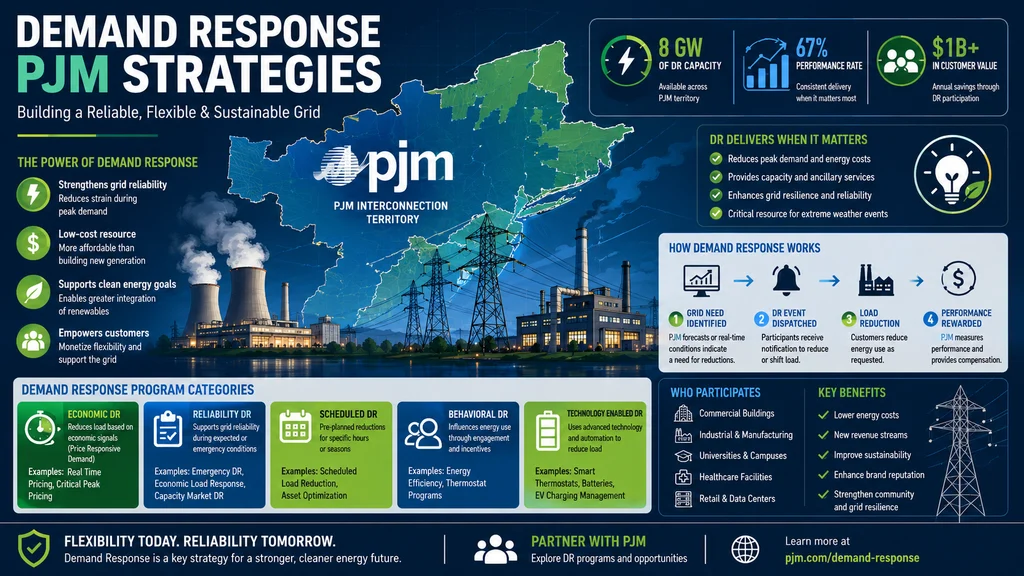
The best Demand Response PJM strategies help balance the grid by reducing electricity use during peak times in exchange for payments. From emergency load reduction to economic market participation, these programs are vital for reliability. Top alternatives: PJM load management programs, capacity market demand response, emergency demand response, economic demand response, and curtailment service provider programs.You’re sitting in your office on a scorching July afternoon when the notification comes in. PJM is calling on demand response resources. Your facility needs to reduce power consumption immediately .
This is the reality of Demand Response PJM programs. They’re the invisible safety net that keeps the grid running when temperatures soar and electricity demand threatens to outpace supply . From large industrial plants to commercial buildings, participants voluntarily cut back on energy use during critical moments .
The truth is, Demand Response PJM has never been more important. With data center growth exploding and generator retirements accelerating, the gap between supply and demand is tightening . Understanding how these programs work could save your business money, help the grid, and even prevent blackouts .
Emergency Demand Response Strategies
1. Reduce electricity use immediately when PJM issues an alert
Example: Use this during heat waves when the grid is stressed and reserves are low.
Meaning: Emergency response is critical for preventing blackouts during extreme conditions .
2. Pre-arrange load reduction procedures with your team
Example: Have clear protocols for shutting down non-essential equipment during events.
Meaning: Preparation ensures you can respond quickly when PJM calls .
3. Monitor PJM’s emergency procedures website for dispatch notifications
Example: Stay informed about when you need to curtail your load.
Meaning: Being aware of alerts helps you act before mandatory curtailment occurs .
4. Raise thermostat temperatures to reduce air conditioning load
Example: A simple action that reduces power consumption during peak hours.
Meaning: HVAC adjustments are one of the most common demand response actions .
5. Shift production schedules away from peak demand hours
Example: Move energy-intensive operations to off-peak times.
Meaning: Production shifting reduces stress on the grid during critical periods.
6. Participate in load management programs for capacity market payments
Example: Commit to reducing load in the capacity market and earn compensation.
Meaning: These programs provide financial incentives for reliability commitments .
7. Use backup generators to supplement grid power during events
Example: Keep critical operations running while reducing grid demand.
Meaning: On-site generation can offset your grid consumption during emergencies.
8. Coordinate with your Curtailment Service Provider for event participation
Example: Work with your CSP to ensure you meet reduction requirements.
Meaning: CSPs are essential for aggregating and verifying customer participation .
9. Prepare for more frequent dispatch events as reserve margins tighten
Example: With growing demand, expect to be called upon more often .
Meaning: Increased frequency is the new normal for demand response participants .
10. Document your load reductions for verification purposes
Example: Keep records of your actual usage before and after curtailment.
Meaning: Verification is essential for receiving compensation .
11. Understand that failure to perform results in financial penalties
Example: Commitments in the capacity market are binding obligations.
Meaning: Performance is mandatory to avoid penalties .
12. Be ready for manual load shedding when automated systems aren’t enough
Example: Manual actions may be required during severe grid stress.
Meaning: Having manual procedures ensures you can still perform when needed .
Economic Demand Response Strategies
1. Participate in the day-ahead energy market with load reduction offers
Example: Submit offers to reduce power when prices are high.
Meaning: You can earn revenue by competing like a generator .
2. Use real-time energy markets when prices spike
Example: Reduce consumption when wholesale prices exceed your costs.
Meaning: Economic DR is profitable when prices are high .
3. Offer load reduction into ancillary services markets
Example: Provide minute-by-second or second-by-second flexibility.
Meaning: Fast response times command premium payments .
4. Ensure reductions are above normal operating patterns
Example: You can’t earn money for routine energy efficiency.
Meaning: Only explicit, event-driven reductions qualify .
5. Work with a CSP to identify the best market opportunities
Example: Leverage expert knowledge to maximize your earnings.
Meaning: CSPs optimize your participation across multiple markets .
6. Compare your offer price to the marginal power price
Example: If your offer is competitive, you’ll be dispatched like a generator.
Meaning: Economic DR is based on merit order economics .
7. Consider combined participation in both economic and emergency programs
Example: Participate in multiple programs for maximum revenue.
Meaning: Different programs offer different revenue streams .
8. Use behind-the-meter generation strategically
Example: Run generators when wholesale prices justify the fuel costs.
Meaning: On-site generation can be dispatched economically.
9. Automate your demand response for faster response times
Example: Use technology to reduce power without manual intervention.
Meaning: Automation improves performance and reliability.
10. Participate in the Synchronized Reserve market
Example: Provide rapid response for grid stability.
Meaning: Fast-responding resources are valuable for grid operators.
11. Optimize your demand response across all PJM markets
Example: Balance participation across capacity, energy, and ancillary services.
Meaning: Diversifying participation maximizes your financial return.
12. Track your performance metrics for future market participation
Example: Historical data helps you improve your offers.
Meaning: Better data leads to better bidding strategies.
Capacity Market Participation Strategies
1. Commit to load reductions in the Reliability Pricing Model auction
Example: Bid your reduction capacity into the capacity market three years ahead.
Meaning: The capacity market ensures resources are available when needed .
2. Receive payments for your commitment to reduce demand
Example: Earn revenue for being ready to curtail if called.
Meaning: Participation in the capacity market is how most demand response is transacted .
3. Work with a CSP to aggregate your reduction capability
Example: Smaller customers pool their capacity through a CSP.
Meaning: CSPs enable broader participation in wholesale markets .
4. Understand that commitments must be honored with financial penalties
Example: Failure to reduce load when called results in significant penalties.
Meaning: Capacity market commitments are binding obligations .
5. Consider both pre-emergency and emergency DR participation
Example: Different levels of commitment for different conditions .
Meaning: Pre-emergency DR is called before emergency measures.
6. Register your capability with PJM through your CSP
Example: Your reduction capacity must be properly registered.
Meaning: Proper registration ensures you can participate .
7. Offer your load management resources into the capacity market
Example: Your reduction capabilities are a resource PJM can count on.
Meaning: Demand response is treated like supply-side generation .
8. Be aware that reserve margins are tightening
Example: Your capacity commitments are increasingly valuable to the grid .
Meaning: Demand response is becoming more critical for reliability.
9. Review the results of PJM’s capacity auctions
Example: Stay informed about market conditions and pricing.
Meaning: Auction results inform your bidding decisions.
10. Understand that capacity payments are for being available, not just for performing
Example: You earn revenue for your commitment, even if you’re not called.
Meaning: Availability is compensated to ensure resources are ready .
11. Plan your capacity commitments based on your operational flexibility
Example: Only commit to what you can realistically deliver.
Meaning: Realistic commitments prevent penalties .
12. Consider the long-term trend of rising capacity prices
Example: Prices have increased over 1,100% in recent years .
Meaning: Demand response value is increasing significantly.
Demand Response for Large Loads
1. Data centers can participate in demand response to earn revenue
Example: Google reduces computing workloads during grid stress .
Meaning: Even hyperscale loads can provide grid flexibility .
2. New large loads should be first to curtail, not demand response participants
Example: A “non-firm goes first” policy protects existing DR providers .
Meaning: Fairness requires new entrants to provide their own flexibility.
3. Large loads can bring their own capacity through generators or demand response
Example: Secure firm commitments from other sources if not directly participating .
Meaning: Self-reliance reduces pressure on the grid .
4. Consider Non-Capacity-Backed Load status for cost savings
Example: Forego capacity costs in exchange for being subject to curtailment .
Meaning: This new option could reduce costs for some large loads .
5. Participate in demand response to reduce your capacity charges
Example: Lower your electricity bill by reducing consumption during peak times .
Meaning: Demand response directly impacts your bottom line.
6. Automated demand response is essential for data center participation
Example: Software can shift or curtail non-critical computing workloads .
Meaning: Automation enables participation without disrupting core operations.
7. Large loads should be dispatched at the same time as other DR participants
Example: A “go last” model would unfairly burden existing providers .
Meaning: Synchronized dispatch is fairer and more effective.
8. Industrial customers can earn revenue from existing flexible assets
Example: Reduce production during peak times and earn compensation .
Meaning: Flexibility creates a new revenue stream.
9. Be aware that large load growth is driving demand response value
Example: Data center growth is increasing the need for grid flexibility .
Meaning: Your participation is becoming more valuable .
10. Consider joining a Virtual Power Plant for aggregated participation
Example: Combine with other loads to provide larger blocks of flexibility .
Meaning: VPPs enable participation for smaller loads .
11. Work with a CSP to navigate the growing complexity of DR programs
Example: New programs like NCBL require expert guidance .
Meaning: Complexity makes CSPs increasingly valuable.
12. Plan for more frequent dispatch events as load growth accelerates
Example: Your facility may be called on multiple times per summer .
Meaning: Increased dispatch is the future of demand response.
Virtual Power Plant Strategies
1. Aggregated smaller loads can participate like large industrial facilities
Example: Even individual homes can be part of a virtual power plant .
Meaning: Aggregation unlocks new participation opportunities.
2. Use virtual power plants to provide capacity market services
Example: Earn capacity payments for aggregated load reduction capabilities .
Meaning: VPPs are a growing part of PJM’s capacity picture.
3. Statistical sampling can verify VPP performance
Example: FERC now allows sampling for verification when meter data isn’t available .
Meaning: This ruling unlocks gigawatts of residential capacity .
4. Participate through a demand response aggregator like Voltus or CPower
Example: Firms that aggregate customers and offer their flexibility into markets .
Meaning: Aggregators provide the expertise and infrastructure .
5. Combine different asset types for optimal dispatch
Example: Use generators, batteries, and demand reduction together .
Meaning: Hybrid approaches maximize value and reliability .
6. Earn compensation for reducing household electricity demand
Example: Homeowners can earn payments for adjusting thermostats or EV charging.
Meaning: Even small reductions add up to significant capacity .
7. Understand that FERC ruling allows broader VPP participation
Example: PJM must accept statistical sampling for verification .
Meaning: This removes barriers for residential and small commercial loads .
8. VPPs provide carbon-free resource flexibility
Example: Reducing demand doesn’t generate emissions like starting a peaker plant.
Meaning: VPPs are a clean alternative to traditional generation .
9. Work with utilities to enable data sharing
Example: Smart meter data is essential for verification .
Meaning: Data access is critical for VPP success .
10. Participate in energy and ancillary services markets through a VPP
Example: VPPs can offer into multiple PJM market segments .
Meaning: VPPs are full market participants .
11. Be aware of the growing importance of VPPs in PJM
Example: FERC found PJM is losing out on at least 4.9 GW due to strict rules .
Meaning: VPPs represent significant untapped capacity.
12. Use VPPs to earn on-bill savings and reduce capacity charges
Example: Lowering peak consumption reduces your overall electricity costs .
Meaning: VPP participation offers multiple financial benefits.
Performance and Verification Strategies
1. Ensure your load reductions can be accurately measured
Example: Use interval data to document your baseline consumption .
Meaning: Measurement is essential for receiving compensation .
2. Work with your CSP to submit load data
Example: Your CSP handles the verification process with PJM .
Meaning: CSPs manage the technical requirements of verification.
3. Understand that performance is critical for avoiding penalties
Example: Summer 2025 performance was 67%, well below historical 90%+ levels .
Meaning: Poor performance threatens the value of demand response .
4. Use baseline calculations to verify your reductions
Example: Your reduction is measured against your normal usage .
Meaning: Accurate baselines are essential for fair compensation.
5. Participate in PJM’s stakeholder process to improve performance issues
Example: PJM is addressing the 67% performance problem with stakeholders .
Meaning: Continuous improvement is essential for program success.
6. Ensure your telemetry systems are functioning properly
Example: Real-time data is needed for event verification .
Meaning: Technology reliability is crucial for performance.
7. Document your curtailment actions for later verification
Example: Manual records support your measurement data .
Meaning: Documentation protects you in case of disputes.
8. Understand that the gap between supply and demand is increasing
Example: Better performance is needed to maintain reliability .
Meaning: Performance expectations are rising .
9. Use automated curtailment systems to improve response time
Example: Automation reduces the gap between notification and action.
Meaning: Faster response improves performance metrics.
10. Work with your CSP to address underperformance issues
Example: Identify why you’re not achieving expected reductions .
Meaning: Root cause analysis improves future performance.
11. Be aware that PJM uses measurement data for verification
Example: Actual reductions must be verified against commitments .
Meaning: Accurate data is essential for the program’s credibility.
12. Prepare for a potential stakeholder process to address performance
Example: PJM plans to open a process to resolve performance issues .
Meaning: Program rules may change based on performance lessons.
Market and Pricing Strategies
1. Capacity prices have increased over 1,100% in four years
Example: From $28.92/MW-day in 2023 to $333.44/MW-day expected for 2027/2028 .
Meaning: Demand response value has skyrocketed .
2. Understand that capacity charges can be 25% of your electricity bill
Example: Reducing peak usage can significantly lower your costs .
Meaning: Demand response directly impacts your bottom line.
3. Consider how wholesale prices affect your participation decisions
Example: Economic DR is profitable when prices exceed your costs .
Meaning: Price awareness helps you optimize participation.
4. Monitor PJM’s wholesale electricity markets for opportunity
Example: Prices can surge to $2,500/MWh during grid stress .
Meaning: High prices create significant earning opportunities.
5. Work with a CSP to identify market entry timing
Example: Expert advice helps you maximize your returns .
Meaning: Market timing expertise is valuable.
6. Understand that PJM’s load is growing due to data centers and electrification
Example: Demand growth is driving increased market value .
Meaning: Long-term value of demand response is increasing .
7. Consider how generator retirements affect market dynamics
Example: Fewer generators means higher prices and more demand response calls .
Meaning: Market conditions favor demand response participants.
8. Use demand response to hedge against high electricity prices
Example: Reducing consumption during high-price periods protects your budget.
Meaning: Demand response is a risk management tool.
9. Understand the relationship between reserve margins and prices
Example: Tight margins drive higher capacity prices .
Meaning: Scarcity increases demand response value.
10. Be aware of FERC decisions that impact PJM markets
Example: The recent FERC ruling on statistical sampling unlocks new participation .
Meaning: Regulatory changes can create new opportunities.
11. Consider how seasonal patterns affect market opportunities
Example: Summer peaks provide the highest value opportunities .
Meaning: Seasonal planning maximizes your returns.
12. Stay informed about PJM’s ongoing market reforms
Example: PJM is considering proposals for large loads and demand response .
Meaning: Policy changes can create new participation options.
Technology and Automation Strategies
1. Use automation to respond to PJM signals
Example: Technology automatically reduces load without manual intervention .
Meaning: Automation improves response speed and reliability.
2. Implement energy management systems for visibility
Example: Know your real-time consumption across your facility.
Meaning: Visibility enables better demand response decisions.
3. Deploy battery storage to support demand response efforts
Example: Batteries can reduce grid consumption during peak events .
Meaning: Storage adds flexibility to your demand response capability.
4. Combine generators and batteries for optimal dispatch
Example: A generator plus a battery provides more dispatch options .
Meaning: Multiple assets improve reliability and value .
5. Use microgrids for comprehensive energy management
Example: On-site generation and storage provide complete energy control .
Meaning: Microgrids enable sophisticated demand response participation.
6. Implement HVAC control systems for automated load reduction
Example: Smart thermostats can pre-cool buildings before peak events.
Meaning: Automated HVAC control is a key demand response technology.
7. Use load-shedding software for non-critical equipment
Example: Reduce non-essential loads automatically during events.
Meaning: Software enables precise, automated load reduction.
8. Install telemetry for real-time load monitoring
Example: Know your consumption minute-by-minute .
Meaning: Real-time data enables better decisions.
9. Implement demand forecasting tools for better planning
Example: Predict your consumption and identify reduction opportunities.
Meaning: Forecasting improves your participation strategy.
10. Use data analytics to optimize your demand response participation
Example: Historical data helps you identify the best reduction opportunities.
Meaning: Analytics improves performance and profitability.
11. Consider how automation enables participation in multiple markets
Example: Automated systems can respond to different market signals.
Meaning: Automation maximizes your market participation.
12. Work with technology partners to implement solutions
Example: Collaborations like Generac and CPower provide integrated solutions .
Meaning: Partnerships provide expertise and technology .
Stakeholder and Policy Strategies
1. Participate in PJM’s stakeholder processes
Example: Engage in committees and working groups to shape policy .
Meaning: Your voice matters in shaping demand response rules.
2. Advocate for policies that protect existing demand response
Example: Support “non-firm goes first” and synchronized dispatch .
Meaning: Protecting existing DR ensures continuity.
3. Engage your state’s utility commission on demand response
Example: States can drive policies that support demand response .
Meaning: State-level engagement amplifies your impact.
4. Support policies that expand demand response opportunities
Example: Advocate for broader participation and simplified verification .
Meaning: Expansion benefits all participants.
5. Understand the importance of data access for demand response
Example: Smart meter data is essential for verification .
Meaning: Data policy is critical to program success.
6. Work with utilities to enable demand response participation
Example: Utilities are key partners in enabling DR .
Meaning: Utility cooperation is essential .
7. Advocate for fair curtailment priority policies
Example: New loads should be curtailed before existing DR participants .
Meaning: Fairness protects the value of existing commitments.
8. Support regulatory changes that unlock new capacity
Example: The FERC statistical sampling ruling unlocked gigawatts of capacity .
Meaning: Policy changes can dramatically expand program participation.
9. Engage with coalitions that support demand response
Example: Groups like Advanced Energy United advocate for DR .
Meaning: Collective advocacy is more effective.
10. Understand how PJM decisions could set national precedents
Example: PJM’s policies often influence other regions .
Meaning: PJM leadership shapes the national market .
11. Advocate for policies that encourage Virtual Power Plant growth
Example: VPPs are the future of demand response .
Meaning: Policy should support this growing resource.
12. Stay informed about proposed rule changes and comment periods
Example: Engage in formal proceedings to shape outcomes .
Meaning: Active participation drives better policy.
FAQ
What is Demand Response PJM?
Demand Response PJM is a program that pays customers to reduce their electricity use during peak times when the grid is stressed. It helps balance supply and demand while keeping the lights on .
Who can participate in PJM demand response?
Commercial and industrial customers are the primary participants, but virtual power plants are enabling residential customers to participate. You typically work through a Curtailment Service Provider .
How do I get started with PJM demand response?
Contact a Curtailment Service Provider who will assess your facility’s reduction capability and help you register for participation .
What happens if I don’t perform when called?
Failure to reduce load can result in significant financial penalties, especially for capacity market commitments .
Is demand response the same as energy efficiency?
No. Energy efficiency is permanent reduction in usage, while demand response is temporary reduction during specific events. Only the latter is eligible for market payments .
Conclusion
Demand Response PJM has never been more important. With data center growth, generator retirements, and rising prices, the grid needs every megawatt of flexibility it can get . Whether you’re a large industrial customer, a data center operator, or even a residential consumer, there are opportunities to participate and earn revenue.
The strategies in this guide represent the essential toolkit for understanding and participating in PJM’s demand response programs. From emergency load reduction to capacity market commitments, each approach serves a specific purpose in keeping the grid reliable and affordable.
Mastering demand response isn’t just about earning money. It’s about being part of the solution to our energy challenges. As reserve margins tighten and the grid becomes more stressed, your flexibility becomes increasingly valuable .
Bookmark this guide, share it with your team, and use it to navigate the complex world of PJM demand response. The next time the grid needs help, you’ll be ready to respond.








4 thoughts on “50+ Best Demand Response PJM Strategies for Grid Reliability For 2026”