

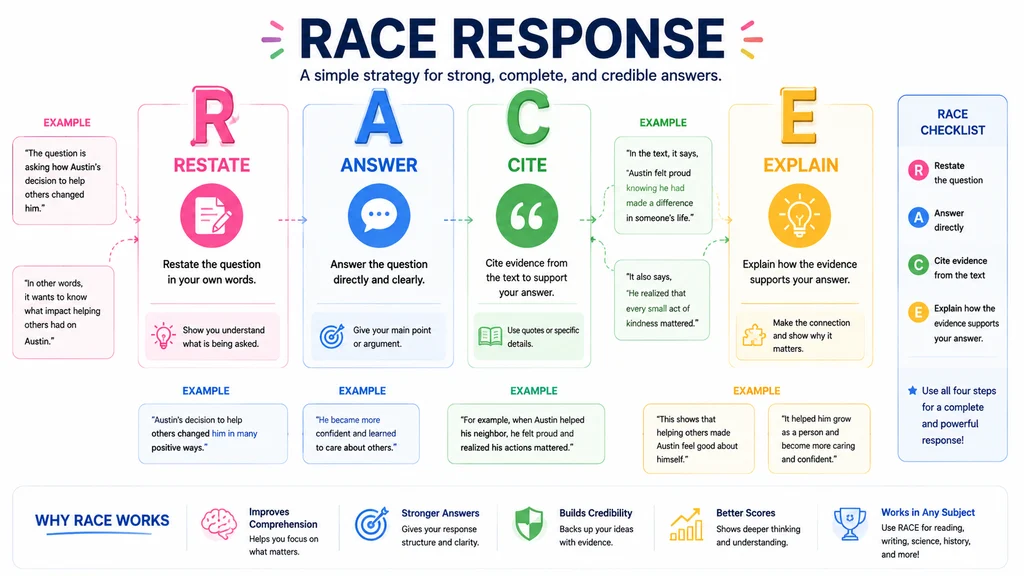
A race response is a structured writing method that helps students and professionals answer questions clearly using evidence. The acronym RACE stands for Restate, Answer, Cite, and Explain. Top alternatives: RACES (with Summarize), short constructed response, text-dependent analysis, evidence-based response, and structured paragraph response.You’re staring at a question. It could be a teacher asking you to analyze a passage, a boss wanting your recommendation, or a friend who wants your opinion. Your mind goes blank. How do you actually answer well?
The pressure is real. You know you need to say something, but you also want it to be good. You want to sound smart, make your point, and back it up. That’s where the race response method comes in. It takes the guesswork out of answering questions by giving you a simple, step-by-step formula.
Whether you’re a student tackling homework, a professional writing a report, or someone who just wants to communicate more effectively, learning how to use the RACE strategy can change everything. A good race response makes your answer clear, your evidence solid, and your reasoning easy to follow. Here’s everything you need to know.
Restate the Question Responses
1. Restate the question as part of your answer
Example: When someone asks, “Why is exercise good for you?” you start with “Exercise is good for me because”
Meaning: Turns the question into a statement that sets up your answer.
2. Use the question’s keywords in your opening sentence
Example: If asked about character motivation, say “The character is motivated by”
Meaning: Shows you understood what was being asked.
3. Flip the question into a statement
Example: Instead of “What is the main idea?” use “The main idea is”
Meaning: A simple trick that gets you started immediately.
4. Start with “Based on the text” for reading questions
Example: “Based on the passage, the author’s purpose is”
Meaning: Grounds your answer in the source material.
5. Use “According to” to introduce your response
Example: “According to the article, climate change affects”
Meaning: Shows you’re using evidence from the text.
6. Include “I think” for opinion-based questions
Example: “I think the best solution is”
Meaning: Signals that you’re sharing your perspective.
7. Start with “The evidence suggests”
Example: “The evidence suggests that regular practice improves”
Meaning: Builds authority and confidence.
8. Use “The answer is” for clarity
Example: “The answer is that both characters are similar because”
Meaning: Direct and clear opening.
9. Begin with “It is important to understand”
Example: “It is important to understand how energy flows”
Meaning: Shows the topic’s significance.
10. Start with “When we consider”
Example: “When we consider the author’s background”
Meaning: Invites deeper thinking.
11. Use “Looking at the information provided”
Example: “Looking at the information provided, we can see”
Meaning: References the source material.
12. Begin with “To answer this question”
Example: “To answer this question, we must examine”
Meaning: Direct and purposeful opening.
Answer the Question Responses
1. Give a direct answer right after restating
Example: “Exercise is good for you because it builds strength.”
Meaning: Clear and immediate response.
2. State your main point simply
Example: “The author wants readers to understand friendship.”
Meaning: Straightforward and easy to follow.
3. Be specific, not vague
Example: Instead of “It’s good,” say “It improves heart health.”
Meaning: Provides concrete information.
4. Use one clear sentence for your answer
Example: “The theme is the importance of perseverance.”
Meaning: Focused and direct.
5. Connect your answer to the question
Example: “The conflict is resolved when characters compromise.”
Meaning: Shows you understand what was asked.
6. Avoid just repeating the question
Example: Don’t say “The question is about” Say the actual answer.
Meaning: Shows you’re answering, not stalling.
7. Make your answer complete
Example: “The main character learns to be brave.”
Meaning: A full thought, not a fragment.
8. State the obvious when needed
Example: “Both texts are about environmental conservation.”
Meaning: Sometimes simple and clear is best.
9. Use precise language
Example: “The author uses symbolism” not “The author kind of uses”
Meaning: Shows confidence and knowledge.
10. Start with “The reason is”
Example: “The reason is that exercise reduces stress.”
Meaning: Provides a clear explanation.
11. Say “This shows” after your answer
Example: “The character helps others. This shows she’s caring.”
Meaning: Connects answer to evidence.
12. Keep it in your own words
Example: Paraphrase the answer naturally.
Meaning: Shows understanding, not copying.
Cite Evidence Responses
1. Quote directly from the text
Example: “The text says, ‘Exercise improves mood.'”
Meaning: Uses the author’s exact words.
2. Paraphrase the evidence
Example: “The article mentions that exercise helps with sleep.”
Meaning: Restates the idea in your own words.
3. Use “For example” to introduce evidence
Example: “For example, the text describes how”
Meaning: Signals that evidence is coming.
4. Start with “In the text”
Example: “In the text, the author states that”
Meaning: Connects evidence to the source.
5. Say “According to the author”
Example: “According to the author, the character changes”
Meaning: Credits the source.
6. Use “On page” or “In paragraph”
Example: “On page 4, it says that” (Use when citing specific locations)
Meaning: Precise evidence location.
7. Begin with “The evidence shows”
Example: “The evidence shows that students learn better”
Meaning: Signals strong support.
8. Say “This is proven by”
Example: “This is proven by the study’s findings.”
Meaning: Show’s the proof behind your answer.
9. Use “Research indicates”
Example: “Research indicates that practice makes perfect.”
Meaning: Connects to broader evidence.
10. Say “For instance”
Example: “For instance, the story describes a peaceful setting.”
Meaning: Provides a clear example.
11. Use “The data suggests”
Example: “The data suggests that response times improve.
Meaning: Uses data as evidence.
12. Say “We can see this when”
Example: “We can see this when the character chooses to help.”
Meaning: Points to specific evidence.
Explain the Evidence Responses
1. Explain how evidence supports your answer
Example: “This shows the author believes that because”
Meaning: Makes the connection clear.
2. Use “This means” to explain
Example: “This means the author is emphasizing the importance of”
Meaning: Clarifies the evidence’s meaning.
3. Say “This demonstrates that”
Example: “This demonstrates that conflict is central to the story.”
Meaning: Shows what the evidence proves.
4. Connect evidence to your answer
Example: “This quote proves the character is brave because”
Meaning: Links evidence to your original point.
5. Use “Therefore” to show reasoning
Example: “Therefore, the author’s message is about hope.”
Meaning: Shows logical conclusion.
6. Say “In other words”
Example: “In other words, the text is suggesting” (Use when paraphrasing for clarity)
Meaning: Clarifies complex ideas.
7. Explain why the evidence matters
Example: “This is significant because it shows character growth.”
Meaning: Shows the evidence’s importance.
8. Use “This reveals”
Example: “This reveals the author’s opinion on”
Meaning: Uncovers deeper meaning.
9. Say “This proves that”
Example: “This proves that exercise has long-term benefits.”
Meaning: Shows strong support.
10. Use “This connects to”
Example: “This connects to the main idea because”
Meaning: Shows relationships between ideas.
11. Explain the “why” behind the evidence
Example: “The author includes this to show that”
Meaning: Shows author’s purpose.
12. Say “As a result”
Example: “As a result, the character learns an important lesson.”
Meaning: Shows cause and effect.
RACES (Add Summarize) Responses
1. Summarize your main points at the end
Example: “In conclusion, exercise improves health in several ways.”
Meaning: Brings your response together.
2. Use “In summary”
Example: “In summary, the author’s point is clear.”
Meaning: Signals the conclusion.
3. Restate your answer briefly
Example: “So overall, the answer is that”
Meaning: Reinforces your main point.
4. End with “All in all”
Example: “All in all, the evidence supports this conclusion.”
Meaning: Friendly and conclusive.
5. Use “To conclude”
Example: “To conclude, the character’s journey is about growth.”
Meaning: Clear ending.
6. Say “As shown above”
Example: “As shown above, the author proves their point.”
Meaning: References your argument.
7. Summarize without new ideas
Example: “In short, the key takeaway is”
Meaning: Wraps up without introducing new points.
8. Use “Overall”
Example: “Overall, the response is that”
Meaning: Simple and effective.
9. Say “Therefore, I conclude”
Example: “Therefore, I conclude that the main theme is”
Meaning: Strong and confident.
10. Use “The final takeaway is”
Example: “The final takeaway is that persistence pays off.”
Meaning: Modern and direct.
11. Say “In the end”
Example: “In the end, the author leaves us with”
Meaning: Conclusive and reflective.
12. Use “To sum up”
Example: “To sum up, the evidence clearly points to”
Professional Responses
1. Use a structured response for work emails
Example: “I recommend the new software because it saves time. Research shows 20% faster processing. This means our team can be more productive.”
Meaning: Uses RACE for professional communication.
2. Cite reports in business writing
Example: “According to the Q2 report, sales increased. This shows our strategy is working.”
Meaning: Professional evidence use.
3. Answer client questions with RACE
Example: “The solution is upgrading the system. Case studies show a 30% improvement. This means you’ll see results quickly.”
Meaning: Clear, evidence-based responses.
4. Use the structure in meeting follow-ups
Example: “We agreed on the new timeline. The project plan shows feasibility. This ensures we meet the deadline.”
Meaning: Structured professional communication.
5. Apply RACE to performance reviews
Example: “I improved my skills by taking courses. My performance metrics improved by 15%. This shows my commitment to growth.”
Meaning: Evidence-based self-assessment.
6. Use it for project proposals
Example: “We should expand to new markets. Data shows customer demand. This means we can increase revenue.”
Meaning: Structured project recommendations.
7. Cite data in reports
Example: “The data shows team productivity improved. Project completion rates increased by 25%. This proves the new process works.”
Meaning: Evidence-based reporting.
8. Use for recommendations
Example: “I suggest hiring a new designer. Their portfolio shows strong skills. This will improve our creative output.”
Meaning: Clear, supported recommendations.
9. Apply to feedback
Example: “You do well with deadlines. Your recent work shows consistent quality. This demonstrates reliability.”
Meaning: Structured, actionable feedback.
10. Use in presentations
Example: “Our plan is to increase investment. The market analysis shows opportunity. This should drive growth.”
Meaning: Persuasive, structured presentations.
11. Apply to problem-solving
Example: “The issue is outdated technology. User feedback shows frustration. This means we need to upgrade.”
Meaning: Clear problem analysis.
12. Use in training materials
Example: “The new procedure is simple. Employee tests show 90% understanding. This means training is effective.”
Meaning: Evidence-based training content.
Academic Responses
1. Restate the essay prompt
Example: “This essay explores how social media affects teenagers.”
Meaning: Sets up the academic argument.
2. Answer directly in your thesis
Example: “Social media significantly impacts teen mental health.”
Meaning: Clear thesis statement.
3. Cite scholarly sources
Example: “According to Smith (2022), social media causes anxiety.”
Meaning: Proper academic citation.
4. Explain research findings
Example: “Smith found that teen anxiety increased by 15%. This suggests social media plays a role.”
Meaning: Evidence-based explanation.
5. Use direct quotes from research
Example: “Smith states, ‘Social media is a major factor.'”
Meaning: Direct evidence from experts.
6. Paraphrase research findings
Example: “Research shows that social media affects mental health.”
Meaning: Original expression of research.
7. Provide analysis after evidence
Example: “This finding is significant because it shows”
Meaning: Shows critical thinking.
8. Use academic language
Example: “The data indicate a correlation between variables.”
Meaning: Formal academic style.
9. Cite page numbers properly
Example: “(Smith, 2022, p. 15)” (Use appropriate format)
Meaning: Proper academic referencing.
10. Connect evidence to thesis
Example: “This supports the argument that social media causes anxiety.”
Meaning: Links evidence to main point.
11. Explain contradictory evidence
Example: “Although Johnson (2023) disagrees, the evidence supports”
Meaning: Academic debate and nuance.
12. Summarize academic arguments
Example: “In conclusion, the research demonstrates that”
Meaning: Strong academic conclusion.
Creative Writing Responses
1. Use the structure for narrative descriptions
Example: “The sunset was beautiful. The clouds glowed orange and red. This created a peaceful feeling.”
Meaning: Descriptive and structured.
2. Apply to character analysis
Example: “The character is brave. She jumps into danger without thinking. This shows her courage.”
Meaning: Evidence-based character study.
3. Use in poetry explanations
Example: “The poem is about loneliness. The imagery includes empty rooms. This creates isolation.”
Meaning: Structured literary analysis.
4. Apply to story summaries
Example: “The plot is about friendship. Characters support each other. This shows loyalty is important.”
Meaning: Summarizes with evidence.
5. Use in creative writing workshops
Example: “This paragraph is effective because” (Then explain using the method)
Meaning: Structured peer feedback.
6. Apply to worldbuilding explanations
Example: “My setting is a fantasy kingdom. The map shows diverse landscapes. This creates an immersive world.”
Meaning: Clear, supported worldbuilding.
7. Use for sensory descriptions
Example: “The room smelled like cinnamon. The warmth reminded me of home. This creates comfort.”
Meaning: Sensory and descriptive.
8. Apply to mood analysis
Example: “The story feels suspenseful. Shadows loom in every scene. This creates tension.”
Meaning: Evidence-based mood analysis.
9. Use in dialogue analysis
Example: “The dialogue is realistic. Characters interrupt each other. This creates natural conversation.”
Meaning: Structured dialogue analysis.
10. Apply to theme exploration
Example: “The theme is freedom. Characters escape restrictions. This shows the value of liberty.”
Meaning: Evidence-based theme analysis.
11. Use in author’s purpose
Example: “The author wants to inspire. The ending offers hope. This leaves readers optimistic.”
Meaning: Explains author’s intent.
12. Apply to literary devices
Example: “The author uses symbolism. The river represents change. This suggests transformation.”
Meaning: Structured literary device analysis.
Digital and Social Media Responses
1. Use the method for Instagram captions
Example: “This sunset is stunning. The sky turns pink and orange. This creates perfect lighting.”
Meaning: Structured, engaging captions.
2. Apply to Twitter threads
Example: “Thread: The best way to learn is practice. Studies show 50% improvement. This means consistent effort matters.”
Meaning: Structured social media content.
3. Use in email marketing
Example: “You should buy our product. Customers rate it 4.9 stars. This means you’ll love it.”
Meaning: Persuasive marketing.
4. Apply to blog posts
Example: “The topic is important. 90% of people struggle. This shows why you need this advice.”
Meaning: Structured blog content.
5. Use for video scripts
Example: “This video is about cooking. The recipe is easy to follow. This makes it perfect for beginners.”
Meaning: Clear, structured scripts.
6. Apply to LinkedIn posts
Example: “Leadership is about listening. Research shows better team results. This proves listening matters.”
Meaning: Professional social media.
7. Use for online reviews
Example: “This restaurant is great. The food is delicious. I’ll definitely come back.”
Meaning: Structured, helpful reviews.
8. Apply to product descriptions
Example: “This product solves your problem. Users report 80% satisfaction. This makes it a smart choice.”
Meaning: Persuasive, evidence-based descriptions.
9. Use for FAQ responses
Example: “The answer is yes. Our refund policy guarantees it. This gives you peace of mind.”
Meaning: Clear, supported answers.
10. Apply to email replies
Example: “We’ll help with this issue. 95% of users resolve it quickly. This means you’ll be fine.”
Meaning: Structured, reassuring responses.
11. Use for social media replies
Example: “I’m happy to help. The solution is simple. This should fix your problem.”
Meaning: Helpful, clear support.
12. Apply to newsletter content
Example: “This week’s advice is clear. Readers show 40% better results. This proves it works.”
Meaning: Evidence-based newsletter content.
Conflict Resolution Responses
1. Restate the problem clearly
Example: “The problem is we have a misunderstanding.”
Meaning: Shows you understand the issue.
2. Answer with your solution
Example: “We can fix this by talking openly.”
Meaning: Offers a clear solution.
3. Cite examples of past success
Example: “We’ve resolved similar issues before.”
Meaning: Shows experience and confidence.
4. Explain why this works
Example: “Open communication builds trust.”
Meaning: Explains the rationale.
5. Restate both sides of the conflict
Example: “You feel ignored and I feel rushed.”
Meaning: Shows empathy and understanding.
6. Answer with a compromise
Example: “We can both adjust our schedules.”
Meaning: Offers a balanced solution.
7. Cite common ground
Example: “We both want this project to succeed.”
Meaning: Finds agreement.
8. Explain the benefit of resolution
Example: “Fixing this reduces everyone’s stress.”
Meaning: Shows positive outcome.
9. Restate in your own words
Example: “So you’re saying you need more time.”
Meaning: Ensures understanding.
10. Answer with next steps
Example: “We’ll meet tomorrow to discuss this.”
Meaning: Offers concrete action.
11. Cite expectations for moving forward
Example: “The plan is to improve communication.”
Meaning: Sets clear goals.
12. Explain how to avoid future issues
Example: “Regular check-ins will prevent this.”
Meaning: Shows proactive thinking.
Personal Growth Responses
1. Use RACE to reflect on your goals
Example: “My goal is to improve at work. I’ve taken three courses. This shows my commitment.”
Meaning: Structured self-reflection.
2. Apply to journaling
Example: “I feel anxious today. Three things triggered this. This tells me I need to change.”
Meaning: Structured personal reflection.
3. Use for habit tracking
Example: “My exercise habit is improving. I worked out five times this week. This shows progress.”
Meaning: Evidence-based self-improvement.
4. Apply to therapy work
Example: “My thought is that I’m not good enough. I have evidence I am capable. This shows I can challenge my beliefs.”
Meaning: Structured cognitive reflection.
5. Use in self-assessments
Example: “I improved this month. I completed all my projects. This proves I’m making progress.”
Meaning: Evidence-based self-assessment.
6. Apply to life planning
Example: “I want to get promoted. I’m working on new skills. This means I’m on the right track.”
Meaning: Structured goal planning.
7. Use for personal mission statements
Example: “My purpose is to help others. I volunteer regularly. This shows I’m making an impact.”
Meaning: Structured personal mission.
8. Apply to decision making
Example: “I should take this job. The offer matches my goals. This means it’s the right choice.”
Meaning: Structured decision-making.
9. Use for relationship reflections
Example: “My relationship is healthy. We communicate well. This shows we’re compatible.”
Meaning: Structured relationship assessment.
10. Apply to career planning
Example: “I’m on the right career path. I’ve achieved key milestones. This proves I’m making progress.”
Meaning: Structured career planning.
11. Use for gratitude practice
Example: “I’m grateful for my support system. They’ve helped me through hard times. This shows I’m not alone.”
Meaning: Structured gratitude reflection.
12. Apply to strengths analysis
Example: “My strength is leadership. I’ve led multiple successful projects. This proves I’m effective.”
Meaning: Evidence-based strengths analysis.
Teaching and Tutoring Responses
1. Model the RACE method for students
Example: “First, I’ll restate the question. Then I’ll answer it. Watch as I show you how.”
Meaning: Demonstrates the process.
2. Use sentence starters with learners
Example: “Try starting with ‘The answer is'”
Meaning: Provides scaffolding for success.
3. Practice each step separately
Example: “Today we’ll just practice restating. Tomorrow, we’ll add citing.”
Meaning: Breaks it down for learning.
4. Provide RACE templates
Example: “Use this graphic organizer to write your answer.”
Meaning: Gives students structure.
5. Offer examples of good responses
Example: “Here’s a strong RACE response. Notice how each step is clear.”
Meaning: Shows learners what success looks like.
6. Provide feedback on each step
Example: “Good restating! Now let’s work on citing evidence.”
7. Use rubrics for assessment
Example: “The rubric has 4 points for each step.”
Meaning: Clear evaluation criteria.
8. Practice with simple questions first
Example: “Start with easy questions to build confidence.”
Meaning: Builds skills gradually.
9. Challenge with complex questions later
Example: “Now let’s try a more difficult question.”
Meaning: Deepens practice.
10. Have students peer review
Example: “Exchange responses with a partner. Check each step.”
Meaning: Collaborative learning.
11. Use group writing activities
Example: “Work together to write a RACE response.”
Meaning: Collaborative practice.
12. Celebrate improvement
Example: “Your evidence use has improved so much!”
Meaning: Positive reinforcement.
Tips for Mastering RACE
1. Practice each step individually
Example: “Write just the restate. Then just the answer. Then just the cite.”
Meaning: Focus on one skill at a time.
2. Use color coding
Example: “Highlight your restate in pink, answer in blue, etc.”
3. Start with short responses
Example: “One sentence for each step.”
Meaning: Builds confidence.
4. Read examples of strong responses
Example: “Look at this model answer.”
5. Get feedback regularly
Example: “Share your responses with a partner.”
Meaning: Continuous improvement.
6. Keep practicing
Example: “Write a RACE response every day.
Meaning: Builds skill through repetition.
7. Use it in all subjects
Example: “Apply RACE to science, social studies, and more.”
8. Review your progress
Example: “Look at your first response vs your recent ones.”
Meaning: Shows improvement.
9. Ask clarifying questions
Example: “Do I need more evidence here?”
Meaning: Critical self-reflection.
10. Explain your reasoning to others
Example: “Let me explain why I chose this evidence.”
Meaning: Deepens understanding.
11. Learn from mistakes
Example: “I missed explaining my evidence. I’ll add that next time.”
Meaning: Growth mindset.
12. Celebrate small wins
Example: “Today I cited evidence correctly!”
Meaning: Positive reinforcement.
FAQ
What does RACE stand for in writing?
RACE stands for Restate, Answer, Cite, and Explain. It’s a method for writing clear, evidence-based answers to questions.
How do I use RACE in my writing?
Start by restating the question in your own words. Then give a direct answer. Next, cite evidence or examples. Finally, explain how the evidence supports your answer.
What’s the difference between RACE and RACES?
RACES adds a fifth step: Summarize. After explaining your evidence, you sum up your main points. Some teachers also use “S” for “So what?” to add significance.
Is RACE only for reading questions?
No, you can use RACE for any question that requires a structured answer. It’s useful for work, personal reflections, conflict resolution, and more.
Can I use RACE for opinion questions?
Yes, adapt it to fit. Restate the opinion question, give your opinion as the answer, cite reasons or examples, and explain why you hold that opinion.
Conclusion
The RACE response method isn’t just for students. It’s a powerful tool that can change how you write, think, and communicate in every part of your life. Whether you’re in a classroom, a meeting, or just having a conversation, having a clear structure helps you sound confident and make your point effectively.
The best part is, once you learn the pattern, it sticks with you. You’ll start restating questions naturally. You’ll reach for evidence without thinking. Your explanations will flow smoothly.
So try it out. Start small. Maybe use RACE for your next social media post, or your next email. You’ll notice the difference immediately. And if you teach others, you’ll be giving them a gift that keeps on giving. Good luck, and get writing!
SEO Meta Title: 125+ Best “What is a Race Response” Explanations for Writing Success
SEO Meta Description: Discover what a RACE response is and how to use it. Learn 125+ ways to restate, answer, cite, and explain with confidence for better writing.
Infographic Feature Image Prompt125+ Ways to Understand and Respond to “What is a Race Response”
Quick Answer 🔥
A race response is a structured writing method that helps students and professionals answer questions clearly using evidence. The acronym RACE stands for Restate, Answer, Cite, and Explain. Top alternatives: RACES (with Summarize), short constructed response, text-dependent analysis, evidence-based response, and structured paragraph response.
Introduction
You’re staring at a question. It could be a teacher asking you to analyze a passage, a boss wanting your recommendation, or a friend who wants your opinion. Your mind goes blank. How do you actually answer well?
The pressure is real. You know you need to say something, but you also want it to be good. You want to sound smart, make your point, and back it up. That’s where the race response method comes in. It takes the guesswork out of answering questions by giving you a simple, step-by-step formula.
Whether you’re a student tackling homework, a professional writing a report, or someone who just wants to communicate more effectively, learning how to use the RACE strategy can change everything. A good race response makes your answer clear, your evidence solid, and your reasoning easy to follow. Here’s everything you need to know.
Restate the Question Responses
1. Restate the question as part of your answer
Example: When someone asks, “Why is exercise good for you?” you start with “Exercise is good for me because”
Meaning: Turns the question into a statement that sets up your answer.
2. Use the question’s keywords in your opening sentence
Example: If asked about character motivation, say “The character is motivated by”
Meaning: Shows you understood what was being asked.
3. Flip the question into a statement
Example: Instead of “What is the main idea?” use “The main idea is”
Meaning: A simple trick that gets you started immediately.
4. Start with “Based on the text” for reading questions
Example: “Based on the passage, the author’s purpose is”
Meaning: Grounds your answer in the source material.
5. Use “According to” to introduce your response
Example: “According to the article, climate change affects”
Meaning: Shows you’re using evidence from the text.
6. Include “I think” for opinion-based questions
Example: “I think the best solution is”
Meaning: Signals that you’re sharing your perspective.
7. Start with “The evidence suggests”
Example: “The evidence suggests that regular practice improves”
Meaning: Builds authority and confidence.
8. Use “The answer is” for clarity
Example: “The answer is that both characters are similar because”
Meaning: Direct and clear opening.
9. Begin with “It is important to understand”
Example: “It is important to understand how energy flows”
Meaning: Shows the topic’s significance.
10. Start with “When we consider”
Example: “When we consider the author’s background”
Meaning: Invites deeper thinking.
11. Use “Looking at the information provided”
Example: “Looking at the information provided, we can see”
Meaning: References the source material.
12. Begin with “To answer this question”
Example: “To answer this question, we must examine”
Meaning: Direct and purposeful opening.
Answer the Question Responses
1. Give a direct answer right after restating
Example: “Exercise is good for you because it builds strength.”
Meaning: Clear and immediate response.
2. State your main point simply
Example: “The author wants readers to understand friendship.”
Meaning: Straightforward and easy to follow.
3. Be specific, not vague
Example: Instead of “It’s good,” say “It improves heart health.”
Meaning: Provides concrete information.
4. Use one clear sentence for your answer
Example: “The theme is the importance of perseverance.”
Meaning: Focused and direct.
5. Connect your answer to the question
Example: “The conflict is resolved when characters compromise.”
Meaning: Shows you understand what was asked.
6. Avoid just repeating the question
Example: Don’t say “The question is about” Say the actual answer.
Meaning: Shows you’re answering, not stalling.
7. Make your answer complete
Example: “The main character learns to be brave.”
Meaning: A full thought, not a fragment.
8. State the obvious when needed
Example: “Both texts are about environmental conservation.”
Meaning: Sometimes simple and clear is best.
9. Use precise language
Example: “The author uses symbolism” not “The author kind of uses”
Meaning: Shows confidence and knowledge.
10. Start with “The reason is”
Example: “The reason is that exercise reduces stress.”
Meaning: Provides a clear explanation.
11. Say “This shows” after your answer
Example: “The character helps others. This shows she’s caring.”
Meaning: Connects answer to evidence.
12. Keep it in your own words
Example: Paraphrase the answer naturally.
Meaning: Shows understanding, not copying.
Cite Evidence Responses
1. Quote directly from the text
Example: “The text says, ‘Exercise improves mood.'”
Meaning: Uses the author’s exact words.
2. Paraphrase the evidence
Example: “The article mentions that exercise helps with sleep.”
Meaning: Restates the idea in your own words.
3. Use “For example” to introduce evidence
Example: “For example, the text describes how”
Meaning: Signals that evidence is coming.
4. Start with “In the text”
Example: “In the text, the author states that”
Meaning: Connects evidence to the source.
5. Say “According to the author”
Example: “According to the author, the character changes”
Meaning: Credits the source.
6. Use “On page” or “In paragraph”
Example: “On page 4, it says that” (Use when citing specific locations)
Meaning: Precise evidence location.
7. Begin with “The evidence shows”
Example: “The evidence shows that students learn better”
Meaning: Signals strong support.
8. Say “This is proven by”
Example: “This is proven by the study’s findings.”
Meaning: Show’s the proof behind your answer.
9. Use “Research indicates”
Example: “Research indicates that practice makes perfect.”
Meaning: Connects to broader evidence.
10. Say “For instance”
Example: “For instance, the story describes a peaceful setting.”
Meaning: Provides a clear example.
11. Use “The data suggests”
Example: “The data suggests that response times improve.
Meaning: Uses data as evidence.
12. Say “We can see this when”
Example: “We can see this when the character chooses to help.”
Meaning: Points to specific evidence.
Explain the Evidence Responses
1. Explain how evidence supports your answer
Example: “This shows the author believes that because”
Meaning: Makes the connection clear.
2. Use “This means” to explain
Example: “This means the author is emphasizing the importance of”
Meaning: Clarifies the evidence’s meaning.
3. Say “This demonstrates that”
Example: “This demonstrates that conflict is central to the story.”
Meaning: Shows what the evidence proves.
4. Connect evidence to your answer
Example: “This quote proves the character is brave because”
Meaning: Links evidence to your original point.
5. Use “Therefore” to show reasoning
Example: “Therefore, the author’s message is about hope.”
Meaning: Shows logical conclusion.
6. Say “In other words”
Example: “In other words, the text is suggesting” (Use when paraphrasing for clarity)
Meaning: Clarifies complex ideas.
7. Explain why the evidence matters
Example: “This is significant because it shows character growth.”
Meaning: Shows the evidence’s importance.
8. Use “This reveals”
Example: “This reveals the author’s opinion on”
Meaning: Uncovers deeper meaning.
9. Say “This proves that”
Example: “This proves that exercise has long-term benefits.”
Meaning: Shows strong support.
10. Use “This connects to”
Example: “This connects to the main idea because”
Meaning: Shows relationships between ideas.
11. Explain the “why” behind the evidence
Example: “The author includes this to show that”
Meaning: Shows author’s purpose.
12. Say “As a result”
Example: “As a result, the character learns an important lesson.”
Meaning: Shows cause and effect.
RACES (Add Summarize) Responses
1. Summarize your main points at the end
Example: “In conclusion, exercise improves health in several ways.”
Meaning: Brings your response together.
2. Use “In summary”
Example: “In summary, the author’s point is clear.”
Meaning: Signals the conclusion.
3. Restate your answer briefly
Example: “So overall, the answer is that”
Meaning: Reinforces your main point.
4. End with “All in all”
Example: “All in all, the evidence supports this conclusion.”
Meaning: Friendly and conclusive.
5. Use “To conclude”
Example: “To conclude, the character’s journey is about growth.”
Meaning: Clear ending.
6. Say “As shown above”
Example: “As shown above, the author proves their point.”
Meaning: References your argument.
7. Summarize without new ideas
Example: “In short, the key takeaway is”
Meaning: Wraps up without introducing new points.
8. Use “Overall”
Example: “Overall, the response is that”
Meaning: Simple and effective.
9. Say “Therefore, I conclude”
Example: “Therefore, I conclude that the main theme is”
Meaning: Strong and confident.
10. Use “The final takeaway is”
Example: “The final takeaway is that persistence pays off.”
Meaning: Modern and direct.
11. Say “In the end”
Example: “In the end, the author leaves us with”
Meaning: Conclusive and reflective.
12. Use “To sum up”
Example: “To sum up, the evidence clearly points to”
Professional Responses
1. Use a structured response for work emails
Example: “I recommend the new software because it saves time. Research shows 20% faster processing. This means our team can be more productive.”
Meaning: Uses RACE for professional communication.
2. Cite reports in business writing
Example: “According to the Q2 report, sales increased. This shows our strategy is working.”
Meaning: Professional evidence use.
3. Answer client questions with RACE
Example: “The solution is upgrading the system. Case studies show a 30% improvement. This means you’ll see results quickly.”
Meaning: Clear, evidence-based responses.
4. Use the structure in meeting follow-ups
Example: “We agreed on the new timeline. The project plan shows feasibility. This ensures we meet the deadline.”
Meaning: Structured professional communication.
5. Apply RACE to performance reviews
Example: “I improved my skills by taking courses. My performance metrics improved by 15%. This shows my commitment to growth.”
Meaning: Evidence-based self-assessment.
6. Use it for project proposals
Example: “We should expand to new markets. Data shows customer demand. This means we can increase revenue.”
Meaning: Structured project recommendations.
7. Cite data in reports
Example: “The data shows team productivity improved. Project completion rates increased by 25%. This proves the new process works.”
Meaning: Evidence-based reporting.
8. Use for recommendations
Example: “I suggest hiring a new designer. Their portfolio shows strong skills. This will improve our creative output.”
Meaning: Clear, supported recommendations.
9. Apply to feedback
Example: “You do well with deadlines. Your recent work shows consistent quality. This demonstrates reliability.”
Meaning: Structured, actionable feedback.
10. Use in presentations
Example: “Our plan is to increase investment. The market analysis shows opportunity. This should drive growth.”
Meaning: Persuasive, structured presentations.
11. Apply to problem-solving
Example: “The issue is outdated technology. User feedback shows frustration. This means we need to upgrade.”
Meaning: Clear problem analysis.
12. Use in training materials
Example: “The new procedure is simple. Employee tests show 90% understanding. This means training is effective.”
Meaning: Evidence-based training content.
Academic Responses
1. Restate the essay prompt
Example: “This essay explores how social media affects teenagers.”
Meaning: Sets up the academic argument.
2. Answer directly in your thesis
Example: “Social media significantly impacts teen mental health.”
Meaning: Clear thesis statement.
3. Cite scholarly sources
Example: “According to Smith (2022), social media causes anxiety.”
Meaning: Proper academic citation.
4. Explain research findings
Example: “Smith found that teen anxiety increased by 15%. This suggests social media plays a role.”
Meaning: Evidence-based explanation.
5. Use direct quotes from research
Example: “Smith states, ‘Social media is a major factor.'”
Meaning: Direct evidence from experts.
6. Paraphrase research findings
Example: “Research shows that social media affects mental health.”
Meaning: Original expression of research.
7. Provide analysis after evidence
Example: “This finding is significant because it shows”
Meaning: Shows critical thinking.
8. Use academic language
Example: “The data indicate a correlation between variables.”
Meaning: Formal academic style.
9. Cite page numbers properly
Example: “(Smith, 2022, p. 15)” (Use appropriate format)
Meaning: Proper academic referencing.
10. Connect evidence to thesis
Example: “This supports the argument that social media causes anxiety.”
Meaning: Links evidence to main point.
11. Explain contradictory evidence
Example: “Although Johnson (2023) disagrees, the evidence supports”
Meaning: Academic debate and nuance.
12. Summarize academic arguments
Example: “In conclusion, the research demonstrates that”
Meaning: Strong academic conclusion.
Creative Writing Responses
1. Use the structure for narrative descriptions
Example: “The sunset was beautiful. The clouds glowed orange and red. This created a peaceful feeling.”
Meaning: Descriptive and structured.
2. Apply to character analysis
Example: “The character is brave. She jumps into danger without thinking. This shows her courage.”
Meaning: Evidence-based character study.
3. Use in poetry explanations
Example: “The poem is about loneliness. The imagery includes empty rooms. This creates isolation.”
Meaning: Structured literary analysis.
4. Apply to story summaries
Example: “The plot is about friendship. Characters support each other. This shows loyalty is important.”
Meaning: Summarizes with evidence.
5. Use in creative writing workshops
Example: “This paragraph is effective because” (Then explain using the method)
Meaning: Structured peer feedback.
6. Apply to worldbuilding explanations
Example: “My setting is a fantasy kingdom. The map shows diverse landscapes. This creates an immersive world.”
Meaning: Clear, supported worldbuilding.
7. Use for sensory descriptions
Example: “The room smelled like cinnamon. The warmth reminded me of home. This creates comfort.”
Meaning: Sensory and descriptive.
8. Apply to mood analysis
Example: “The story feels suspenseful. Shadows loom in every scene. This creates tension.”
Meaning: Evidence-based mood analysis.
9. Use in dialogue analysis
Example: “The dialogue is realistic. Characters interrupt each other. This creates natural conversation.”
Meaning: Structured dialogue analysis.
10. Apply to theme exploration
Example: “The theme is freedom. Characters escape restrictions. This shows the value of liberty.”
Meaning: Evidence-based theme analysis.
11. Use in author’s purpose
Example: “The author wants to inspire. The ending offers hope. This leaves readers optimistic.”
Meaning: Explains author’s intent.
12. Apply to literary devices
Example: “The author uses symbolism. The river represents change. This suggests transformation.”
Meaning: Structured literary device analysis.
Digital and Social Media Responses
1. Use the method for Instagram captions
Example: “This sunset is stunning. The sky turns pink and orange. This creates perfect lighting.”
Meaning: Structured, engaging captions.
2. Apply to Twitter threads
Example: “Thread: The best way to learn is practice. Studies show 50% improvement. This means consistent effort matters.”
Meaning: Structured social media content.
3. Use in email marketing
Example: “You should buy our product. Customers rate it 4.9 stars. This means you’ll love it.”
Meaning: Persuasive marketing.
4. Apply to blog posts
Example: “The topic is important. 90% of people struggle. This shows why you need this advice.”
Meaning: Structured blog content.
5. Use for video scripts
Example: “This video is about cooking. The recipe is easy to follow. This makes it perfect for beginners.”
Meaning: Clear, structured scripts.
6. Apply to LinkedIn posts
Example: “Leadership is about listening. Research shows better team results. This proves listening matters.”
Meaning: Professional social media.
7. Use for online reviews
Example: “This restaurant is great. The food is delicious. I’ll definitely come back.”
Meaning: Structured, helpful reviews.
8. Apply to product descriptions
Example: “This product solves your problem. Users report 80% satisfaction. This makes it a smart choice.”
Meaning: Persuasive, evidence-based descriptions.
9. Use for FAQ responses
Example: “The answer is yes. Our refund policy guarantees it. This gives you peace of mind.”
Meaning: Clear, supported answers.
10. Apply to email replies
Example: “We’ll help with this issue. 95% of users resolve it quickly. This means you’ll be fine.”
Meaning: Structured, reassuring responses.
11. Use for social media replies
Example: “I’m happy to help. The solution is simple. This should fix your problem.”
Meaning: Helpful, clear support.
12. Apply to newsletter content
Example: “This week’s advice is clear. Readers show 40% better results. This proves it works.”
Meaning: Evidence-based newsletter content.
Conflict Resolution Responses
1. Restate the problem clearly
Example: “The problem is we have a misunderstanding.”
Meaning: Shows you understand the issue.
2. Answer with your solution
Example: “We can fix this by talking openly.”
Meaning: Offers a clear solution.
3. Cite examples of past success
Example: “We’ve resolved similar issues before.”
Meaning: Shows experience and confidence.
4. Explain why this works
Example: “Open communication builds trust.”
Meaning: Explains the rationale.
5. Restate both sides of the conflict
Example: “You feel ignored and I feel rushed.”
Meaning: Shows empathy and understanding.
6. Answer with a compromise
Example: “We can both adjust our schedules.”
Meaning: Offers a balanced solution.
7. Cite common ground
Example: “We both want this project to succeed.”
Meaning: Finds agreement.
8. Explain the benefit of resolution
Example: “Fixing this reduces everyone’s stress.”
Meaning: Shows positive outcome.
9. Restate in your own words
Example: “So you’re saying you need more time.”
Meaning: Ensures understanding.
10. Answer with next steps
Example: “We’ll meet tomorrow to discuss this.”
Meaning: Offers concrete action.
11. Cite expectations for moving forward
Example: “The plan is to improve communication.”
Meaning: Sets clear goals.
12. Explain how to avoid future issues
Example: “Regular check-ins will prevent this.”
Meaning: Shows proactive thinking.
Personal Growth Responses
1. Use RACE to reflect on your goals
Example: “My goal is to improve at work. I’ve taken three courses. This shows my commitment.”
Meaning: Structured self-reflection.
2. Apply to journaling
Example: “I feel anxious today. Three things triggered this. This tells me I need to change.”
Meaning: Structured personal reflection.
3. Use for habit tracking
Example: “My exercise habit is improving. I worked out five times this week. This shows progress.”
Meaning: Evidence-based self-improvement.
4. Apply to therapy work
Example: “My thought is that I’m not good enough. I have evidence I am capable. This shows I can challenge my beliefs.”
Meaning: Structured cognitive reflection.
5. Use in self-assessments
Example: “I improved this month. I completed all my projects. This proves I’m making progress.”
Meaning: Evidence-based self-assessment.
6. Apply to life planning
Example: “I want to get promoted. I’m working on new skills. This means I’m on the right track.”
Meaning: Structured goal planning.
7. Use for personal mission statements
Example: “My purpose is to help others. I volunteer regularly. This shows I’m making an impact.”
Meaning: Structured personal mission.
8. Apply to decision making
Example: “I should take this job. The offer matches my goals. This means it’s the right choice.”
Meaning: Structured decision-making.
9. Use for relationship reflections
Example: “My relationship is healthy. We communicate well. This shows we’re compatible.”
Meaning: Structured relationship assessment.
10. Apply to career planning
Example: “I’m on the right career path. I’ve achieved key milestones. This proves I’m making progress.”
Meaning: Structured career planning.
11. Use for gratitude practice
Example: “I’m grateful for my support system. They’ve helped me through hard times. This shows I’m not alone.”
Meaning: Structured gratitude reflection.
12. Apply to strengths analysis
Example: “My strength is leadership. I’ve led multiple successful projects. This proves I’m effective.”
Meaning: Evidence-based strengths analysis.
Teaching and Tutoring Responses
1. Model the RACE method for students
Example: “First, I’ll restate the question. Then I’ll answer it. Watch as I show you how.”
Meaning: Demonstrates the process.
2. Use sentence starters with learners
Example: “Try starting with ‘The answer is'”
Meaning: Provides scaffolding for success.
3. Practice each step separately
Example: “Today we’ll just practice restating. Tomorrow, we’ll add citing.”
Meaning: Breaks it down for learning.
4. Provide RACE templates
Example: “Use this graphic organizer to write your answer.”
Meaning: Gives students structure.
5. Offer examples of good responses
Example: “Here’s a strong RACE response. Notice how each step is clear.”
Meaning: Shows learners what success looks like.
6. Provide feedback on each step
Example: “Good restating! Now let’s work on citing evidence.”
7. Use rubrics for assessment
Example: “The rubric has 4 points for each step.”
Meaning: Clear evaluation criteria.
8. Practice with simple questions first
Example: “Start with easy questions to build confidence.”
Meaning: Builds skills gradually.
9. Challenge with complex questions later
Example: “Now let’s try a more difficult question.”
Meaning: Deepens practice.
10. Have students peer review
Example: “Exchange responses with a partner. Check each step.”
Meaning: Collaborative learning.
11. Use group writing activities
Example: “Work together to write a RACE response.”
Meaning: Collaborative practice.
12. Celebrate improvement
Example: “Your evidence use has improved so much!”
Meaning: Positive reinforcement.
Tips for Mastering RACE
1. Practice each step individually
Example: “Write just the restate. Then just the answer. Then just the cite.”
Meaning: Focus on one skill at a time.
2. Use color coding
Example: “Highlight your restate in pink, answer in blue, etc.”
3. Start with short responses
Example: “One sentence for each step.”
Meaning: Builds confidence.
4. Read examples of strong responses
Example: “Look at this model answer.”
5. Get feedback regularly
Example: “Share your responses with a partner.”
Meaning: Continuous improvement.
6. Keep practicing
Example: “Write a RACE response every day.
Meaning: Builds skill through repetition.
7. Use it in all subjects
Example: “Apply RACE to science, social studies, and more.”
8. Review your progress
Example: “Look at your first response vs your recent ones.”
Meaning: Shows improvement.
9. Ask clarifying questions
Example: “Do I need more evidence here?”
Meaning: Critical self-reflection.
10. Explain your reasoning to others
Example: “Let me explain why I chose this evidence.”
Meaning: Deepens understanding.
11. Learn from mistakes
Example: “I missed explaining my evidence. I’ll add that next time.”
Meaning: Growth mindset.
12. Celebrate small wins
Example: “Today I cited evidence correctly!”
Meaning: Positive reinforcement.
FAQ
What does RACE stand for in writing?
RACE stands for Restate, Answer, Cite, and Explain. It’s a method for writing clear, evidence-based answers to questions.
How do I use RACE in my writing?
Start by restating the question in your own words. Then give a direct answer. Next, cite evidence or examples. Finally, explain how the evidence supports your answer.
What’s the difference between RACE and RACES?
RACES adds a fifth step: Summarize. After explaining your evidence, you sum up your main points. Some teachers also use “S” for “So what?” to add significance.
Is RACE only for reading questions?
No, you can use RACE for any question that requires a structured answer. It’s useful for work, personal reflections, conflict resolution, and more.
Can I use RACE for opinion questions?
Yes, adapt it to fit. Restate the opinion question, give your opinion as the answer, cite reasons or examples, and explain why you hold that opinion.
Conclusion
The RACE response method isn’t just for students. It’s a powerful tool that can change how you write, think, and communicate in every part of your life. Whether you’re in a classroom, a meeting, or just having a conversation, having a clear structure helps you sound confident and make your point effectively.
The best part is, once you learn the pattern, it sticks with you. You’ll start restating questions naturally. You’ll reach for evidence without thinking. Your explanations will flow smoothly.
So try it out. Start small. Maybe use RACE for your next social media post, or your next email. You’ll notice the difference immediately. And if you teach others, you’ll be giving them a gift that keeps on giving. Good luck, and get writing!








13 thoughts on “125+ Ways to Understand and Respond to “What is a Race Respons for 2026”