

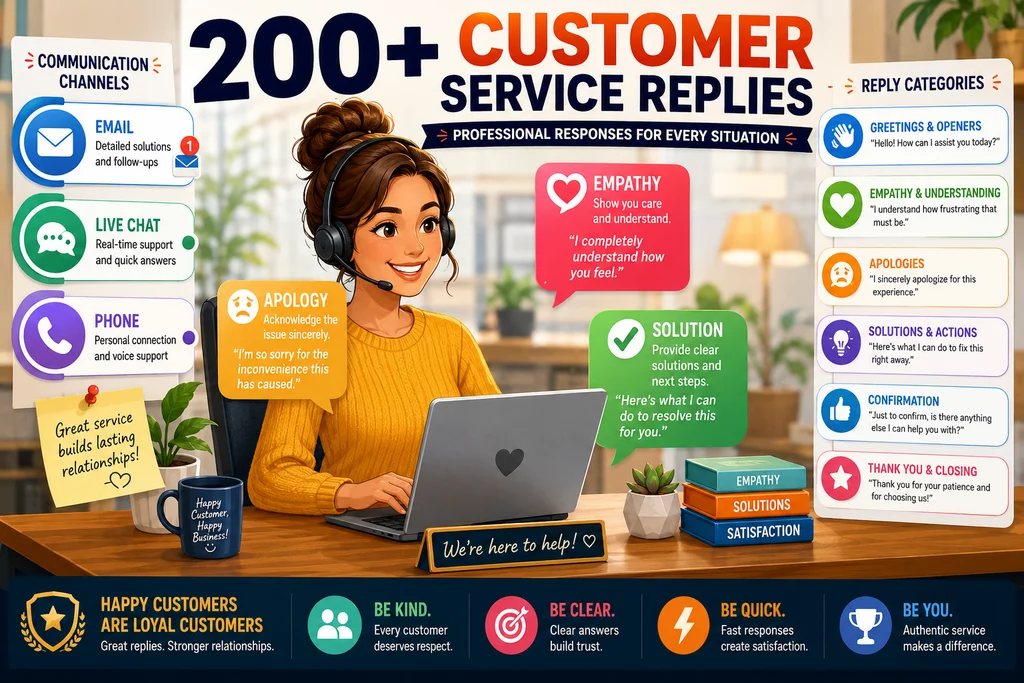
The best customer service replies are empathetic, clear, and action-oriented. They acknowledge the customer’s frustration, apologize sincerely, offer a solution, and set clear expectations for next steps . Top alternatives: customer support templates, service recovery scripts, complaint response examples, help desk reply templates, and customer care response guides.
Your customer just sent a frustrated message. Their product arrived damaged. The shipping took too long. They were double-charged. And now they’re taking it out on you.
How you reply in this moment doesn’t just solve their problem. It determines whether they ever buy from you again . Research shows that 83% of customers remain loyal to businesses that resolve their complaints effectively . That means every angry email is actually an opportunity to build lasting trust.
The trick is having the right words ready when emotions run high. Whether you’re handling a refund request, an angry phone call, or a negative review, the right customer service replies can turn frustration into loyalty. This guide covers 200+ ready-to-use responses for every customer service scenario you’ll ever face.
Empathetic Responses
1. I completely understand your frustration. I’d feel the same way.
Example: Use this when a customer expresses anger about a service failure.
Meaning: Validates their emotion without necessarily agreeing with their position .
2. I’m so sorry that happened to you. Let me see how I can make this right.
Example: Use this as an opening for any complaint call or chat.
Meaning: Combines genuine apology with immediate action orientation .
3. I can imagine how inconvenient this is for you.
Example: Use this for shipping delays or technical issues.
Meaning: Personalizes empathy and builds trust through understanding .
4. I understand you’re upset, and I’m here to help.
Example: Use this when a customer is shouting or using aggressive language.
Meaning: Acknowledges their emotion while redirecting to a solution .
5. I’m truly sorry, and I will do my very best to help you.
Example: Use this as a sincere opening to any complaint.
Meaning: Shows commitment and personal accountability .
6. This one’s on us, plain and simple. I’m sorry you had to deal with this.
Example: Use this when the company is clearly at fault.
Meaning: Direct ownership of mistakes builds trust .
7. I’m so sorry to hear you’ve had such a poor experience.
Example: Use this when a customer threatens to cancel.
Meaning: Shows you take their dissatisfaction seriously .
8. I’m sorry you’re back here for the same problem. That shouldn’t have happened.
Example: Use this for repeated issues a customer has contacted about before.
Meaning: Acknowledges the customer’s frustration at having to follow up .
9. I can see why that would be frustrating. Let me fix this for you.
Example: Use this after listening to the customer’s complaint.
Meaning: Validates their feeling and transitions to action.
10. I’m sorry our conversation is adding to your frustration.
Example: Use this when a chat or call isn’t going smoothly.
Meaning: Acknowledges the customer’s pain point, including the interaction itself .
11. I’m sad to hear about your negative experience with us.
Example: Use this as a gentle opening to an unhappy chat.
Meaning: Expresses personal disappointment while staying professional .
12. I’d be frustrated too if I were in your position. Let’s fix this.
Example: Use this for escalated or complex complaints.
Meaning: Builds rapport by showing you understand their perspective.
Professional and Polite Responses
1. Thank you for reaching out. I’m reviewing your request and will follow up shortly.
Example: Use this as an initial response when you need time to research.
Meaning: Sets expectations and reassures them their issue is being handled .
2. Thank you for your patience while we work on this.
Example: Use this when resolution is taking longer than expected.
Meaning: Acknowledges their effort to wait .
3. Thank you for your honest feedback. It helps us improve.
Example: Use this for complaints or negative reviews .
Meaning: Reframes criticism as a gift .
4. We genuinely apologize for the inconvenience caused. Let me make it right.
Example: Use this for service failures or errors.
Meaning: Focuses on solutions and rebuilding trust .
5. I’m going to send you a quick guide that should help. One moment please!
Example: Use this when providing self-help resources.
Meaning: Provides resources while reassuring the customer you’re still present .
6. If you prefer, we can schedule a call to walk you through this.
Example: Use this for complex issues where a call would be better.
Meaning: Offers a personal touch and alternative communication method .
7. I’ll stay with you until I confirm the next steps.
Example: Use this when escalating or transferring an issue.
Meaning: Shows commitment to seeing them through the process .
8. You can also find helpful information at [link]. Let me know if you need assistance!
Example: Use this when pointing customers to resources.
Meaning: Empowers customers to find help quickly .
9. I’m happy to help with this. Let me get started right away.
Example: Use this as a positive opening to any request.
Meaning: Demonstrates enthusiasm and efficiency.
10. We appreciate you taking the time to share your experience.
Example: Use this for reviews and feedback.
Meaning: Shows you value their input, even if negative .
11. I can see you reached out about this before. Thank you for your patience.
Example: Use this when a customer has contacted multiple times.
Meaning: Shows you’ve reviewed their history and acknowledges the delay .
12. Let’s try a few quick troubleshooting steps.
Example: Use this for technical or product issues.
Meaning: Gives clear and actionable next steps .
Service Recovery Responses
1. This is definitely our fault. I’m so sorry about the mix-up.
Example: Use this for clear-cut errors like wrong orders or billing mistakes.
Meaning: Direct admission of fault disarms customer anger .
2. I’m approving your full refund right now. It’ll show in [timeframe].
Example: Use this when a customer demands a refund and the company is clearly at fault.
Meaning: Takes immediate action without hesitation .
3. A damaged order is bad. A week of silence from our team is worse. I’m sorry.
Example: Use this when multiple things have gone wrong.
Meaning: Acknowledges the full scope of the failure.
4. We’d like to offer you [discount/reimbursement] for the inconvenience.
Example: Use this to compensate for service failures .
Meaning: Tangible compensation shows you mean the apology.
5. I’ve already escalated this to our [Team] team. They’ll follow up today.
Example: Use this for issues requiring specialized handling.
Meaning: Shows you’re taking action beyond just saying sorry .
6. I’ve sent you a replacement order and flagged this with our warehouse team.
Example: Use this for shipping or product quality issues.
Meaning: Demonstrates immediate action on multiple fronts.
7. You mentioned this was time-sensitive, so I’ll prioritize it.
Example: Use this when a customer has an urgent need.
Meaning: Shows you’re listening and acting on their priorities .
8. I’d like to sincerely apologize for the inconvenience.
Example: Use this as a direct, heartfelt opening to any serious complaint.
Meaning: Places apology front and center before discussing details .
9. We’re implementing changes to prevent this from happening again.
Example: Use this when a complaint reveals a systemic problem.
Meaning: Shows you’re learning from feedback and improving .
10. I’ve reviewed your account, and here’s exactly what happened.
Example: Use this to explain the cause of a billing or service error.
Meaning: Transparency builds trust even when delivering bad news.
11. You’re right. We should have done better. Here’s what we’re doing now.
Example: Use this when the customer has a valid point and needs to hear agreement.
Meaning: Agrees fully without defensiveness.
12. I’m genuinely sorry we let you down. Let me show you how we’ll fix it.
Example: Use this to close a complaint conversation.
Meaning: Ends on a positive, action-oriented note.
Setting Boundaries and Handling Difficult Customers
1. I understand you’re upset and I want to help. Let’s keep this respectful.
Example: Use this when a customer uses profanity or personal insults.
Meaning: Sets a boundary while keeping the door open to resolution .
2. I can see why you’d feel that way. What I can do is [solution].
Example: Use this to gently correct a customer’s misunderstanding.
Meaning: Validates their feeling while steering toward the facts.
3. I’m not able to do that, but here’s what I can do instead.
Example: Use this when a customer asks for something impossible.
Meaning: Offers a positive alternative instead of a flat rejection .
4. I’m sorry you feel that way. Let’s focus on finding a solution.
Example: Use this when a customer is being unreasonable.
Meaning: Acknowledges their emotion while moving toward resolution.
5. If you’d like to speak to my supervisor, I’m happy to get them.
Example: Use this when a customer demands a manager.
Meaning: Removes the pressure and shows you’re not blocking their access .
6. I can see how it looked that way. What’s actually happening is [explanation].
Example: Use this to correct misinformation without calling the customer wrong.
Meaning: Gently educates while preserving their dignity .
7. You don’t need to repeat everything. I’ve read the full history.
Example: Use this when a frustrated customer is repeating themselves.
Meaning: Shows you’ve done your homework and saves them time .
8. I’ll need to get some additional information to resolve this.
Example: Use this when you need to ask follow-up questions.
Meaning: Politely gathers necessary details.
9. I’ll be here when you’re ready to continue.
Example: Use this when a customer needs to pause or collect themselves.
Meaning: Leaves the door open without pressure.
10. Could I ask you a few questions so we can resolve this quickly?
Example: Use this to steer an angry conversation toward a solution.
Meaning: Redirects energy from complaint to resolution .
11. While we can’t do [request], let me show you what we can do.
Example: Use this for policy limitations.
Meaning: Focuses on possibilities rather than restrictions.
12. Let’s take a moment to make sure we’re on the same page.
Example: Use this when communication is getting confused.
Meaning: Pauses to clarify and reset the conversation.
Positive Review Responses
1. Thank you for such a thoughtful review! We’re thrilled to hear you’re enjoying [product].
Example: Use this for detailed five-star reviews.
Meaning: Shows genuine appreciation and references specific details .
2. Thank you for your kind words! We’re so glad to hear you enjoyed [product/service].
Example: Use this for short positive reviews.
Meaning: Simple gratitude that still feels personal .
3. We’ll be sure to share your feedback with our [team]!
Example: Use this when a customer praises a specific team member or function.
Meaning: Shows you value the feedback internally .
4. We’re so happy you had a great experience. Thanks for choosing us!
Example: Use this for general positive reviews.
Meaning: Warm closing that encourages repeat business .
5. Your thoughtful review made our day! Thank you.
Example: Use this for especially kind feedback.
Meaning: Shows the emotional impact of their words.
6. We love that you love us! Thanks for being a fantastic customer.
Example: Use this for enthusiastic, glowing reviews.
Meaning: Playful, warm, and appreciative .
7. Thanks for your support. It means the world to our small team.
Example: Use this for reviews on small business platforms.
Meaning: Personalizes the gratitude.
8. We appreciate you taking the time to share your experience.
Example: Use this as a standard positive review response.
Meaning: Acknowledges the effort they made to write the review.
9. We’re delighted to hear [product] exceeded your expectations!
Example: Use this when a customer mentions specific product satisfaction.
Meaning: Shows you read the review carefully.
10. We hope your [product] joins you on plenty more adventures!
Example: Use this for products like backpacks, travel gear, etc.
Meaning: Adds a personal, human touch .
11. Thanks for the five stars! We’re here if you need anything else.
Example: Use this for short positive reviews.
Meaning: Gratitude plus invitation for future contact.
12. We’re so glad you enjoyed it. Come back anytime!
Example: Use this for local business or hospitality reviews.
Meaning: Friendly and encourages repeat visits.
Negative Review Responses
1. Thank you for your honest feedback. We’re sorry to hear about your experience.
Example: Use this as a standard opening for one-star reviews.
Meaning: Shows appreciation for feedback and empathy for their experience .
2. We’d appreciate the opportunity to make things right. Please contact us at [email].
Example: Use this to move sensitive details to a private conversation.
Meaning: Allows resolution without public back-and-forth .
3. We’re sorry your order arrived damaged. We’d love to make this right.
Example: Use this for product quality complaints.
Meaning: Specifically addresses their complaint and offers a path forward .
4. Thank you for bringing this to our attention. We’ll take immediate action.
Example: Use this for complaints that reveal serious issues.
Meaning: Shows appreciation and urgency .
5. This isn’t the standard we aim to provide, and we’re disappointed too.
Example: Use this when the business fell short.
Meaning: Aligns with the customer’s feelings without making excuses.
6. We’ve sent you a follow-up email to address your concerns directly.
Example: Use this to show proactive action.
Meaning: Takes the next step without requiring the customer to do more work .
7. We’re implementing changes to prevent this from happening again.
Example: Use this when the complaint reveals a systemic issue.
Meaning: Shows you’re learning from feedback and improving .
8. I’m the owner, and this isn’t the business I want to run. I’m sorry.
Example: Use this for serious complaints that need personal accountability.
Meaning: Shows genuine investment in fixing problems.
9. A damaged order is bad. A week of silence is worse. We’re so sorry.
Example: Use this for compounded failures.
Meaning: Acknowledges the full scope of the issue.
10. We’d love to show you what we’re about on a different day.
Example: Use this when the customer had an off experience.
Meaning: Invites them to give you another chance.
11. Honest reviews are extremely helpful for other customers.
Example: Use this when thanking them for feedback.
Meaning: Validates the value of their time .
12. Your feedback helps us improve our shipping process.
Example: Use this when a complaint leads to a process change.
Meaning: Shows their input made a real difference .
Refund and Cancellation Responses
1. I’ve processed your refund for [amount]. You’ll see it within [timeframe].
Example: Use this to confirm a refund request.
Meaning: Clear action with specific timing .
2. I’m sorry to see you go. If you change your mind, we’ll be here.
Example: Use this for cancellation requests.
Meaning: Respects their decision while leaving the door open .
3. We’ve successfully canceled your subscription. Refund will appear in [timeframe].
Example: Use this for subscription cancellations.
Meaning: Confirms both cancellation and refund .
4. I’ve checked your order and approved the refund. Here’s what happens next.
Example: Use this for product returns.
Meaning: Confirms action and sets expectations.
5. I really don’t want to lose you over this. Before you decide, let me make it right.
Example: Use this for retention when a customer threatens to leave.
Meaning: Shows you value their business and want to fix things .
6. If you decide to continue your subscription in the future, you can easily reactivate.
Example: Use this to end cancellation conversations positively.
Meaning: Leaves the door open without pressure .
7. I understand why you want to cancel. I’d feel the same way in your position.
Example: Use this for cancellation requests due to poor service.
Meaning: Validates their frustration before offering a solution.
8. Here’s what we can do to make this right before you go.
Example: Use this to offer a retention solution.
Meaning: Offers one last chance to fix things.
9. I’ve canceled your order as requested. No further action is needed.
Example: Use this for order cancellation confirmations.
Meaning: Clear and complete confirmation .
10. We’re so grateful for your business and hope to see you back soon.
Example: Use this for cancellation emails.
Meaning: Ends on a positive, appreciative note .
11. Your refund is on its way. Let me know if you have any questions.
Example: Use this after processing a refund.
Meaning: Opens the door for follow-up.
12. I’m sorry we couldn’t meet your expectations this time.
Example: Use this for cancellations due to product or service issues.
Meaning: Shows you take responsibility for their dissatisfaction.
Out-of-Stock and Delay Responses
1. Thank you for your interest in [product]. Unfortunately, it’s currently out of stock.
Example: Use this when a customer asks about an unavailable item.
Meaning: Direct and honest with clear information .
2. We’re working to restock this item as quickly as possible. Please check back.
Example: Use this when you don’t have an ETA.
Meaning: Shows you’re working on it without overpromising .
3. I wanted to let you know your preorder has experienced a delay.
Example: Use this for delayed preorders.
Meaning: Proactive communication that prevents frustration .
4. Would you like to keep the order and wait, or would you prefer a refund?
Example: Use this to give the customer control over the outcome.
Meaning: Offers choice and respects their timeline .
5. I’m sorry the item you wanted isn’t available. Let me check alternatives.
Example: Use this when a customer asks about unavailable items.
Meaning: Moves toward solutions instead of ending with “no.”
6. The good news is that there will be other promotions in the future!
Example: Use this when a customer missed a deal.
Meaning: Ends on a positive, hopeful note .
7. Please do check back regularly to see if the item is back in stock.
Example: Use this when you don’t have notification capabilities.
Meaning: Gives a clear next step .
8. I’m so sorry you missed out on the discount this time.
Example: Use this for expired promotions.
Meaning: Empathy for their disappointment .
9. Let me set up a notification for you when this item is back in stock.
Example: Use this when your system supports alerts.
Meaning: Proactive solution that saves them work .
10. We’re restocking this item by [date]. Would you like me to hold one for you?
Example: Use this when you have an ETA.
Meaning: Gives specific timing and offers priority access.
11. Your order is on the way. Here’s your tracking number.
Example: Use this for shipping confirmations.
Meaning: Proactive communication that prevents “where’s my order?” questions.
12. I’ve flagged your order for priority shipping once the item is back in stock.
Example: Use this for backordered items.
Meaning: Shows you’re doing something extra.
Live Chat Replies
1. I’m so sorry that happened to you. Let me see how I can make this right.
Example: Use this as an opening for complaint chats.
Meaning: Immediate empathy and action orientation .
2. Please give me a moment while I check on this for you.
Example: Use this when you need to research.
Meaning: Buys time while reassuring them you’re working.
3. I’m sad to hear about your negative experience. Please tell me what happened.
Example: Use this for unhappy chat customers.
Meaning: Invites them to share details in a safe way .
4. Let’s see if we can fix it together.
Example: Use this to position the conversation as teamwork.
Meaning: Focuses on collaboration and resolution .
5. I’m sorry you’ve had to deal with this problem. Let me see how to fix it.
Example: Use this for technical or product issue chats.
Meaning: Acknowledges their pain and moves to action .
6. Here’s what I recommend: [solution]. Let’s see if this helps!
Example: Use this when offering a solution.
Meaning: Suggests with confidence and optimism .
7. Does that sound good to you?
Example: Use this after presenting a solution.
Meaning: Involves the customer in decision-making .
8. I’m glad I could help today! Let me know if you have any other questions.
Example: Use this to close a positive chat.
Meaning: Ends warmly and leaves the door open .
9. I’ve escalated your case, and you should hear back within [timeframe].
Example: Use this when transferring or escalating.
Meaning: Sets clear expectations .
10. I’m connecting you to a specialist who can better assist you.
Example: Use this to transfer a chat.
Meaning: Positions escalation positively as a benefit .
11. I’ll send you a step-by-step guide right now. One moment!
Example: Use this when providing resources.
Meaning: Maintains momentum while they wait .
12. Thank you for chatting with us today. Have a great day!
Example: Use this for closing.
Meaning: Polite and warm final impression .
FAQ
What is the best way to respond to an angry customer?
The best response combines empathy with action. Apologize sincerely, validate their feelings, offer a specific solution, and set clear next steps. Research shows 83% of customers remain loyal to businesses that resolve complaints effectively .
What are the golden rules of customer service writing?
Customer service writing should be simple, short, and specific. Avoid jargon, use the customer’s language, ask questions politely, and proofread everything . The golden rule is to reduce the work the customer must do to solve their problem.
Should I apologize if I don’t think I’m wrong?
Yes, apologize for their experience, not necessarily for the outcome. A statement like “I’m sorry this happened to you” acknowledges their feelings without admitting fault .
How quickly should I respond to a customer request?
Aim to reply within 24 hours, especially for public reviews and social media. A quick response shows you care and are paying attention .
What phrases should I avoid in customer service?
Avoid “No,” “I don’t know,” “That’s not my job,” and “Calm down.” Also avoid “As I said” (implies they weren’t listening) and “To be honest with you” (implies you weren’t honest before) .
Conclusion
Customer service replies are the voice of your business. Every email, chat, and phone call is an opportunity to build trust, demonstrate care, and turn a frustrated customer into a loyal advocate.
The templates in this guide give you a starting point, but remember that the best responses feel human. Personalize them with the customer’s name, reference their specific issue, and let your genuine personality shine through. As one expert puts it, “The agent should always control and edit and give a little bit of human touch” to templates .
Keep this guide handy the next time you face a difficult customer. With the right words, you can turn even the angriest interaction into a win.







11 thoughts on “200+ Best Customer Service Replies for Every Support Scenario For 2026”