

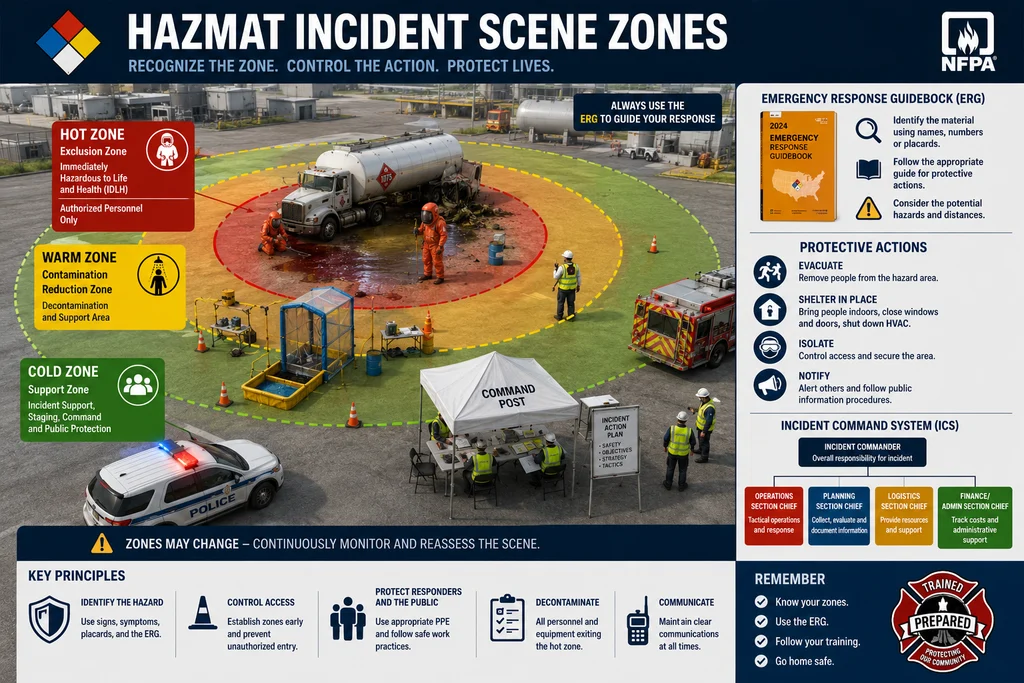
Hazmat emergency response is the structured process of identifying, managing, and mitigating incidents involving hazardous materials to protect people, the environment, and property . Key components include scene safety, material identification using the Emergency Response Guidebook, containment procedures, and coordination with emergency services. Top alternatives: Hazardous materials incident response, Chemical emergency management, HAZMAT spill response, Dangerous goods emergency protocol, and Toxic substance incident control.
Imagine this. You’re first on scene. There’s a overturned tanker truck, a strange smell in the air, and people are starting to cough and stumble away. Your phone buzzes with the dispatch: “Unknown substance, multiple casualties.” Your training kicks in, but where do you even start?
That’s where hazmat emergency response comes in. It’s not just about putting on a hazmat suit and running toward the danger. It’s about a disciplined, structured approach that prioritizes safety while working to protect lives and the environment. Every year, the U.S. Department of Transportation distributes nearly 2 million copies of the Emergency Response Guidebook to first responders across the country because those first minutes of an incident are absolutely critical.
Whether you’re a firefighter, EMS provider, law enforcement officer, or safety professional at an industrial facility, understanding the principles of hazmat emergency response is essential. This guide breaks down the key concepts, procedures, and tools you need to know.
Scene Safety and Size-Up Responses
1. Do not become victim number two
Example: Use this as the mental stop sign before approaching any hazmat scene.
Meaning: Your safety is the top priority; you can’t help others if you become a casualty yourself .
2. Begin the hazmat size-up before opening the vehicle door
Example: Use this to start assessing the scene from a safe distance.
Meaning: What you see, smell, or hear from a distance provides critical clues about the hazard .
3. If uncertain about the hazard, stop and stage at a safe distance
Example: Use this when you can’t immediately identify the material.
Meaning: Staging allows time to gather information and request appropriate resources .
4. A patient lying in a contaminated area is not helped by adding responders to the hot zone
Example: Use this to resist the urge to rush into an unsafe scene.
Meaning: Rushing in without proper protection only creates more victims .
5. Park like you may need to escape
Example: Use this when positioning your emergency vehicle.
Meaning: Maintain clear access and egress routes; avoid parking downhill, downwind, or in visible vapor clouds .
6. Don’t fixate on the dispatch label; reassess the scene for hazmat indicators
Example: Use this when the call comes in as something routine like a “sick person.”
Meaning: Dispatch labels can be misleading; a “sick person” call could be a carbon monoxide exposure .
7. Look for patterns: multiple patients with similar symptoms may indicate a hazmat incident
Example: Use this to recognize a potential chemical exposure.
Meaning: Five patients with shortness of breath outside the same building is a hazmat red flag until proven otherwise .
8. If it is wet and sticky and not yours, do not touch it without proper PPE
Example: Use this as a personal safety rule at any hazmat scene.
Meaning: Unknown substances should be treated as hazardous until identified .
9. Consider wind direction and slope when positioning your response
Example: Use this to avoid being downwind of a vapor release.
Meaning: Wind and terrain can carry hazardous materials toward your position .
10. The first decision is not how fast you can reach the patient; it’s whether you can reach them safely
Example: Use this when prioritizing speed versus safety.
Meaning: Patient contact must be balanced with responder safety protocols .
11. Once contamination enters the patient compartment, the incident follows EMS to the hospital
Example: Use this when deciding where to triage and treat patients.
Meaning: Contaminated patients should not be loaded into ambulances before decontamination .
12. A “fall victim” call can become a hydrocarbon release when the scene doesn’t match the dispatch notes
Example: Use this to challenge your assumptions based on dispatch information.
Meaning: Always verify what you see against what you were told .
Material Identification Responses
1. Look for the UN/NA number on shipping papers or placards
Example: Use this as your first step in identifying a hazardous material.
Meaning: The UN/NA number is the key to finding the correct guide in the ERG .
2. Use the Yellow Section of the ERG to search by UN/NA identification number
Example: Use this when you have the ID number but not the material name.
Meaning: The Yellow Section is organized numerically for quick reference .
3. Use the Blue Section of the ERG to search alphabetically by material name
Example: Use this when you know the material name but not the ID number.
Meaning: The Blue Section is organized by chemical name for easy lookup .
4. Check the Orange Section for initial response guidance including fire, spill, and health hazards
Example: Use this after you’ve found the correct guide number.
Meaning: The Orange Section provides the action guidance for each material .
5. Review the Green Section for initial isolation and protective action distances
Example: Use this to determine how far to evacuate or shelter in place.
Meaning: The Green Section provides specific distance recommendations .
6. Look for placards, package markings, and container labels to identify the material
Example: Use this when shipping papers are not immediately available.
Meaning: Visual clues can help identify the hazard class .
7. For transportation incidents, check the Rail Car Identification Chart for rail shipments
Example: Use this when responding to a train derailment.
Meaning: Updated in the 2024 ERG, this chart helps identify rail car types and their contents .
8. Check the Road Trailer Identification Chart for cargo tank identification
Example: Use this when responding to a truck accident.
Meaning: This chart helps identify tank types and their potential contents .
9. Identify damaged, defective, or recalled lithium batteries specifically
Example: Use this when responding to electric vehicle or battery fires.
Meaning: The 2024 ERG includes guidance for DDR lithium batteries .
10. Use the ERG alongside SDS information and facility-specific plans for more detailed guidance
Example: Use this when the ERG provides initial but not comprehensive information.
Meaning: The ERG is for the initial phase; additional resources provide more detail .
11. Consider using the free ERG mobile app for IOS and Android
Example: Use this when you need quick access in the field.
Meaning: The electronic version provides the same information in a searchable format .
12. Responders should use the ERG as a shared starting point for early response decisions
Example: Use this to establish common ground with other responding agencies.
Meaning: The ERG provides a consistent reference across different departments .
Protective Actions and Isolation Responses
1. Isolate the scene and restrict access immediately upon arrival
Example: Use this to establish control at the start of a hazmat incident.
Meaning: Limiting access protects both responders and the public .
2. Use the Green Section of the ERG to determine initial isolation distances
Example: Use this to establish the inner perimeter.
Meaning: The ERG provides specific distances based on the material and container type .
3. Decide between evacuation and shelter-in-place based on the specific incident
Example: Use this when the incident is near schools or hospitals.
Meaning: The 2024 ERG includes a table to help with this critical decision .
4. Establish a safe zone at a distance that accounts for wind direction and terrain
Example: Use this when establishing the incident command post.
Meaning: Position yourself upwind and uphill from the hazard .
5. The ERG should not replace formal hazmat training or site-specific emergency plans
Example: Use this when training new responders.
Meaning: The ERG is one tool in a comprehensive hazmat response system .
6. Assign a safety officer to monitor conditions and ensure responder safety
Example: Use this in larger-scale hazmat operations.
Meaning: A dedicated safety officer helps prevent responder injuries .
7. Set up a decontamination corridor before allowing patients or responders to leave the hot zone
Example: Use this when contamination is present.
Meaning: Decontamination prevents spread to clean areas and the hospital .
8. Direct patients to stop and remove grossly contaminated outer clothing before moving to the ambulance
Example: Use this when patients are walking toward the ambulance.
Meaning: Removing contaminated clothing can reduce exposure significantly .
9. Use absorbent materials, dikes, and neutralizers for liquid spill control
Example: Use this when containing a small chemical spill.
Meaning: The 2024 ERG includes guidance on liquid spill control methods .
10. For unknown liquids, powders, or vapors, assume they are hazardous until proven otherwise
Example: Use this when you can’t identify the material.
Meaning: Treat unknown substances with appropriate caution .
11. Consider the possibility of a chemical or biological warfare agent in suspicious incidents
Example: Use this in potential terrorism or criminal cases.
Meaning: The 2024 ERG consolidated CWA information into one section .
12. Use the Protective Action Decision Factors table for evacuation versus shelter-in-place decisions
Example: Use this when time is critical and the situation is evolving.
Meaning: This new table in the 2024 ERG speeds up decision-making .
Regulatory Framework Responses
1. OSHA 29 CFR 1910.120(q) HAZWOPER sets training and response requirements
Example: Use this when developing your department’s hazmat program.
Meaning: HAZWOPER establishes the legal framework for workplace hazmat response .
2. EPA 40 CFR 112 SPCC covers oil spill prevention and response
Example: Use this when responding to oil spills.
Meaning: SPCC has specific requirements for oil-containing facilities .
3. EPA 40 CFR 112.20 FRP requires facility response plans for worst-case discharges
Example: Use this when developing facility-specific plans.
Meaning: FRPs are required where oil could reach navigable waters .
4. RCRA 40 CFR 264 Subpart D requires contingency plans for hazardous waste generators
Example: Use this when responding to incidents at waste facilities.
Meaning: Hazardous waste generators must have formal contingency plans .
5. CERCLA 103 and EPCRA 304 require reporting releases at or above reportable quantities
Example: Use this to ensure proper notification after a release.
Meaning: The National Response Center (NRC) line is 1-800-424-8802 .
6. NFPA 472 and NFPA 1072 set responder competency standards for hazmat
Example: Use this when developing training programs.
Meaning: These standards define what responders must know and be able to do .
7. NFPA 1620 covers pre-incident planning for hazmat scenarios
Example: Use this when preparing for potential incidents at high-risk facilities.
Meaning: Pre-incident planning coordinates with the fire department interface .
8. Local Emergency Planning Committees (LEPCs) maintain county-wide emergency response plans
Example: Use this to understand local hazmat planning requirements.
Meaning: LEPCs assess county hazmat resources and conduct training and exercises .
9. LEPCs develop facility-specific off-site emergency response plans
Example: Use this when responding to incidents at specific facilities.
Meaning: These plans include contact numbers and vulnerability zones .
10. The 2024 Emergency Response Guidebook is published by PHMSA and distributed free to responders
Example: Use this to obtain copies for your department.
Meaning: Over 1.8 million copies were distributed for the 2024 edition .
11. Hazardous Materials Regulations (49 CFR Parts 171-180) govern transportation of dangerous goods
Example: Use this when responding to transportation incidents.
Meaning: These regulations specify shipping requirements and documentation .
12. DOT’s goal is to place an ERG in every public emergency service vehicle nationwide
Example: Use this when requesting resources for your department.
Meaning: Over 18 million free copies have been distributed through state coordinators .
Training and Preparedness Responses
1. One-day Awareness Level training meets OSHA and EPA requirements for first responders
Example: Use this when scheduling department training.
Meaning: Awareness Level prepares responders to recognize hazmat incidents and notify authorities .
2. Regular drills and tabletop exercises help maintain hazmat response readiness
Example: Use this when planning department training cycles.
Meaning: Quarterly tabletops and annual functional drills are recommended .
3. Operations Level training enables responders to perform defensive containment actions
Example: Use this when planning career progression for firefighters.
Meaning: Operations Level responders can contain at a distance with absorbents and dikes .
4. Technician Level training allows offensive response including plugging and patching
Example: Use this for specialized hazmat team members.
Meaning: Technician Level responders work in Level A or B PPE to stop releases .
5. Most industrial sites should clearly adopt defensive or evacuation-only response postures
Example: Use this when developing facility emergency plans.
Meaning: Offensive response requires extensive training, PPE, and medical surveillance .
6. Training on the ERG should cover how to use the Yellow, Blue, Orange, and Green sections
Example: Use this when teaching ERG usage.
Meaning: Each section serves a specific purpose in the response process .
7. Include hazmat in new employee orientation and annual refresher training
Example: Use this to ensure all personnel have current knowledge.
Meaning: Regular training is required to maintain competency .
8. Tabletop exercises test decision-making without the logistical complexity of full-scale drills
Example: Use this when budget or time is limited.
Meaning: Tabletops can identify gaps in planning and coordination .
9. Full-scale drills with mutual aid partners should be conducted every 2-3 years
Example: Use this when coordinating multi-agency training.
Meaning: Full-scale drills test the entire response system .
10. Pre-incident coordination with emergency partners improves response time and outcomes
Example: Use this when building relationships with other agencies.
Meaning: Knowing each other’s capabilities before an incident matters .
11. Training should include lessons learned from major incidents like Bhopal and Buncefield
Example: Use this for credible scenario design.
Meaning: Historical incidents provide critical learning opportunities .
12. HAZMAT training programs can effectively task-shift emergency response competencies to non-traditional responders
Example: Use this when considering community or industrial training programs.
Meaning: A structured program in India trained over 2,900 highway stakeholders in hazmat response .
Incident Command and Coordination Responses
1. Establish a unified command structure with fire, EMS, and law enforcement
Example: Use this for multi-agency hazmat incidents.
Meaning: Unified command ensures coordinated decision-making .
2. Designate an Incident Commander responsible for overall strategy and resource allocation
Example: Use this when setting up incident management.
Meaning: One person must be in charge to maintain clear direction.
3. Assign a Safety Officer to monitor hazards and ensure responder safety
Example: Use this in larger-scale hazmat operations.
Meaning: The Safety Officer has the authority to stop unsafe activities .
4. Establish a staging area for incoming units and a waiting area for responding agencies
Example: Use this to manage the flow of resources.
Meaning: Staging prevents congestion at the incident scene .
5. Coordinate with local emergency responders including fire departments and hazmat teams
Example: Use this when managing a hazmat incident.
Meaning: Local responders have jurisdiction and local knowledge .
6. For facilities, the on-site emergency response plan should be maintained and updated with local authorities
Example: Use this when developing facility preparedness.
Meaning: Plans must be reviewed and updated annually by LEPCs .
7. LEPCs maintain facility off-site plans and send copies to the responding fire department
Example: Use this to ensure information is available at the scene.
Meaning: The fire department must have access to facility-specific plans .
8. Coordinate with the National Response Center for reportable releases
Example: Use this when a release exceeds reportable quantities.
Meaning: NRC notification is required by CERCLA and EPCRA .
9. Mutual aid agreements can help departments meet hazmat response capability needs
Example: Use this when your department lacks specialized resources.
Meaning: Mutual aid expands available resources and expertise.
10. Contact emergency response support providers like CHEMTREC for 24/7 technical guidance
Example: Use this when additional expertise is needed.
Meaning: CHEMTREC provides access to specialists, toxicology, and medical resources .
11. The ERG helps communicate risk across response teams with a shared reference point
Example: Use this to ensure everyone is using the same information.
Meaning: Common references reduce confusion .
12. Document all response actions for compliance and after-action review
Example: Use this to improve future responses.
Meaning: Documentation supports regulatory reporting and learning .
Decontamination Responses
1. Set up a decontamination corridor before patients or responders leave the hot zone
Example: Use this when contamination is confirmed or suspected.
Meaning: Decon is required to prevent spread .
2. Remove grossly contaminated outer clothing before moving patients into the ambulance
Example: Use this when patients are being transported.
Meaning: Removing clothing can reduce contamination by 80-90% .
3. Once contamination enters the patient compartment, the ambulance becomes part of the incident
Example: Use this to justify decontamination before transport.
Meaning: Contaminated ambulances can spread hazmat to hospitals .
4. The ambulance should not become the collection point for contaminated patients
Example: Use this when establishing the patient collection area.
Meaning: Contaminated patients should be held in a designated area outside the ambulance .
5. Use the decontamination zone for washing patients and responders before medical treatment
Example: Use this when setting up the incident command layout.
Meaning: Medical treatment follows decontamination, not the reverse.
6. Consider the type of contamination when choosing decontamination methods
Example: Use this when dealing with chemical versus biological agents.
Meaning: Different materials require different decon approaches.
7. Establish gross decontamination (removing clothing) and secondary decontamination (washing)
Example: Use this when planning the decontamination process.
Meaning: Gross decon is the first and most effective step.
8. Protect decontamination runoff from entering drains and waterways
Example: Use this when siting the decontamination zone.
Meaning: Runoff may be hazardous and must be contained.
9. EMS providers should be trained in decontamination procedures before responding to hazmat incidents
Example: Use this when training EMS personnel.
Meaning: EMS providers need to protect themselves and their patients .
10. Decontamination is not just for patients; contaminated equipment must also be decontaminated
Example: Use this when handling medical equipment at the scene.
Meaning: Equipment can spread contamination and must be addressed.
11. If patients are walking toward the ambulance, direct them to stop and wait for decontamination
Example: Use this to prevent contamination spread.
Meaning: Patient movement should be controlled to protect the ambulance and its crew .
12. Decontamination is patient care in a hazmat incident
Example: Use this when EMS providers are reluctant to delay patient contact.
Meaning: Decontamination is necessary for safe patient treatment .
EMS-Specific Responses
1. EMS providers trained to move toward patients must override that instinct at hazmat scenes
Example: Use this when training EMS providers.
Meaning: The instinct to help must be balanced with safety .
2. The first EMS unit should assess scene safety and request additional resources before approaching
Example: Use this as protocol for EMS first responders.
Meaning: Scene size-up is the first step in EMS hazmat response .
3. Think toxidrome, not just product name
Example: Use this when patients present with chemical exposure symptoms.
Meaning: Clinical findings can guide treatment even when the specific chemical is unknown .
4. A single patient with shortness of breath may be routine; five patients with similar symptoms is a hazmat incident
Example: Use this to identify potential mass exposures.
Meaning: Pattern recognition is critical in hazmat EMS .
5. Unknown liquids, powders, residues, and vapors are not harmless just because a patient needs help nearby
Example: Use this when approaching any potentially contaminated patient.
Meaning: Patient need does not eliminate the hazard .
6. Do not let contaminated patients into the ambulance before decontamination
Example: Use this when establishing transport protocols.
Meaning: Ambulance contamination spreads the incident .
7. EMS should resist the urge to fixate on the dispatch labels; a “sick person” call can be a hazmat incident
Example: Use this when responding to seemingly routine calls.
Meaning: Dispatch information may be incomplete or incorrect .
8. Park the ambulance upwind and uphill from the incident to avoid vapor exposure
Example: Use this when positioning on scene.
Meaning: Proper positioning protects the ambulance and its crew .
9. If patients are walking toward the ambulance, that is a warning sign of an evolving hazmat incident
Example: Use this to assess scene conditions.
Meaning: Casualties self-evacuating can indicate a serious hazard .
10. A monitor, airway bag, drug box, or radio strap can all become contaminated
Example: Use this when considering what equipment to bring into the scene.
Meaning: Equipment can carry contamination and must be managed .
11. Contact with the wrong material can turn a provider, monitor, or ambulance into an extension of the incident
Example: Use this to emphasize the importance of PPE and scene safety.
Meaning: Hazmat incidents can spread through contaminated responders and equipment .
12. In hazmat response, scene control is patient care
Example: Use this when EMS providers are eager to reach patients.
Meaning: Safety and control are prerequisites for effective patient care .
Plan Development Responses
1. A defensible hazmat emergency response plan must include a material inventory for every hazardous substance on site
Example: Use this when developing a facility emergency response plan.
Meaning: Knowing what materials are present is the foundation of planning .
2. Include the response posture per material: evacuate, defensive, or offensive, with thresholds for each
Example: Use this to define roles for your response team.
Meaning: Different materials and quantities require different response levels .
3. Develop a notification matrix with internal and external contacts, and test phone numbers quarterly
Example: Use this to ensure you can reach the right people when needed.
Meaning: Contact information must be current and verified .
4. Identify primary and backup spill kits located within 90 seconds of every release point
Example: Use this when placing emergency equipment in a facility.
Meaning: Quick access to spill kits is essential for timely containment .
5. List trained responders by name and training tier so everyone knows who can do what
Example: Use this for staff accountability and assignment.
Meaning: Response capabilities depend on who is available and trained .
6. LEPCs develop facility-specific off-site emergency response plans for fixed facilities
Example: Use this when understanding local planning requirements.
Meaning: Off-site plans include vulnerability zones and population protection procedures .
7. The county-wide emergency response plan includes hazard analysis, facility lists, and transportation routes
Example: Use this for comprehensive community hazmat planning.
Meaning: The community plan coordinates resources and procedures across the county .
8. Facility off-site plans must include contact information, resource lists, and hazard analysis
Example: Use this when developing or updating facility plans.
Meaning: Plans provide critical information to responding agencies .
9. LEPCs send copies of off-site plans to the fire department that would respond to the facility
Example: Use this to ensure information is available at the scene.
Meaning: Responding agencies need access to facility-specific plans .
10. Plans must be reviewed and updated annually, with changes submitted to the state commission
Example: Use this to maintain plan currency.
Meaning: Annual updates ensure the plan reflects current operations .
11. The plan must be written, dated, and owned by a specific person who is accountable for updates
Example: Use this for plan governance.
Meaning: Accountability ensures the plan is maintained .
12. Pre-incident planning (NFPA 1620) coordinates facility plans with the fire department response
Example: Use this when developing facility emergency plans.
Meaning: Coordination with responders ensures smooth response .
Special Situations Responses
1. The 2024 ERG includes new guidance for lithium battery and electric vehicle fires
Example: Use this when responding to EV incidents.
Meaning: Lithium battery fires require special considerations and are increasingly common .
2. Chemical warfare agents are now consolidated into one section in the 2024 ERG
Example: Use this when responding to a suspected terrorism incident.
Meaning: The updated ERG provides a single reference for CWA response .
3. New chemical and biological warfare agents are listed based on type and symptoms, not by name
Example: Use this when exposure to an unknown agent is suspected.
Meaning: Symptoms guide the response when the specific agent is unknown .
4. The polymerization hazard is now listed for UN3302 (2-Dimethylaminoethyl acrylate, stabilized)
Example: Use this for specific chemical hazards.
Meaning: Polymerization can create additional hazards .
5. The Rail Car Identification Chart now includes a cryogenic rail car
Example: Use this for rail incidents involving cryogenic liquids.
Meaning: Cryogenic liquids have unique hazards and are stored in specialized cars .
6. The Road Trailer Identification Chart includes new descriptive text for tank types
Example: Use this to identify road transport tanks.
Meaning: Tank type helps predict contents and hazards .
7. Liquid spill control methods guidance is new to the 2024 ERG
Example: Use this for containment of liquid spills.
Meaning: The 2024 ERG provides more detailed guidance on containment methods .
8. The Protective Action Decision Factors table helps decide evacuation versus shelter-in-place
Example: Use this when time is critical and conditions are changing.
Meaning: This new table speeds up decision-making .
9. The ERG is intended for the initial phase of a transportation incident involving hazardous materials
Example: Use this when understanding the scope of the ERG.
Meaning: The ERG is a starting point, not a comprehensive response guide .
10. For transportation incidents, the ERG may be the only resource available for some departments
Example: Use this when training rural departments with limited resources.
Meaning: The ERG is a critical resource where hazmat teams are hours away .
11. The 2024 ERG removed obsolete placard designs including the triangular Marine Pollutant marking
Example: Use this to ensure your department is using current reference materials.
Meaning: Obsolete information can be misleading .
12. Chemical warfare agents were removed from the Yellow and Blue sections and moved to a new section
Example: Use this when looking for CWA information in the 2024 ERG.
Meaning: The new section is more comprehensive and accessible .
FAQs
What is hazmat emergency response?
Hazmat emergency response is the structured process of identifying, managing, and mitigating incidents involving hazardous materials. It helps protect people, the environment, assets, and reputation during incidents like chemical spills, gas leaks, fires, or toxic exposures .
What is the Emergency Response Guidebook (ERG) and who uses it?
The ERG is a manual published by the U.S. Department of Transportation that provides guidance to first responders during the initial phase of a transportation incident involving hazardous materials . It’s used by firefighters, police, EMS, and safety professionals .
What are the key sections of the Emergency Response Guidebook?
The ERG has four color-coded sections: Yellow for UN/NA number search, Blue for alphabetical material name search, Orange for initial response guidance, and Green for isolation and protective action distances .
What are the training levels for hazmat responders?
OSHA 1910.120(q) defines three primary training levels: Awareness Level (recognize and notify), Operations Level (defensive containment), and Technician Level (offensive response including plugging and patching) .
What is the first thing to do when responding to a suspected hazmat incident?
Size up from a safe distance. Identify the material using the ERG if possible, and avoid becoming a victim yourself . Staging and requesting appropriate resources is critical before entering the scene .
Who develops local hazmat emergency response plans?
Local Emergency Planning Committees (LEPCs) develop county-wide plans and facility-specific off-site plans. LEPCs include representatives from emergency response agencies, local government, industry, and community groups .
Conclusion
Hazmat emergency response is a structured, systematic approach that prioritizes safety while working to protect lives and the environment. From the critical first moments of scene size-up to the careful identification of materials using the Emergency Response Guidebook, every step matters.
Whether you’re a first responder on the front lines or a safety professional developing plans, the key is preparation. Know your regulations, train your people, and practice your procedures. The ERG provides a shared starting point, but it’s training, coordination, and discipline that make the difference in a real incident.
So keep this guide handy. Use the ERG. Stay safe. And remember, the most important rule is this: protect yourself so you can protect others. Because in hazmat emergency response, safety isn’t just a priority, it’s a prerequisite.







5 thoughts on “150+ Hazmat Emergency Response Strategies for First Responders For 2026”