

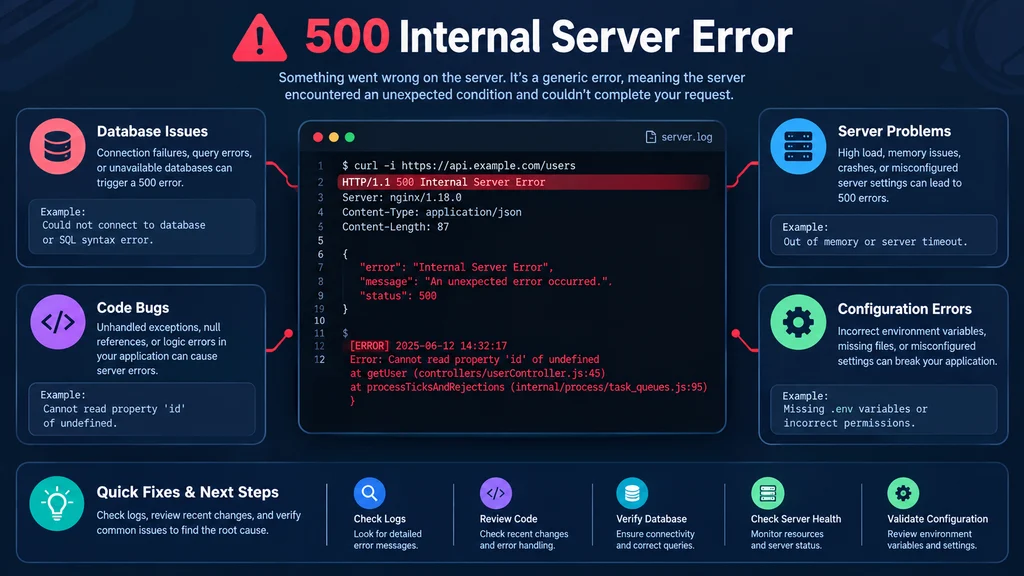
The HTTP response code 500 (Internal Server Error) means the server encountered an unexpected condition that prevented it from fulfilling the request. It's a generic catch-all error indicating something broke on the server side. Top alternatives: Internal Server Error, server-side exception, unexpected backend failure, application error, and unhandled server exception.You’re testing your API, everything looks perfect, and then it hits you. A big, ugly 500 error staring back at you from the console. No helpful message, no clue what went wrong, just “Internal Server Error.”
Sound familiar? If you’ve spent any time building or debugging web applications, you’ve definitely met the http response code 500. It’s the error that says “something went wrong” without telling you what, where, or why. It’s frustrating, mysterious, and honestly a little dramatic.
But here’s the thing: a 500 error isn’t the end of the world. It’s your server’s way of saying “I tried, but something broke.” Maybe it’s a database connection issue, a null pointer exception, or a typo in your code that only shows up in production. Whatever it is, understanding the 500 status code is the first step to fixing it. This guide covers everything you need to know about the 500 error.
Core Definition Responses
1. The 500 Internal Server Error indicates an unexpected condition on the server
Example: Use this when explaining the error to a non-technical stakeholder.
Meaning: Something went wrong on the server side that wasn’t anticipated.
2. A 500 response means the server encountered an error and couldn’t complete the request
Example: Use this when documenting API error responses.
Meaning: The request was received but processing failed.
3. HTTP 500 is a generic catch-all error for server-side failures
Example: Use this when teaching HTTP status codes.
Meaning: It covers any unexpected server condition.
4. The 500 status code belongs to the 5xx family of server error responses
Example: Use this when categorizing HTTP errors.
Meaning: 5xx codes indicate server-side problems.
5. A 500 error is not caused by the client’s request
Example: Use this when reassuring users that they didn’t do anything wrong.
Meaning: The issue lies with the server, not the request.
6. The server encountered an unexpected condition preventing request fulfillment
Example: Use this in technical documentation.
Meaning: The official definition of the 500 status code.
7. 500 Internal Server Error is the most common server error response
Example: Use this when explaining why users see 500 errors frequently.
Meaning: It’s the default error when something breaks.
8. A 500 response indicates a problem with the server’s configuration or code
Example: Use this when diagnosing server issues.
Meaning: The error originates from the server environment.
9. The 500 error provides no specific details about the failure
Example: Use this when explaining why 500 errors are hard to debug.
Meaning: The error is intentionally vague for security reasons.
10. HTTP 500 is returned when no more specific error code applies
Example: Use this when explaining the relationship between 500 and other 5xx codes.
Meaning: It’s the fallback when nothing else fits.
11. A 500 response can be temporary or persistent depending on the cause
Example: Use this when discussing error resolution timelines.
Meaning: Some 500 errors resolve on retry, others need fixes.
12. The 500 status code indicates a server-side exception or misconfiguration
Example: Use this when debugging backend issues.
Meaning: Something in the server code or config failed.
Common Causes Responses
1. Database connection failures often cause 500 errors
Example: Use this when troubleshooting database-related issues.
Meaning: The server can’t connect to the database.
2. Unhandled exceptions in application code trigger 500 responses
Example: Use this when reviewing application logs.
Meaning: A bug in the code caused an unexpected crash.
3. Missing or incorrect file permissions can cause 500 errors
Example: Use this when checking server configuration.
Meaning: The server can’t access required files.
4. Syntax errors in server-side scripts lead to 500 responses
Example: Use this when debugging PHP, Python, or Node.js applications.
Meaning: A coding mistake broke the script.
5. Timeout errors from external services cause 500 responses
Example: Use this when integrating with third-party APIs.
Meaning: An external service didn’t respond in time.
6. Memory exhaustion or resource limits trigger 500 errors
Example: Use this when the server is under heavy load.
Meaning: The server ran out of resources.
7. Misconfigured .htaccess files cause 500 errors on Apache servers
Example: Use this when troubleshooting Apache configurations.
Meaning: A configuration file has a syntax error.
8. Broken plugins or extensions cause 500 errors in CMS platforms
Example: Use this when debugging WordPress or similar platforms.
Meaning: A plugin conflict or bug broke the site.
9. Uncaught exceptions in async operations trigger 500 responses
Example: Use this when debugging Node.js or modern JavaScript applications.
Meaning: An async error wasn’t handled properly.
10. Invalid SSL certificates can cause 500 errors
Example: Use this when troubleshooting HTTPS issues.
Meaning: The SSL configuration is incorrect.
11. Corrupted cache or session data causes 500 errors
Example: Use this when users report intermittent 500 errors.
Meaning: Stale or corrupted data is breaking the application.
12. Server overload from traffic spikes causes 500 errors
Example: Use this during high-traffic events.
Meaning: The server can’t handle the volume of requests.
Debugging Responses
1. Check the server error logs first
Example: Use this as your first step when diagnosing a 500 error.
Meaning: Logs contain the actual error message and stack trace.
2. Enable detailed error reporting in development
Example: Use this when working on a local or staging environment.
Meaning: Detailed errors help identify the root cause.
3. Reproduce the error consistently
Example: Use this when trying to understand what triggers the 500.
Meaning: Consistent reproduction makes debugging easier.
4. Check recent code changes or deployments
Example: Use this when a 500 error appears suddenly.
Meaning: Recent changes often introduce new bugs.
5. Verify database connectivity and credentials
Example: Use this when the error is related to data operations.
Meaning: Database issues are a common cause of 500 errors.
6. Test with a minimal request to isolate the issue
Example: Use this when the error is hard to reproduce.
Meaning: Simplifying the request helps identify the trigger.
7. Review server resource usage and limits
Example: Use this when the server is under load.
Meaning: Resource exhaustion can cause 500 errors.
8. Check third-party service status pages
Example: Use this when your app depends on external APIs.
Meaning: External outages can cause 500 errors.
9. Temporarily disable plugins or extensions
Example: Use this for CMS-based sites with 500 errors.
Meaning: Isolating the problem plugin helps identify the cause.
10. Roll back to a previous working version
Example: Use this when a recent deployment caused the error.
Meaning: Reverting changes can restore functionality quickly.
11. Test the request with different parameters
Example: Use this when the error is intermittent.
Meaning: Specific inputs may be triggering the failure.
12. Use debugging tools and profilers
Example: Use this for complex application errors.
Meaning: Profilers help identify performance bottlenecks and exceptions.
User-Facing Responses
1. We’re experiencing a temporary issue. Please try again shortly.
Example: Use this on a website when a 500 error occurs.
Meaning: A friendly message that reassures users.
2. Something went wrong on our end. We’re working on it.
Example: Use this when the error is being investigated.
Meaning: Acknowledges the issue without technical jargon.
3. Our servers are having a moment. Please refresh the page.
Example: Use this for transient 500 errors.
Meaning: A lighthearted way to ask users to retry.
4. We’re sorry for the inconvenience. Our team is on it.
Example: Use this when the error is widespread.
Meaning: Shows accountability and action.
5. This page is temporarily unavailable. Please check back soon.
Example: Use this for persistent 500 errors.
Meaning: Sets expectations for users.
6. We encountered an unexpected error. Please contact support if it persists.
Example: Use this when users need a next step.
Meaning: Provides a path for resolution.
7. Oops, something broke. We’re fixing it now.
Example: Use this for a casual brand voice.
Meaning: A friendly and apologetic message.
8. Our system is taking a quick break. Please try again in a few minutes.
Example: Use this for short-lived errors.
Meaning: A playful way to explain the issue.
9. We’re unable to process your request right now. Please try later.
Example: Use this for API errors.
Meaning: A clear message for developers and users.
10. This isn’t you, it’s us. We’re working to fix it.
Example: Use this to reassure users.
Meaning: Acknowledges the error is server-side.
11. We’re experiencing higher than normal traffic. Please try again soon.
Example: Use this during traffic spikes.
Meaning: Explains the cause without technical details.
12. Our team has been notified and is investigating.
Example: Use this for unexpected errors.
Meaning: Shows proactive monitoring and response.
Developer Best Practices
1. Never expose stack traces or sensitive details in 500 responses
Example: Use this when configuring error handling.
Meaning: Security best practice to prevent information leaks.
2. Log 500 errors with full context for debugging
Example: Use this when implementing error logging.
Meaning: Detailed logs help diagnose issues quickly.
3. Return 500 only for unexpected server errors
Example: Use this when deciding which status code to use.
Meaning: Use specific codes (400, 404, etc.) when applicable.
4. Implement global exception handlers to catch unhandled errors
Example: Use this in application architecture.
Meaning: Ensures all errors are handled gracefully.
5. Set up alerts for 500 error spikes
Example: Use this in monitoring and observability.
Meaning: Early detection helps resolve issues faster.
6. Provide a request ID in 500 responses for support
Example: Use this when debugging user-reported issues.
Meaning: Request IDs help trace specific errors.
7. Test error handling in staging environments
Example: Use this before deploying to production.
Meaning: Ensures error responses are correct.
8. Use circuit breakers to prevent cascading failures
Example: Use this in microservices architectures.
Meaning: Stops repeated failures from overwhelming the system.
9. Gracefully degrade functionality when possible
Example: Use this for non-critical features.
Meaning: Prevents 500 errors by providing fallbacks.
10. Document common 500 error causes and fixes
Example: Use this for team knowledge sharing.
Meaning: Helps developers resolve issues faster.
11. Monitor server resources to prevent exhaustion
Example: Use this in infrastructure management.
Meaning: Proactive monitoring prevents 500 errors.
12. Implement retry logic with exponential backoff for clients
Example: Use this in API client libraries.
Meaning: Helps clients recover from transient 500 errors.
API-Specific Responses
1. 500 Internal Server Error is returned for unexpected API failures
Example: Use this in API documentation.
Meaning: Indicates a server-side issue during API processing.
2. API 500 errors should include a correlation ID for tracing
Example: Use this in API error response design.
Meaning: Helps developers and support teams debug issues.
3. REST APIs return 500 when the server fails to process a request
Example: Use this in API design discussions.
Meaning: The standard response for unexpected server failures.
4. GraphQL APIs may return 500 for resolver exceptions
Example: Use this when debugging GraphQL servers.
Meaning: Resolver errors can trigger 500 responses.
5. API gateways can return 500 when upstream services fail
Example: Use this in microservices architectures.
Meaning: Gateway errors often manifest as 500 responses.
6. 500 errors in APIs should be logged with request details
Example: Use this in API monitoring.
Meaning: Helps diagnose issues without exposing sensitive data.
7. API clients should handle 500 errors gracefully
Example: Use this when building client libraries.
Meaning: Retry or display user-friendly messages.
8. Rate limiting can sometimes return 500 instead of 429
Example: Use this when debugging API errors.
Meaning: Misconfigured rate limiters may return 500.
9. API 500 errors can indicate database query failures
Example: Use this when debugging API backends.
Meaning: Database issues often surface as 500 errors.
10. Webhook endpoints should return 500 for processing failures
Example: Use this when implementing webhooks.
Meaning: Signals to the sender that the webhook failed.
11. API versioning can help isolate 500 errors to specific versions
Example: Use this when managing API changes.
Meaning: Version-specific errors are easier to debug.
12. 500 errors in APIs should trigger alerts for on-call engineers
Example: Use this in API operations.
Meaning: Ensures rapid response to critical failures.
Web Server Specific Responses
1. Apache returns 500 when .htaccess has syntax errors
Example: Use this when troubleshooting Apache servers.
Meaning: A common cause of 500 errors on Apache.
2. Nginx returns 500 for upstream errors or misconfigurations
Example: Use this when debugging Nginx.
Meaning: Upstream failures often result in 500 responses.
3. IIS returns 500 for ASP.NET application errors
Example: Use this when debugging IIS-hosted applications.
Meaning: Application exceptions trigger 500 responses.
4. Node.js servers return 500 for unhandled exceptions
Example: Use this when debugging Express or Koa applications.
Meaning: Uncaught errors trigger 500 responses.
5. Python servers return 500 for unhandled exceptions in Django or Flask
Example: Use this when debugging Python web applications.
Meaning: Unhandled exceptions produce 500 errors.
6. PHP servers return 500 for fatal errors or parse errors
Example: Use this when debugging PHP applications.
Meaning: Fatal PHP errors trigger 500 responses.
7. Ruby on Rails returns 500 for unhandled exceptions
Example: Use this when debugging Rails applications.
Meaning: Uncaught exceptions result in 500 errors.
8. Java servers return 500 for unhandled servlet exceptions
Example: Use this when debugging Java web applications.
Meaning: Servlet exceptions trigger 500 responses.
9. Go servers return 500 for panic errors
Example: Use this when debugging Go web applications.
Meaning: Unrecovered panics result in 500 errors.
10. Cloud platforms return 500 for function execution failures
Example: Use this when debugging serverless functions.
Meaning: Lambda or Cloud Function errors produce 500 responses.
11. Load balancers return 500 when all backend servers fail
Example: Use this when troubleshooting high availability setups.
Meaning: No healthy backends means 500 errors.
12. CDNs return 500 for origin server errors
Example: Use this when debugging CDN configurations.
Meaning: Origin failures propagate as 500 errors.
FAQ
What does HTTP response code 500 mean?
The 500 Internal Server Error means the server encountered an unexpected condition that prevented it from fulfilling the request. It’s a generic error indicating something went wrong on the server side.
Is a 500 error the client’s fault?
No, a 500 error is always a server-side issue. The client’s request was valid, but the server couldn’t process it.
How do I fix a 500 error?
Check server logs for the actual error message. Common fixes include correcting code bugs, fixing database connections, adjusting file permissions, or resolving configuration issues.
Can a 500 error be temporary?
Yes, some 500 errors are transient and resolve on retry. Others are persistent and require code or configuration fixes.
What’s the difference between 500 and 502?
500 is a generic server error, while 502 Bad Gateway means a server acting as a gateway received an invalid response from an upstream server.
Conclusion
The HTTP response code 500 is the server’s way of saying “I messed up.” It’s not the most helpful error, but it’s a signal that something on the backend needs attention. Whether it’s a database connection issue, a code bug, or a configuration problem, the 500 error is your cue to dive into the logs and figure out what’s broken.
For developers, understanding the 500 status code is essential for building resilient applications. For users, seeing a 500 error means the issue isn’t on your end. It’s the server’s problem to fix.
Save this guide for your next debugging session. Share it with your team. And remember, every 500 error is just a puzzle waiting to be solved. Happy debugging!







7 thoughts on “150+ Best HTTP Response Code 500 Explanations for Developers For 2026”