

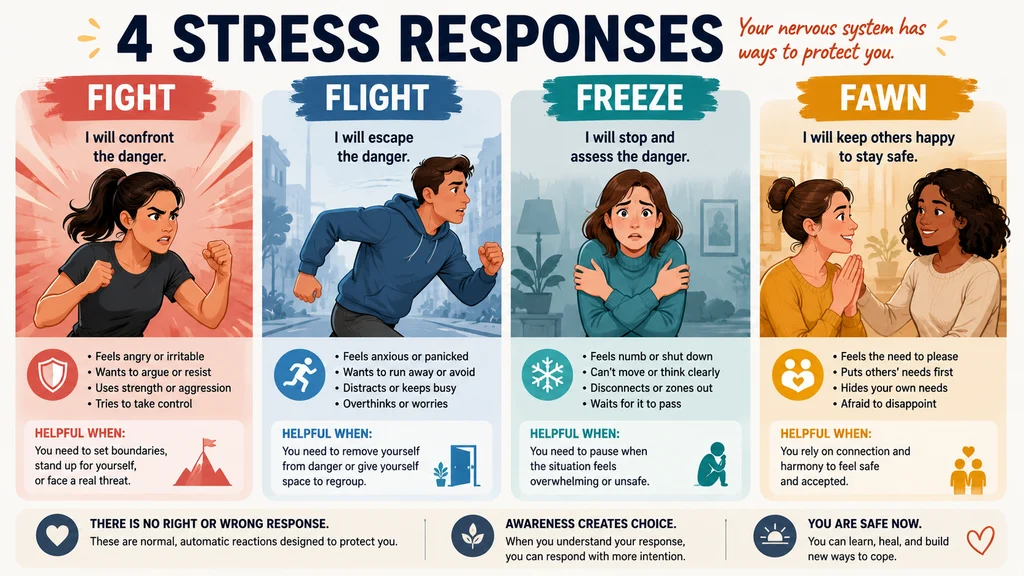
The best trauma response quiz helps you identify your dominant survival pattern among fight, flight, freeze, or fawn. This self-awareness can explain your reactions to stress and guide you toward healing. Top alternatives: fight flight freeze fawn assessment, trauma response type test, nervous system reaction quiz, survival response evaluation, and 4 Fs trauma pattern identifier.You’re in a meeting and someone criticizes your work. Your face flushes, your heart races, and suddenly you’re either fighting back, mentally checking out, or desperately trying to please everyone in the room. Sound familiar?
These aren’t just personality quirks or bad habits. They’re trauma responses, automatic survival strategies your nervous system developed to keep you safe. And here’s the thing: most of us don’t even realize we have a default response pattern until we take a trauma response quiz and see the results staring back at us.
Whether you tend to fight, flee, freeze, or fawn (people-please), understanding your default trauma response can transform how you navigate conflict, relationships, and everyday stress. It’s not about labeling yourself as broken. It’s about recognizing the strategies that once kept you safe and deciding if they’re still serving you.
Fight Response Insights
1. Your instinct is to meet stress with confrontation
Example: Use this insight when you notice yourself getting defensive during disagreements.
Meaning: Your nervous system perceives threats and prepares to fight them off.
2. You protect yourself through control and assertiveness
Example: Use this when you realize you’re trying to control situations that feel uncertain.
Meaning: Control creates a sense of safety for fight types.
3. Anger feels safer than vulnerability
Example: Use this when you notice anger rising in situations that actually make you feel hurt.
Meaning: Anger can be a shield protecting softer emotions.
4. Your boundaries are strong but sometimes rigid
Example: Use this when you recognize you’re pushing people away unnecessarily.
Meaning: Fight responses often show up as firm boundaries that don’t bend.
5. You speak up courageously when something feels wrong
Example: Use this when you advocate for yourself in difficult situations.
Meaning: The healthy side of fight is assertiveness and protecting others.
6. You may struggle with constantly feeling on high alert
Example: Use this when you notice you’re always ready for a battle.
Meaning: Unhealthy fight can lead to chronic stress and vigilance.
7. Your confidence can intimidate others
Example: Use this when people seem uncomfortable with your directness.
Meaning: Fight types often come across as strong, which can be intimidating.
8. You push through challenges with determination
Example: Use this when you’re tackling difficult tasks or obstacles.
Meaning: The fight response includes resilience and persistence.
9. You may demand perfection from yourself or others
Example: Use this when you notice unrealistic expectations causing tension.
Meaning: Unhealthy fight can manifest as perfectionism and control.
10. You rarely back down from a challenge
Example: Use this when you notice you’re always ready to prove yourself.
Meaning: Fight types see challenges as opportunities to assert strength.
11. You speak up when others stay silent
Example: Use this when you’re the first to address an issue in a group.
Meaning: Fight responses can make you a natural advocate.
12. You protect others when you see injustice
Example: Use this when you defend someone who’s being mistreated.
Meaning: The fight response includes protective instincts for others.
Flight Response Insights
1. Your instinct is to escape or avoid stressful situations
Example: Use this when you notice yourself making excuses to leave uncomfortable settings.
Meaning: Your nervous system tells you that safety lies in getting away.
2. You stay busy to avoid feeling difficult emotions
Example: Use this when you realize you’re constantly working or scrolling to avoid thinking.
Meaning: Busyness becomes a way to outrun internal discomfort.
3. You’re highly productive but struggle to rest
Example: Use this when you feel guilty for taking time off.
Meaning: Flight types often equate productivity with safety.
4. Perfectionism drives your workaholic tendencies
Example: Use this when you notice you’re working too hard to feel worthy.
Meaning: The belief that perfection brings safety fuels overwork.
5. You avoid conflict at almost any cost
Example: Use this when you realize you’re letting issues slide to keep peace.
Meaning: Flight types often see conflict as something to escape.
6. You may struggle with anxiety and racing thoughts
Example: Use this when your mind won’t stop spinning with worries.
Meaning: Flight responses include mental escape patterns.
7. You’re quick to change subjects when things get uncomfortable
Example: Use this when you notice you’re deflecting serious conversations.
Meaning: Redirecting attention is a subtle escape strategy.
8. You may have difficulty sitting still or relaxing
Example: Use this when you’re always fidgeting or feeling restless.
Meaning: Flight types often experience physical restlessness.
9. You’re resourceful and good at solving problems quickly
Example: Use this when you excel in crisis situations.
Meaning: The healthy side of flight is adaptability and quick thinking.
10. You often say “I’m fine” when you’re not
Example: Use this when you’re deflecting concern from others.
Meaning: Deflecting questions is a way to avoid vulnerability.
11. You may use humor or deflection to avoid emotional depth
Example: Use this when you notice yourself joking instead of connecting.
Meaning: Humor becomes a flight mechanism from intimacy.
12. You struggle to slow down and be present
Example: Use this when you’re always rushing to the next thing.
Meaning: Flight types often fear what they’ll feel if they stop.
Freeze Response Insights
1. Your instinct is to shut down when overwhelmed
Example: Use this when you notice yourself going blank during arguments.
Meaning: Your nervous system defaults to immobilization when threatened.
2. You go numb or disconnect from your emotions
Example: Use this when you realize you’re not feeling anything in stressful moments.
Meaning: Numbing protects you from overwhelming feelings.
3. You feel stuck and struggle to take action
Example: Use this when you’re procrastinating on important tasks.
Meaning: The freeze response includes a sense of paralysis.
4. You may dissociate or “space out”
Example: Use this when you realize you’ve lost time or don’t remember conversations.
Meaning: Dissociation is a form of freeze that creates emotional distance.
5. You hide from conflict by becoming invisible
Example: Use this when you make yourself small in confrontational situations.
Meaning: Freeze types often hope threats will pass if they stay still.
6. You may struggle to make decisions
Example: Use this when you’re paralyzed by even small choices.
Meaning: Freeze includes indecision as a protective strategy.
7. You’re highly observant and thoughtful
Example: Use this when you notice you pick up on details others miss.
Meaning: The healthy side of freeze is mindfulness and awareness.
8. You may experience chronic fatigue or low motivation
Example: Use this when you feel exhausted without clear cause.
Meaning: Freeze responses consume energy through constant vigilance.
9. You withdraw from relationships when stressed
Example: Use this when you pull away from people you love.
Meaning: Isolation feels safer than connection during stress.
10. You feel disconnected from your own body
Example: Use this when you realize you’re not noticing physical sensations.
Meaning: Freeze includes a mind-body disconnect.
11. You may have difficulty expressing emotions
Example: Use this when you feel things but can’t put them into words.
Meaning: Freeze includes emotional shutdown.
12. You wait for problems to resolve themselves
Example: Use this when you’re hoping things will get better without action.
Meaning: Freeze types often hope time will bring safety.
Fawn Response Insights
1. Your instinct is to please others to stay safe
Example: Use this when you notice yourself agreeing when you really disagree.
Meaning: Your nervous system equates other people’s approval with safety .
2. You suppress your own needs to avoid conflict
Example: Use this when you realize you’re putting yourself last again.
Meaning: Fawn types believe their needs threaten connection.
3. You’re everyone’s peacekeeper
Example: Use this when you’re always mediating others’ conflicts.
Meaning: Keeping the peace feels like survival for fawn types .
4. You struggle to set or maintain boundaries
Example: Use this when you notice others taking advantage of you.
Meaning: Boundaries feel dangerous to fawn responses.
5. You may feel guilty for having needs or wants
Example: Use this when you apologize for needing help.
Meaning: Fawn types often believe needing others is wrong.
6. You accommodate others at your own expense
Example: Use this when you’re exhausted from taking care of everyone else.
Meaning: Accommodation becomes a survival strategy .
7. You’re highly empathetic and caring
Example: Use this when you naturally understand others’ feelings.
Meaning: The healthy side of fawn is deep compassion.
8. You may stay in unhealthy relationships too long
Example: Use this when you realize you’re tolerating unacceptable behavior.
Meaning: Fawn types often overstay in pursuit of safety.
9. You over-apologize for things that aren’t your fault
Example: Use this when you say sorry constantly.
Meaning: Apologizing preemptively avoids perceived conflict .
10. You struggle to know what you truly want
Example: Use this when you realize you’re always following others’ lead.
Meaning: Fawn types can lose their sense of self.
11. You feel responsible for others’ emotions
Example: Use this when you’re exhausted from managing everyone’s feelings.
Meaning: Fawn types often take on others’ emotional labor.
12. You may attract people who take advantage of your kindness
Example: Use this when you notice patterns in your relationships.
Meaning: Fawn responses can attract those who exploit people-pleasing.
Recognizing Your Triggers
1. Certain sounds or smells can trigger intense reactions
Example: Use this when you notice specific sensory inputs causing distress.
Meaning: Trauma responses can be triggered by sensory reminders of past events .
2. Your reactions often feel bigger than the situation warrants
Example: Use this when you overreact and wonder why.
Meaning: Past trauma can amplify present-moment responses .
3. Some environments make you feel instantly unsafe
Example: Use this when you notice anxiety in specific places.
Meaning: Environmental cues can activate survival responses.
4. You may have “false alarms” where there’s no real threat
Example: Use this when you feel panicked but know you’re safe.
Meaning: Your nervous system can mistake safety for danger .
5. Trigger responses can happen without conscious thought
Example: Use this when you react before you can think.
Meaning: Trauma responses are automatic nervous system reactions .
6. You may have physical reactions before emotional ones
Example: Use this when your body reacts before your mind catches up.
Meaning: The body often registers threat before conscious awareness .
7. Relationships can be your biggest triggers
Example: Use this when you notice patterns in relationship conflicts.
Meaning: Relational dynamics can activate survival responses.
8. Conflict often triggers your default response
Example: Use this when you notice your pattern in disagreements.
Meaning: Conflict is a common trigger for trauma responses.
9. Criticism may feel like a life threat
Example: Use this when feedback feels devastating.
Meaning: For trauma survivors, criticism can activate survival responses .
10. Your triggers can surprise you with their intensity
Example: Use this when a small thing causes a big reaction.
Meaning: Trigger intensity doesn’t always match trigger size.
11. You may have triggers you don’t even recognize
Example: Use this when you keep reacting and don’t know why.
Meaning: Some triggers operate below conscious awareness.
12. Understanding your triggers reduces their power
Example: Use this when you start noticing patterns.
Meaning: Awareness is the first step to healing .
Working with Your Responses
1. Awareness is the first step to change
Example: Use this when you’ve identified your default response.
Meaning: Understanding your pattern makes change possible .
2. Your response isn’t your fault, it’s your survival system
Example: Use this when you feel shame about your reactions.
Meaning: These responses were learned to keep you safe.
3. You can learn to respond differently over time
Example: Use this when you feel stuck in old patterns.
Meaning: Neuroplasticity means you can create new patterns .
4. Check the facts before reacting
Example: Use this when you feel triggered.
Meaning: Ground yourself by assessing whether current danger matches past danger .
5. Ask yourself what boundaries were crossed
Example: Use this when you feel angry or hurt.
Meaning: Boundaries are often at the root of triggered responses .
6. Self-compassion is essential for healing
Example: Use this when you’re struggling with your responses.
Meaning: Kindness to yourself creates space for change .
7. Therapy can help you process traumatic experiences
Example: Use this when you’re ready for deeper work.
Meaning: Professional support can facilitate healing .
8. Your response may have been adaptive in the past
Example: Use this when judging yourself for old patterns.
Meaning: Your nervous system learned what worked at the time.
9. You can integrate all four responses healthily
Example: Use this when aiming for flexibility in different situations.
Meaning: Each response has healthy applications .
10. Healing isn’t about elimination, it’s about integration
Example: Use this when you want to change but feel frustrated.
Meaning: The goal isn’t to get rid of responses but to use them wisely.
11. Journaling can help you notice your patterns
Example: Use this when you want to understand yourself better.
Meaning: Reflection creates awareness and insight.
12. Healing takes time and patience
Example: Use this when the process feels slow.
Meaning: Recovery is a journey, not a destination.
FAQ
What is a trauma response quiz?
A trauma response quiz helps you identify your dominant stress response pattern among fight, flight, freeze, or fawn. It’s a self-assessment tool designed for awareness, not diagnosis .
What do the trauma response types mean?
The four Fs are survival strategies: Fight involves protection through aggression or control, Flight looks like avoidance or escape, Freeze manifests as shutdown or numbness, and Fawn appears as people-pleasing or compliance.
Can you have more than one trauma response?
Yes, most people have a mix of responses, though one may be more dominant. Your nervous system adapts depending on the situation.
Are trauma responses bad?
No, they’re automatic survival strategies designed to keep you safe. The issue is when they persist after the threat has passed.
Can I change my default trauma response?
Yes. With awareness, therapy, and practice, you can learn to respond more flexibly and access healthy parts of all four responses .
Conclusion
Taking a trauma response quiz isn’t about labeling yourself as broken or stuck. It’s about understanding the survival system your nervous system built to protect you. These patterns aren’t flaws or character defects. They’re adaptations that once kept you safe.
The journey isn’t about eliminating your fight, flight, freeze, or fawn responses. It’s about recognizing when they’re showing up and deciding if they’re still serving you. With awareness and support, you can expand your capacity to respond flexibly to life’s challenges. You can choose responses instead of having them choose you.
Remember, healing isn’t about perfection. It’s about progress. It’s about understanding yourself more deeply and offering yourself compassion along the way. So take the quiz, learn your patterns, and start your journey toward integration and healing








11 thoughts on “ 250+ Best Trauma Response Quiz Insights to Understand Your Default Pattern For 2026”