

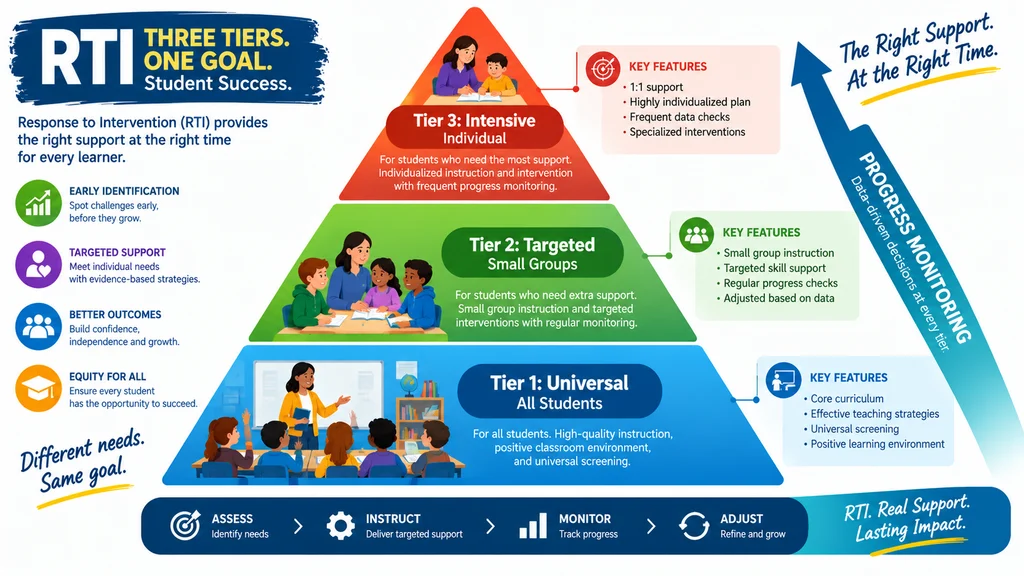
The best Response to Intervention examples use a three-tier framework to support struggling students. Tier 1 delivers high-quality instruction for all, Tier 2 provides targeted small-group support, and Tier 3 offers intensive individualized intervention. Top alternatives: RTI tiered instruction, MTSS framework, three-tier intervention model, early intervention strategies, and data-driven student support.
You’re staring at your class data, and one student’s scores keep dropping. You’ve tried differentiating instruction, offering extra help, and switching up your teaching methods. Nothing’s working. Now what?
That’s where Response to Intervention examples come in. RTI is the framework that schools use to identify struggling students early and provide increasingly intensive support before they fall too far behind . It’s not about labeling kids or waiting for them to fail. It’s about catching them before they slip through the cracks.
Whether you’re a teacher looking for practical strategies, a parent trying to understand what’s happening in your child’s classroom, or an educator building an RTI program, this guide breaks down every tier with real examples you can actually use. From peer tutoring to small-group instruction, here’s how RTI works in the real world.
Tier 1 Universal Instruction Examples
1. Differentiated phonics instruction for all students
Example: Use this when your whole class is working on decoding skills but some kids need extra support.
Meaning: Tier 1 provides high-quality core instruction that meets the needs of most students .
2. Peer mentoring during group reading activities
Example: Pair a struggling student with a peer mentor during literacy centers.
Meaning: Classroom scaffolding helps students access grade-level content .
3. Visual supports and graphic organizers for every lesson
Example: Provide these to all students during math problem-solving activities.
Meaning: Universal design helps everyone, especially those who process differently .
4. Daily check-ins with students who seem off
Example: Use this when you notice a student is withdrawn or acting differently.
Meaning: Early attention can prevent small issues from becoming big ones .
5. Flexible grouping based on ongoing assessment data
Example: Regroup students weekly based on exit tickets and formative assessments.
Meaning: Tier 1 isn’t static; it responds to what students actually need .
6. Explicit vocabulary instruction before every new unit
Example: Preview key terms with all students before introducing complex texts.
Meaning: Front-loading vocabulary supports comprehension for everyone .
7. Classroom behavior expectations reviewed regularly
Example: Use a Collaborate Board to have students share what helps their learning.
Meaning: Positive behavioral supports at Tier 1 reduce the need for more intensive intervention .
8. Small group instruction within the general classroom
Example: Rotate through centers where you work with 4-5 students at a time.
Meaning: Even Tier 1 includes some targeted attention .
9. Providing extra time or reduced assignments for struggling students
Example: Use this when a student needs more practice but doesn’t need different content.
Meaning: Simple accommodations keep students engaged with grade-level material .
10. Partner retell activities during reading
Example: Have students turn to a partner and summarize what they just read.
Meaning: Peer discussion reinforces comprehension for all learners .
11. Anonymous response opportunities during lessons
Example: Use digital tools that let shy students share answers without speaking up.
Meaning: Building confidence at Tier 1 prevents avoidance behaviors .
12. Cross-curricular connections in daily instruction
Example: Use science texts during reading time to reinforce both subjects.
Meaning: Integrated instruction maximizes learning opportunities .
Tier 2 Targeted Intervention Examples
1. Small group reading intervention three times per week
Example: Pull 5-6 students who need extra phonics practice for 30-minute sessions.
Meaning: Tier 2 serves 5-10% of students with targeted instruction .
2. Peer-assisted learning strategies (PALS) for comprehension
Example: Pair sixth-grade tutees with seventh-grade tutors for daily reading support.
Meaning: Cross-age tutoring has shown statistically significant reading gains .
3. Repeated reading with oral retell practice
Example: Have students read the same passage twice and then retell it aloud.
Meaning: Repeated reading builds fluency and comprehension .
4. Handwriting club focusing on pencil grip and letter formation
Example: Run a 30-minute weekly group for students with fine motor concerns.
Meaning: Tier 2 interventions can prevent unnecessary OT referrals .
5. Self-monitoring strategies for attention challenges
Example: Teach students to use silent silly faces or shoulder shrugs to refocus.
Meaning: Social-emotional skills can be taught in small groups .
6. Guided reading groups with leveled texts
Example: Meet with 3-4 students at similar reading levels for 20 minutes daily.
Meaning: Instruction matches where students actually are .
7. Vocabulary building activities for English language learners
Example: Use matching pairs or interactive games to reinforce new words.
Meaning: Targeted vocabulary support accelerates language acquisition .
8. Progress monitoring with weekly data collection
Example: Track each student’s fluency score every Friday to measure growth.
Meaning: Data drives decisions about continuing or changing interventions .
9. Explicit instruction in specific comprehension strategies
Example: Teach students to identify cause and effect using graphic organizers.
Meaning: Skill-specific instruction targets identified gaps .
10. Check-in/check-out systems for behavioral support
Example: Student checks in with a mentor each morning and reviews goals each afternoon.
Meaning: Regular accountability and encouragement support behavior change .
11. Math fact fluency drills with immediate feedback
Example: Use timed practice with error correction during intervention sessions.
Meaning: Building automaticity frees cognitive resources for problem-solving .
12. Reading fluency programs like HELPS
Example: Use scripted 15-minute 1:1 sessions for students needing fluency support.
Meaning: Evidence-based programs provide structured intervention .
Tier 3 Intensive Intervention Examples
1. Individualized instruction based on specific skill deficits
Example: Work one-on-one with a student on phonemic awareness for 45 minutes daily.
Meaning: Tier 3 serves 1-5% of students with the most intensive needs .
2. Functional Behavior Assessment (FBA) to understand root causes
Example: Conduct an FBA when a student’s behavior isn’t responding to Tier 2.
Meaning: Understanding why behavior happens guides effective intervention .
3. Behavior Intervention Plan (BIP) with customized strategies
Example: Create a plan that addresses triggers, replacement behaviors, and reinforcements.
Meaning: Tier 3 requires a customized, team-based approach .
4. Special education evaluation referral
Example: Refer a student for testing after they don’t respond to Tier 2 and Tier 3.
Meaning: RTI can identify learning disabilities early .
5. Intensive reading intervention four to five times per week
Example: Provide 45-minute sessions targeting specific decoding gaps.
Meaning: More time and intensity are hallmarks of Tier 3 .
6. One-on-one tutoring with a specialist
Example: Speech-language pathologist works individually with a student on narrative skills.
Meaning: Specialized expertise addresses complex needs .
7. Wrap-around planning with community agencies
Example: Coordinate school-based and community mental health services.
Meaning: Tier 3 addresses needs across settings .
8. Assistive technology for students with significant challenges
Example: Provide text-to-speech software for students with reading disabilities.
Meaning: Technology can bridge gaps while skills develop.
9. Extended time and modified assignments
Example: Reduce the number of problems while maintaining grade-level content.
Meaning: Access to learning matters more than quantity.
10. Daily progress monitoring with multiple data sources
Example: Track both behavior frequency and academic accuracy each day.
Meaning: Tier 3 requires at least two data sources .
11. Intensive social skills instruction
Example: Teach specific social scripts and practice in controlled settings.
Meaning: Behavioral needs require direct instruction.
12. Collaboration between general and special education teachers
Example: Co-plan instruction that addresses IEP goals and grade-level standards.
Meaning: Teamwork ensures comprehensive support.
Progress Monitoring Examples
1. Weekly reading fluency checks with one-minute timings
Example: Have students read a passage aloud for one minute and count correct words.
Meaning: Brief, frequent assessments track growth over time.
2. Behavior report cards completed daily
Example: Teacher rates student’s target behavior on a 1-5 scale each class period.
Meaning: Quantitative data shows whether intervention is working .
3. Exit tickets after every intervention session
Example: Students answer one question about what they learned before leaving.
Meaning: Immediate feedback informs next steps .
4. Retelling rubrics scored every two weeks
Example: Assess whether students capture salient ideas and sequence events.
Meaning: Rubrics provide consistent measurement .
5. Lexile growth tracking through Reading Inventory
Example: Compare beginning, middle, and end-of-year Lexile scores.
Meaning: Standardized measures show longitudinal progress .
6. Frequency counts for target behaviors
Example: Tally how often a student calls out during a 30-minute period.
Meaning: Objective data replaces subjective impressions .
7. Curriculum-based measurement probes
Example: Use grade-level passages to monitor reading progress weekly.
Meaning: CBM provides reliable, valid data for decision-making.
8. Digital dashboards tracking multiple data points
Example: Use programs like IXL that integrate assessment and instruction data.
Meaning: Technology streamlines progress monitoring .
9. Parent-reported homework completion tracking
Example: Parents check over assignments each evening and report completion.
Meaning: Home-school communication adds another data source .
10. Attendance and engagement records
Example: Track whether students attend at least 80% of intervention sessions.
Meaning: Fidelity of implementation matters for outcomes .
11. Pre- and post-intervention assessments
Example: Administer the same measure before and after a 6-week intervention cycle.
Meaning: Direct comparison shows intervention effectiveness.
12. Behavioral frequency counts with time sampling
Example: Observe a student every 5 minutes and record whether they’re on task.
Meaning: Systematic observation provides objective behavior data.
Data-Based Decision Making Examples
1. Moving students down a tier when they meet goals
Example: Return a student to Tier 1 after six weeks of successful Tier 2 intervention.
Meaning: RTI is fluid; students move in and out of tiers as needed .
2. Moving students up a tier when progress stalls
Example: Refer a student to Tier 3 after they show minimal response to Tier 2.
Meaning: Increased intensity matches persistent need .
3. Changing intervention strategies when data shows no growth
Example: Switch from repeated reading to a different fluency program.
Meaning: If it’s not working, try something else.
4. Extending intervention time when students are progressing slowly
Example: Continue Tier 2 for another six weeks to solidify gains.
Meaning: Some students need more time to respond .
5. Team meetings to review data and make decisions
Example: RTI team meets monthly to review progress monitoring data.
Meaning: Collaborative problem-solving ensures thoughtful decisions .
6. Using cut scores to determine tier placement
Example: Students scoring below the 20th percentile move to Tier 2.
Meaning: Objective criteria guide placement decisions .
7. Comparing individual progress to peer norms
Example: Check whether a student is closing the gap with grade-level peers.
Meaning: RTI aims to accelerate growth, not just maintain it .
8. Documenting intervention integrity
Example: Verify that interventions were delivered as designed at least 80% of the time.
Meaning: Fidelity matters for valid decision-making .
9. Involving parents in data review meetings
Example: Share progress graphs with families and discuss next steps together.
Meaning: Parent partnership strengthens intervention outcomes.
10. Considering multiple data sources before making referrals
Example: Review reading, behavior, and attendance data before special education referral.
Meaning: Comprehensive data prevents inappropriate referrals .
11. Setting specific, measurable goals for each intervention cycle
Example: Target increasing reading fluency from 40 to 60 words per minute.
Meaning: Clear goals make progress measurable.
12. Documenting the intervention history for each student
Example: Keep records of all Tier 1, 2, and 3 interventions attempted.
Meaning: Documentation supports special education eligibility decisions .
Behavioral RTI Examples
1. School-wide positive behavior expectations
Example: Teach and reinforce three simple rules: Be safe, be respectful, be responsible.
Meaning: Tier 1 behavior supports reduce the need for intensive intervention .
2. Class-wide behavior management systems
Example: Use a token economy where students earn points for meeting expectations.
Meaning: Consistent classroom management supports all students .
3. Small group social skills instruction
Example: Run a “Super Self” group teaching self-monitoring strategies.
Meaning: Tier 2 behavior intervention teaches specific skills .
4. Check-in/check-out for students needing extra support
Example: Student meets with a mentor each morning and afternoon to set and review goals.
Meaning: Regular accountability supports behavior change .
5. Behavior report cards with daily feedback
Example: Teachers rate behavior on specific dimensions each class period.
Meaning: Frequent feedback helps students track their own progress .
6. Functional behavior assessment for persistent challenges
Example: Conduct FBA when Tier 2 behavior interventions aren’t working.
Meaning: Understanding function guides effective intervention .
7. Behavior intervention plans with replacement behaviors
Example: Teach a student to ask for a break instead of disrupting class.
Meaning: Tier 3 behavior intervention replaces problem behavior with skills .
8. Wraparound planning with mental health services
Example: Coordinate with community therapists to align school and home supports.
Meaning: Comprehensive support addresses needs across settings .
9. Restorative practices for conflict resolution
Example: Use circles to repair harm and rebuild relationships.
Meaning: Addressing root causes prevents repeat incidents.
10. Sensory supports for students with regulation needs
Example: Provide fidget tools or movement breaks for students who need them.
Meaning: Meeting sensory needs reduces behavioral escalations.
11. Teaching self-advocacy skills
Example: Help students recognize when they need help and how to ask for it.
Meaning: Empowerment prevents frustration and acting out .
12. Data collection on behavior frequency and intensity
Example: Track how often and how severely problem behaviors occur.
Meaning: Objective data guides intervention decisions .
Early Intervention Examples
1. Universal screening in kindergarten for reading readiness
Example: Assess all kindergartners on letter naming and phonemic awareness in fall.
Meaning: Early identification prevents later struggles .
2. Pre-K narrative language assessment
Example: Use story retelling tasks to identify children who need language support.
Meaning: Early language intervention supports school readiness .
3. One-minute letter writing fluency checks
Example: Have kindergartners write as many lowercase letters as they can in one minute.
Meaning: Brief assessments can identify at-risk students early .
4. Dynamic tier placement based on immediate needs
Example: Place students directly in the tier they need rather than moving sequentially.
Meaning: Some research shows direct placement accelerates progress .
5. Winter and spring universal screenings
Example: Re-screen all students mid-year and end-of-year to catch new struggles.
Meaning: Ongoing screening identifies students who begin to struggle later .
6. Speech and language screening for all students
Example: Conduct brief screenings to identify communication concerns early.
Meaning: Early speech intervention prevents academic impacts.
7. Social-emotional screening in early grades
Example: Use teacher rating scales to identify students needing behavioral support.
Meaning: Early behavior intervention prevents escalation .
8. Parent-completed developmental questionnaires
Example: Send home surveys about language, motor, and social milestones.
Meaning: Parent input provides valuable developmental information.
9. Vision and hearing screenings before intervention
Example: Rule out sensory issues before assuming learning problems.
Meaning: Basic screenings prevent misidentification .
10. Kindergarten readiness assessments before school entry
Example: Assess incoming students to identify who may need additional support.
Meaning: Proactive planning supports successful transitions .
11. Progress monitoring starting in first grade
Example: Begin weekly fluency checks for students identified as at-risk.
Meaning: Early data collection informs timely intervention .
12. Avoiding the “wait to fail” model
Example: Intervene as soon as concerns arise rather than waiting for grade-level failure.
Meaning: RTI is designed to prevent, not just remediate .
Collaboration Examples
1. Teacher and speech-language pathologist co-planning
Example: Collaborate to differentiate narrative language instruction for at-risk students.
Meaning: Teamwork brings specialized expertise to general education .
2. RTI team meetings with multiple professionals
Example: Include teachers, specialists, and administrators in problem-solving discussions.
Meaning: Diverse perspectives lead to better intervention plans .
3. Parent-teacher conferences focused on intervention progress
Example: Share data and strategies with families to align home and school support.
Meaning: Parent partnership strengthens outcomes.
4. Cross-age tutoring programs
Example: Train older students to tutor younger students using structured protocols.
Meaning: Peer support benefits both tutors and tutees .
5. Grade-level team collaboration on intervention grouping
Example: Teachers within a grade level coordinate to maximize intervention time.
Meaning: Shared planning reduces duplication and gaps .
6. Special education and general education co-teaching
Example: Both teachers work together to support all students in inclusive settings.
Meaning: Collaboration ensures students receive appropriate support.
7. School psychologist involvement in Tier 3 planning
Example: Psychologist conducts evaluations and helps interpret data for intervention decisions.
Meaning: Specialized expertise guides intensive intervention .
8. Occupational therapist consultation for handwriting concerns
Example: OT trains teachers to lead handwriting clubs, reducing caseload pressure.
Meaning: Building capacity prevents unnecessary referrals .
9. Community agency coordination for wraparound services
Example: School and mental health providers align intervention plans across settings.
Meaning: Comprehensive support addresses the whole child .
10. Data sharing between grade-level teachers
Example: Teachers pass along intervention history when students move to the next grade.
Meaning: Continuity prevents starting over each year.
11. Professional development on evidence-based interventions
Example: Train staff on programs like HELPS or PALS to ensure fidelity.
Meaning: Effective implementation requires proper training .
12. Administrators providing time and resources for RTI
Example: Principals schedule daily RTI blocks and allocate intervention materials.
Meaning: Administrative support is essential for RTI success .
FAQ
What is Response to Intervention (RTI)?
RTI is a multi-tiered framework that schools use to identify struggling students early and provide increasingly intensive support. It focuses on prevention and data-based decision-making rather than waiting for students to fail .
What are the three tiers of RTI?
- Tier 1 is universal instruction for all students (80-90%). Tier 2 is targeted small-group intervention for some students (5-10%). Tier 3 is intensive individualized intervention for a few students (1-5%) .
How do students move between tiers?
Students move up a tier when progress monitoring shows they aren’t responding to current intervention. They move down a tier when they meet goals and demonstrate they can succeed with less support. RTI is fluid, not a one-way path .
What does “progress monitoring” mean in RTI?
Progress monitoring is the ongoing collection of data to determine whether students are benefiting from intervention. It uses brief, frequent assessments like weekly fluency checks or behavior report cards .
Can RTI be used for behavior as well as academics?
Yes. RTI frameworks apply to both academic skills and social-emotional/behavioral needs. School-wide positive behavior supports, small group social skills instruction, and functional behavior assessments are all RTI-aligned practices .
Conclusion
Response to Intervention examples show that supporting struggling students isn’t about waiting for them to fail. It’s about catching them early, providing the right level of support, and using data to guide every decision. From Tier 1 universal instruction to Tier 3 intensive intervention, RTI creates a safety net that keeps students from slipping through the cracks.
Whether you’re implementing peer tutoring, small group instruction, or functional behavior assessments, the key is matching support to student need. And when students respond to intervention, they build the skills and confidence they need to succeed.
Save this guide, share it with your team, and use these examples to strengthen your RTI practice. Every student deserves the right support at the right time.







One thought on “200+Best Response to Intervention Examples for Every RTI Tier For 2026”