

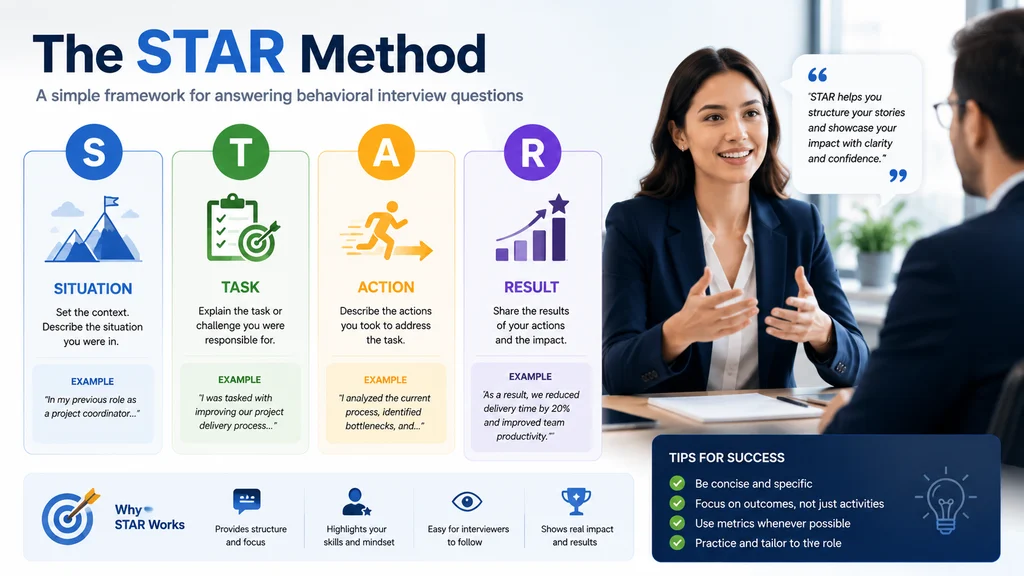
The STAR response method is your secret weapon for acing behavioral interview questions. This structured approach helps you craft compelling stories that showcase your skills and experience. Top alternatives: STAR interview technique, STAR framework, behavioral interview method, STAR format, and STAR storytelling approach.You’re sitting in the interview chair, palms slightly sweaty, and then the question comes: “Tell me about a time when you faced a challenge at work.” Your mind goes blank. Where do you even start? Sound familiar? Behavioral interview questions have a way of making even the most experienced professionals freeze up.
That’s where the STAR response method comes in. This simple but powerful framework (Situation, Task, Action, Result) transforms your scattered memories into clear, compelling stories that interviewers love. Whether you’re a recent graduate or a seasoned executive, mastering the STAR method can be the difference between getting the job and getting passed over.
Think of the STAR response method as your personal storytelling GPS, keeping you on track and ensuring you hit all the key points . It helps you organize your thoughts, highlight your achievements, and demonstrate exactly why you’re the perfect candidate .
STAR Method Basics
1. Start by setting the scene with a specific situation
Example: Use this when you need to provide context for your story.
Meaning: The Situation is where you describe the background and context of your example .
2. Clearly define the task you were responsible for
Example: Use this to explain what goal you were working toward.
Meaning: The Task identifies your specific role and responsibilities in the situation .
3. Focus on YOUR actions, not the team’s
Example: Use this when describing what you personally did to address the challenge.
Meaning: The Action should use “I” statements and highlight your individual contributions .
4. End with concrete results you achieved
Example: Use this to show the positive outcomes of your actions.
Meaning: The Result quantifies your success whenever possible .
5. Keep your STAR response to one to two minutes
Example: Use this to stay concise and maintain interviewer engagement.
Meaning: A strong STAR response is brief but comprehensive .
6. Use the STAR method for competency-based questions
Example: Use this when answering questions that start with “Tell me about a time”
Meaning: Behavioral questions require real-world examples to back up your claims .
7. Always include a positive result, even if the situation was negative
Example: Use this when discussing failures or challenges.
Meaning: Highlight what you learned or how you grew from the experience .
8. Be honest and authentic in your STAR responses
Example: Use this when sharing personal experiences.
Meaning: Interviewers can tell if you’re embellishing your stories .
9. Vary your examples across different areas of your life
Example: Use this to show a well-rounded skill set.
Meaning: Draw from work, academic, volunteer, and personal experiences .
10. Practice applying STAR to multiple experiences
Example: Use this to prepare for unexpected interview questions.
Meaning: Preparation makes the method feel natural and automatic .
11. Align your accomplishments with the job description
Example: Use this to tailor your responses to what the employer wants.
Meaning: Use keywords from the job posting in your STAR examples .
12. Use the STAR method in written applications too
Example: Use this for cover letters and selection criteria responses.
Meaning: STAR works for written and verbal communication .
Leadership Responses
1. I led a team that was struggling with low morale and falling behind deadlines
Example: Use this when asked about your leadership experience.
Meaning: Sets up a leadership challenge scenario .
2. My task was to boost team performance and hit our annual targets
Example: Use this to define the goal you were working toward.
Meaning: Shows you understand the importance of results .
3. I analyzed performance metrics and implemented a new training program
Example: Use this to describe your specific leadership actions.
Meaning: Demonstrates analytical and problem-solving skills .
4. We exceeded our targets and achieved the highest retention rate in five years
Example: Use this to show the impact of your leadership.
Meaning: Quantifiable results demonstrate effectiveness .
5. As captain, I set the goal of improving our team’s competition ranking
Example: Use this when asked about taking initiative.
Meaning: Shows you can set ambitious goals and achieve them .
6. I arranged for mentors to meet with us and increased practice frequency
Example: Use this to describe your strategic actions.
Meaning: Demonstrates resourcefulness and commitment .
7. We improved from last place to third in the regional competition
Example: Use this to show measurable improvement under your leadership.
Meaning: Quantifiable results that prove your leadership ability .
8. Our team was 15% below sales target and morale was low
Example: Use this to describe a leadership challenge.
Meaning: Sets up a difficult situation you had to address .
9. I restructured territory assignments to match individual strengths
Example: Use this to show strategic thinking.
Meaning: Demonstrates ability to optimize team performance .
10. We achieved a 30% performance increase by the third quarter
Example: Use this to quantify your leadership success.
Meaning: Hard numbers make your leadership story more powerful .
11. I facilitated brainstorming sessions to solve a crisis communication problem
Example: Use this when asked about problem-solving leadership.
Meaning: Shows collaborative leadership skills .
12. Our client navigated the crisis with minimal reputational damage
Example: Use this to demonstrate successful crisis management.
Meaning: Positive outcome from your leadership actions .
Teamwork Responses
1. Our group project team was struggling because one member wasn’t contributing
Example: Use this when asked about working in teams.
Meaning: Describes a common teamwork challenge .
2. I set up a meeting to understand her perspective and find a solution
Example: Use this to show proactive conflict resolution.
Meaning: Demonstrates communication and empathy .
3. We redistributed tasks to better match everyone’s skills and interests
Example: Use this to describe collaborative problem-solving.
Meaning: Shows ability to find win-win solutions .
4. The project was completed successfully and the professor gave positive feedback
Example: Use this to show the team’s successful outcome.
Meaning: Demonstrates you can contribute to team success .
5. Our diverse team was experiencing communication breakdowns
Example: Use this when asked about cross-cultural collaboration.
Meaning: Describes a complex team challenge .
6. I actively listened to each member’s perspective and concerns
Example: Use this to show your communication skills.
Meaning: Demonstrates empathy and active listening .
7. I translated complex ideas so everyone could understand
Example: Use this to show your role as a bridge between team members.
Meaning: Shows you can communicate across differences .
8. We completed the project on time and within budget
Example: Use this to show successful collaboration.
Meaning: Demonstrates you can work effectively in diverse teams .
9. Our team had a tight deadline with limited resources
Example: Use this to describe a challenging team environment.
Meaning: Sets up a situation requiring teamwork .
10. I organized regular meetings to track progress and address issues
Example: Use this to show your organizational contributions.
Meaning: Demonstrates proactive team management .
11. I used my proficiency in multiple languages to bridge communication gaps
Example: Use this to highlight unique value to the team.
Meaning: Shows how specific skills contribute to team success .
12. Team morale improved significantly and productivity increased
Example: Use this to demonstrate positive team outcomes.
Meaning: Shows you can improve team dynamics and performance .
Problem-Solving Responses
1. We were facing a critical performance issue with our app and a launch deadline
Example: Use this when asked about solving technical problems.
Meaning: Describes a high-stakes problem-solving scenario .
2. My task was to optimize the algorithm to improve app performance
Example: Use this to define the problem you needed to solve.
Meaning: Shows understanding of the technical challenge .
3. I used profiling tools to identify resource-intensive code sections
Example: Use this to describe your technical approach.
Meaning: Demonstrates analytical and debugging skills .
4. I reduced execution time by 70% and we met the deadline
Example: Use this to quantify your problem-solving success.
Meaning: Concrete results prove your technical ability .
5. The project was understaffed with a large backlog of work
Example: Use this when asked about managing workloads.
Meaning: Describes a resource-constrained problem .
6. I established a formal request procedure with time estimates
Example: Use this to describe your process improvement.
Meaning: Shows ability to create systems and procedures .
7. I organized regular meetings with account teams to manage expectations
Example: Use this to show proactive communication.
Meaning: Demonstrates ability to manage stakeholders .
8. We cut our average project timeline by four days
Example: Use this to show measurable process improvement.
Meaning: Quantifies your problem-solving impact .
9. Attendance at our events had dropped by 30% over three years
Example: Use this when asked about strategic problem-solving.
Meaning: Describes a business problem needing creative solutions .
10. I designed a new promotional packet and collected community feedback
Example: Use this to describe your creative solution.
Meaning: Shows innovation and customer focus .
11. We raised attendance by 18% in the first year
Example: Use this to show successful implementation.
Meaning: Quantifiable results demonstrate effectiveness .
12. I used cups and paper plates to create a makeshift funnel
Example: Use this to show creative thinking under pressure.
Meaning: Demonstrates resourcefulness and innovation .
Conflict Resolution Responses
1. There was a significant communication breakdown during project testing
Example: Use this when asked about handling conflict.
Meaning: Describes a conflict situation .
2. I had to resolve the conflict and keep the project on track
Example: Use this to define your role in resolving conflict.
Meaning: Shows you take responsibility for solutions .
3. I listened to all perspectives and realized we had different definitions
Example: Use this to show empathy and understanding.
Meaning: Demonstrates ability to identify root causes .
4. Through communication and understanding, we resolved the conflict
Example: Use this to show successful conflict resolution.
Meaning: Demonstrates diplomatic and communication skills .
5. A team member was missing meetings and not completing her work
Example: Use this when asked about handling underperformance.
Meaning: Describes a performance conflict situation .
6. I set up a meeting to discuss our concerns and understand her challenges
Example: Use this to show proactive, compassionate leadership.
Meaning: Demonstrates conflict resolution skills .
7. We redistributed tasks to better fit her skills and interests
Example: Use this to show collaborative problem-solving.
Meaning: Shows you can find solutions that work for everyone .
8. We completed the project successfully and received positive feedback
Example: Use this to show positive conflict resolution outcomes.
Meaning: Demonstrates you can turn conflict into success .
9. Account managers were imposing unreasonable targets on my team
Example: Use this when asked about cross-functional conflict.
Meaning: Describes a resource and expectation conflict .
10. I set clearer expectations by establishing a formal request procedure
Example: Use this to describe your systematic solution.
Meaning: Shows ability to create structure to prevent conflict .
11. I kept my staff updated on new procedures to address their concerns
Example: Use this to show transparency and communication.
Meaning: Demonstrates commitment to team welfare .
12. I learned the importance of clear communication across teams
Example: Use this to show what you learned from the experience.
Meaning: Demonstrates self-reflection and growth .
Initiative Responses
1. I noticed our event attendance had dropped significantly
Example: Use this when asked about taking initiative.
Meaning: Shows you’re observant and proactive .
2. I wanted to do something to improve these numbers
Example: Use this to define your personal goal.
Meaning: Shows internal motivation to make things better .
3. I designed new promotional materials and collected feedback forms
Example: Use this to describe your proactive actions.
Meaning: Demonstrates initiative and creativity .
4. We increased attendance by 18% in the first year
Example: Use this to show the impact of your initiative.
Meaning: Results prove the value of your proactive approach .
5. Our robotics team had placed last for three years straight
Example: Use this when asked about turning around a situation.
Meaning: Describes a challenge requiring initiative .
6. My goal as captain was to improve our competition ranking
Example: Use this to define your ambitious goal.
Meaning: Shows you’re not afraid to take on challenges .
7. I increased practice frequency and arranged for university mentors
Example: Use this to describe your strategic actions.
Meaning: Demonstrates leadership and resourcefulness .
8. We improved from last place to third in the competition
Example: Use this to show significant improvement.
Meaning: Quantifiable success from your initiative .
9. Our sales team was underperforming and morale was low
Example: Use this when asked about leading change.
Meaning: Describes a situation requiring initiative .
10. I analyzed performance metrics and identified improvement opportunities
Example: Use this to show analytical initiative.
Meaning: Demonstrates data-driven decision-making .
11. I implemented new training programs and strategy sessions
Example: Use this to describe your change initiatives.
Meaning: Shows you can drive improvement .
12. We achieved our highest customer retention rate in five years
Example: Use this to show outstanding outcomes from initiative.
Meaning: Demonstrates sustained impact .
Adaptability Responses
1. Three major events were scheduled within one month instead of spread out
Example: Use this when asked about handling change.
Meaning: Describes a sudden change in circumstances .
2. I had to manage logistics and preparation for all three events
Example: Use this to define your challenge.
Meaning: Shows ability to handle increased workload .
3. I analyzed potential returns and prioritized the most promising events
Example: Use this to describe your strategic adaptation.
Meaning: Shows ability to make tough decisions under pressure .
4. We focused resources on two events and executed them successfully
Example: Use this to show successful adaptation.
Meaning: Demonstrates ability to adapt to constraints .
5. It was pouring rain and we had to ensure no toxic runoff
Example: Use this when asked about handling unexpected situations.
Meaning: Describes an unforeseen challenge .
6. I needed to collect water samples from difficult-to-reach areas
Example: Use this to define your challenge.
Meaning: Shows ability to handle physical constraints .
7. I created a makeshift funnel using cups and paper plates
Example: Use this to describe your creative adaptation.
Meaning: Demonstrates resourcefulness and quick thinking .
8. We passed the tests and ensured facility safety
Example: Use this to show successful adaptation.
Meaning: Positive outcome from creative problem-solving .
9. The project timeline was compressed and required quick turnaround
Example: Use this when asked about handling urgency.
Meaning: Describes time pressure adaptation .
10. I created a detailed project plan with interim deadlines
Example: Use this to describe your organizational adaptation.
Meaning: Shows systematic response to urgent demands .
11. I presented my findings to management and got approval for changes
Example: Use this to show persuasive adaptation.
Meaning: Demonstrates ability to influence others .
12. We achieved all goals despite the compressed timeline
Example: Use this to show successful adaptation under pressure.
Meaning: Proves you can deliver results in challenging circumstances .
Communication Responses
1. I needed to persuade a team member to see things from my perspective
Example: Use this when asked about influence.
Meaning: Describes a communication challenge .
2. I prepared clear examples and data to support my position
Example: Use this to describe your persuasive approach.
Meaning: Shows preparation and evidence-based communication .
3. I listened actively to their concerns and addressed them directly
Example: Use this to show balanced communication.
Meaning: Demonstrates empathy and active listening .
4. We reached an agreement that satisfied both parties
Example: Use this to show successful communication.
Meaning: Positive outcome from effective persuasion .
5. I had to present complex technical information to non-experts
Example: Use this when asked about presenting to different audiences.
Meaning: Describes a communication challenge .
6. I translated complex ideas into language everyone could understand
Example: Use this to describe your simplification approach.
Meaning: Shows ability to communicate across expertise levels .
7. I used visual aids and analogies to make the concepts clearer
Example: Use this to describe your presentation techniques.
Meaning: Demonstrates effective communication methods .
8. The team understood the concepts and implemented the solution successfully
Example: Use this to show effective communication.
Meaning: Positive outcome from clear communication .
9. I had to provide difficult feedback to a team member
Example: Use this when asked about giving feedback.
Meaning: Describes a sensitive communication situation .
10. I scheduled a private meeting and discussed our concerns directly
Example: Use this to describe your feedback approach.
Meaning: Shows tact and professionalism .
11. I listened to her perspective and suggested changes to her tasks
Example: Use this to show collaborative feedback.
Meaning: Demonstrates empathy and problem-solving .
12. She became more engaged and contributed meaningfully to the project
Example: Use this to show successful feedback delivery.
Meaning: Positive outcome from effective communication .
Customer Service Responses
1. Our company was getting complaints about slow response times
Example: Use this when asked about customer service.
Meaning: Describes a customer service challenge .
2. I needed to improve customer satisfaction and reduce complaint levels
Example: Use this to define your goal.
Meaning: Shows understanding of customer priorities .
3. I developed a new process for handling complaints with my manager
Example: Use this to describe your improvement action.
Meaning: Shows initiative and process improvement .
4. We significantly reduced formal complaints and improved the work environment
Example: Use this to show customer service improvement.
Meaning: Quantifiable results demonstrate success .
5. A client was unhappy with our service delivery
Example: Use this when asked about handling upset customers.
Meaning: Describes a customer conflict .
6. My task was to resolve the issue and restore the client’s trust
Example: Use this to define your responsibility.
Meaning: Shows commitment to customer satisfaction .
7. I listened to their concerns and provided a proactive solution
Example: Use this to describe your customer handling.
Meaning: Demonstrates empathy and problem-solving .
8. The client renewed their contract and became a long-term partner
Example: Use this to show successful customer recovery.
Meaning: Positive outcome from effective service recovery .
9. We noticed long-term advertisers were not renewing contracts
Example: Use this when asked about customer retention.
Meaning: Describes a business problem .
10. My goal was to increase advertisers by 15% from the previous year
Example: Use this to define your target.
Meaning: Shows understanding of customer growth metrics .
11. I designed a new promotional packet and trained the sales team
Example: Use this to describe your customer acquisition approach.
Meaning: Shows strategic thinking and execution .
12. We signed contracts with 15 former advertisers and five new ones
Example: Use this to show successful customer growth.
Meaning: Quantifiable results demonstrate effectiveness .
Project Management Responses
1. Our advertising revenue was falling off and advertisers weren’t renewing
Example: Use this when asked about managing projects.
Meaning: Describes a revenue challenge .
2. My goal was to increase advertisers by at least 15%
Example: Use this to define your project objective.
Meaning: Shows you set specific, measurable goals .
3. I designed new promotional materials and trained the account executives
Example: Use this to describe your strategic actions.
Meaning: Demonstrates project planning and execution .
4. We increased new advertisers by 20% over the same period last year
Example: Use this to show project success.
Meaning: Quantifiable results prove project effectiveness .
5. We were facing a critical performance issue with a complex algorithm
Example: Use this when asked about technical projects.
Meaning: Describes a technical project challenge .
6. I needed to optimize the algorithm to ensure it was ready for release
Example: Use this to define your project goal.
Meaning: Shows understanding of deadlines and quality .
7. I used profiling tools and experimented with different data structures
Example: Use this to describe your technical actions.
Meaning: Demonstrates systematic problem-solving .
8. I reduced execution time by 70% and we met the deadline
Example: Use this to show project success.
Meaning: Quantifiable results demonstrate technical achievement .
9. We were understaffed with a large backlog of work
Example: Use this when asked about resource management.
Meaning: Describes resource constraints .
10. I established a formal request procedure with time estimates
Example: Use this to describe your process improvement.
Meaning: Shows systematic project management .
11. I organized regular meetings to review bandwidth and provide updates
Example: Use this to show communication and tracking.
Meaning: Demonstrates project monitoring skills .
12. We cut average project timeline by four days the next quarter
Example: Use this to show process improvement.
Meaning: Quantifiable results from your project management .
Personal Growth Responses
1. I realized I needed to improve my public speaking skills
Example: Use this when asked about personal development.
Meaning: Shows self-awareness and growth mindset .
2. I set the goal of becoming more confident in presentations
Example: Use this to define your personal development goal.
Meaning: Shows you take initiative for self-improvement .
3. I joined a Toastmasters group and volunteered to speak more often
Example: Use this to describe your growth actions.
Meaning: Shows proactive approach to skill development .
4. I became a confident presenter and now enjoy speaking engagements
Example: Use this to show personal growth success.
Meaning: Demonstrates successful personal development .
5. I realized I struggled with receiving and giving feedback
Example: Use this when asked about self-awareness.
Meaning: Shows honest self-reflection .
6. I wanted to improve my feedback skills to become a better team member
Example: Use this to define your improvement goal.
Meaning: Shows commitment to professional growth .
7. I read books on feedback and practiced giving constructive criticism
Example: Use this to describe your learning actions.
Meaning: Demonstrates proactive learning .
8. I became more comfortable with feedback and improved team communication
Example: Use this to show personal development.
Meaning: Positive outcome from personal growth efforts .
9. I recognized my emotions were affecting my productivity
Example: Use this when asked about emotional intelligence.
Meaning: Shows self-awareness of personal impact .
10. I wanted to manage my emotions better and remain productive
Example: Use this to define your improvement goal.
Meaning: Shows understanding of emotional impact on work .
11. I learned to recognize triggers and developed coping strategies
Example: Use this to describe your development actions.
Meaning: Shows proactive emotional intelligence development .
12. I became more productive and maintained positive relationships
Example: Use this to show personal growth outcomes.
Meaning: Positive results from emotional intelligence improvement .
FAQ
What does the STAR response method stand for?
STAR stands for Situation, Task, Action, and Result. It’s a structured way to answer behavioral interview questions by telling a clear, compelling story about your experience .
When should I use the STAR method?
Use STAR whenever you’re asked behavioral questions that start with “Tell me about a time” or “Give me an example of.” These questions assess how you’ve handled specific situations in the past .
How long should a STAR response be?
A strong STAR response typically lasts one to two minutes. Keep the situation and task brief, focus most of your time on the action and result .
What if I don’t have a perfect outcome?
Focus on what you learned from the experience. Even if the result wasn’t positive, highlight your growth and how you’d handle it differently .
Can I use STAR for written applications?
Absolutely. The STAR method works well for cover letters, selection criteria responses, and performance reviews .
Conclusion
The STAR response method is more than just an interview technique. It’s a powerful way to tell your professional story with clarity, confidence, and impact. By mastering this simple structure, you’ll never freeze up when asked behavioral questions again.
Remember, STAR is about showing, not just telling. Instead of saying “I’m a good leader,” you demonstrate it through a compelling story. Instead of claiming “I solve problems well,” you prove it with a concrete example. This is what makes STAR so effective .
Practice your STAR stories. Write them down. Refine them. And most importantly, be authentic. The best STAR responses come from real experiences where you genuinely made a difference.
Now go into your next interview with confidence. You’ve got the STAR response method in your toolkit, and you’re ready to shine. Good luck!







2 thoughts on “200+ Best STAR Response Method Examples for Interview Success Forb 2026”