

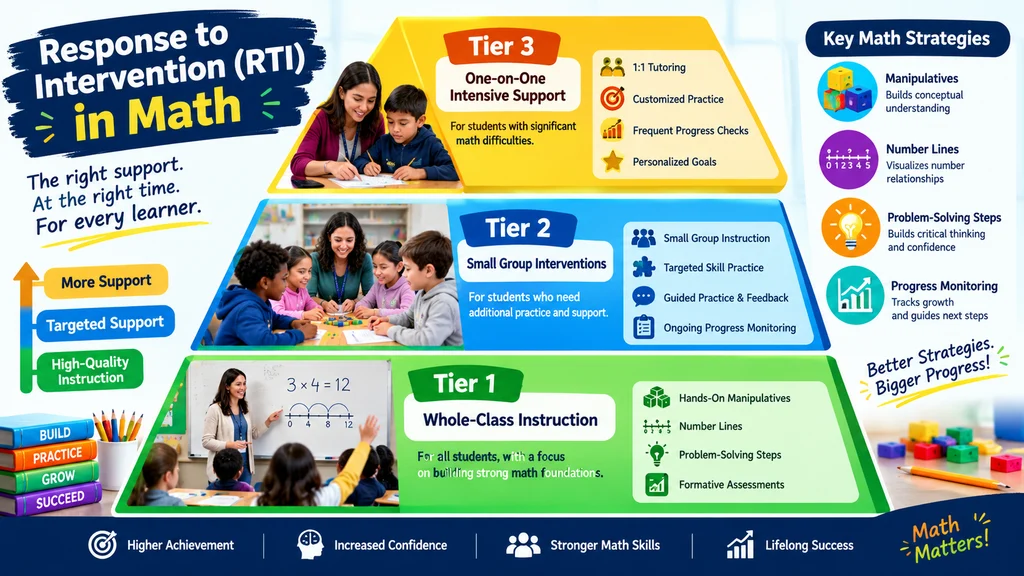
When it comes to response to intervention in math, having the right approach ready can turn a struggling student into a confident problem solver. Try these top tier-1 moves: “Let’s break this down together step by step”, “Show me your thinking process out loud”, “Which part feels tricky right now”, “Can you draw what this problem looks like”, or “Let’s try a different strategy and see what clicks”.
You know that moment when you’re working with a student and you can see the gears turning, but something’s just not clicking? Maybe they’re staring at a fraction problem like it’s written in another language, or they keep getting stuck on the same type of word problem. That’s where having the right response to intervention in math becomes your secret weapon. It’s not about having all the answers – it’s about knowing which strategies to pull out when things get tough.
The thing about math instruction is that one approach doesn’t fit everyone. Some kids need to see it visually, others need to hear it explained out loud, and some need to physically manipulate objects to understand the concept. Having a toolkit of different responses means you’re ready for whatever comes your way. Plus, it makes teaching way more fun when you can switch things up and keep students engaged. Let’s get into some practical strategies that actually work in real classrooms.
Explicit Instruction Responses
“Watch me solve this first, then you try the next one”
Example: When introducing a new type of problem that students haven’t seen before.
Meaning: Using demonstration and modeling to show clear steps before independent work.
“Let me think out loud while I work through this step”
Example: When you want to show the reasoning behind each move in a problem.
Meaning: Verbalizing thought processes through think-alouds to make thinking visible.
“I’m going to break this big problem into smaller chunks”
Example: When students feel overwhelmed by a complex multi-step problem.
Meaning: Using task analysis to make difficult tasks manageable.
“First we do this, then this, then this. Ready to try?”
Example: When students need a clear sequence for solving a specific type of problem.
Meaning: Providing systematic, step-by-step instruction in logical order.
“I noticed you did this part correctly. Let’s look at this next step together”
Example: When a student solves part of a problem but gets stuck later.
Meaning: Offering specific corrective feedback while acknowledging what they did right.
“Let me show you another way to think about this problem”
Example: When your first explanation didn’t quite land with a student.
Meaning: Using multiple approaches to explain the same concept for better understanding.
“Here’s where we’re going with this. See how each step builds?”
Example: When students need to understand the bigger picture of what they’re learning.
Meaning: Providing a roadmap of the lesson so students see connections.
“Tell me what you’re thinking as you work through this one”
Example: When you want to understand how a student is approaching a problem.
Meaning: Encouraging students to talk through their reasoning to identify misconceptions.
“Let’s practice this together a few times before you try alone”
Example: When students aren’t ready for independent work yet.
Meaning: Using guided and scaffolded practice to build confidence and skill.
“Remember yesterday’s lesson? This builds right on that”
Example: When introducing a concept that connects to previous learning.
Meaning: Providing cumulative review to reinforce retention and connections.
“I’m going to walk you through each step slowly. Just follow along”
Example: When a student is really struggling with a new concept.
Meaning: Breaking instruction down into very small, manageable pieces.
“You got the answer right! Now let’s look at how you got there”
Example: When a student solves correctly but might not understand the process.
Meaning: Focusing on process and reasoning rather than just the final answer.
Visual Representation Responses
“Can you draw a picture of what this problem is asking?”
Example: When students struggle to understand a word problem’s meaning.
Meaning: Using visual representations to make abstract concepts concrete.
“Let’s use these blocks to show what’s happening in the problem”
Example: When introducing place value or operations with concrete objects.
Meaning: Using manipulatives to build conceptual understanding before moving to abstract.
“What would this look like on a number line?”
Example: When working on counting, addition, subtraction, or comparing numbers.
Meaning: Using number lines as powerful visual tools for understanding magnitude.
“Let’s draw a diagram to organize the information in this problem”
Example: When students are confused by a complex word problem.
Meaning: Using strip diagrams or simple drawings to clarify information.
“Show me with blocks first, then we’ll write the numbers”
Example: When students need to connect concrete objects to abstract symbols.
Meaning: Moving from concrete to visual to abstract in a systematic way.
“I see you drew that. Now let’s add the numbers next to your drawing”
Example: When you want to bridge the gap between visual and symbolic representation.
Meaning: Connecting visual representations to mathematical notation.
“Let’s use a number line to check if our answer makes sense”
Example: When students need to verify their answers.
Meaning: Using visual tools for self-checking and validation.
“Can you make a chart or table for this data?”
Example: When working with patterns or organizing information.
Meaning: Using visual organization tools to understand relationships.
“These base ten blocks will help us see the place value”
Example: When teaching addition, subtraction, or place value concepts.
Meaning: Using concrete manipulatives to build foundational understanding.
“Draw what this fraction looks like as part of a whole”
Example: When introducing fractions and parts of a whole.
Meaning: Using visual fraction models to build conceptual understanding.
“Your drawing really helps show what’s happening here”
Example: When a student creates a helpful visual representation.
Meaning: Reinforcing the value of visual thinking in math.
“Now that you’ve drawn it, can you write the number sentence?”
Example: When transitioning from concrete/visual to abstract representation.
Meaning: Guiding students from visual understanding to symbolic expression.
Problem Solving Strategy Responses
“Let’s find the important information in this problem first”
Example: When students are overwhelmed by word problems with extra details.
Meaning: Teaching students to identify relevant information before solving.
“What is the problem asking us to find out?”
Example: When students start solving before understanding the question.
Meaning: Focusing on comprehension before computation.
“Can you retell the problem in your own words?”
Example: When you want to check if a student truly understands the problem.
Meaning: Using paraphrase to verify comprehension of problem context.
“Let’s make a plan before we start solving”
Example: When students jump into solving without a strategy.
Meaning: Teaching the importance of planning before executing.
“What strategy could we use for this type of problem?”
Example: When students have learned multiple problem-solving approaches.
Meaning: Encouraging strategic thinking and selection of appropriate methods.
“Let’s solve it using two different ways and see if we get the same answer”
Example: When you want to build confidence and verify understanding.
Meaning: Using multiple solution paths to reinforce concepts.
“What’s the first step you would take?”
Example: When you want to scaffold problem-solving for a struggling student.
Meaning: Breaking problem-solving into manageable first steps.
“I notice you’re stuck. Let’s go back to what we know”
Example: When a student reaches an impasse in solving.
Meaning: Using known information to work forward from what’s familiar.
“Try working backward from the answer to check your work”
Example: When students need to verify their solution.
Meaning: Teaching reverse verification as a problem-solving strategy.
“Does your answer make sense in the context of the problem?”
Example: When you want students to think critically about their solution.
Meaning: Encouraging reasonableness checking of answers.
“Let’s look at similar problems we’ve solved before”
Example: When students don’t see how to apply learned strategies to new problems.
Meaning: Building connections between new and prior knowledge.
“What if we changed the numbers? Would the strategy still work?”
Example: When you want students to see the generalizability of strategies.
Meaning: Promoting transfer of learning to different contexts.
Motivation and Encouragement Responses
“I noticed how hard you worked on that problem. Great effort!”
Example: When students put in genuine effort, even if they didn’t get the right answer.
Meaning: Praising effort and persistence rather than just correct answers.
“You almost had it! Let’s look at what tripped you up”
Example: When a student makes a small error near the end of a problem.
Meaning: Using near-success as a teaching moment.
“You’re getting better at this every time you practice”
Example: When you see improvement over time in a student’s work.
Meaning: Reinforcing the value of practice and growth.
“I love how you kept trying even when it got hard”
Example: When a student demonstrates persistence through difficulty.
Meaning: Valuing resilience in the learning process.
“See? You can do harder problems than you thought”
Example: When a student succeeds at something challenging.
Meaning: Building self-confidence through accomplishment.
“You’re making great progress. Let’s keep building on this”
Example: When you see consistent improvement in a student’s skills.
Meaning: Encouraging continued growth and learning.
“That was a smart way to approach that problem”
Example: When a student uses an effective strategy.
Meaning: Recognizing and reinforcing good problem-solving choices.
“I believe you can figure this out. Let’s work through it”
Example: When a student is discouraged by a difficult problem.
Meaning: Expressing confidence in the student’s abilities.
“Your hard work is really paying off”
Example: When you see tangible results from sustained effort.
Meaning: Connecting effort to achievement.
“That’s a tough one. I’m impressed with your persistence”
Example: When a student tackles a challenging problem.
Meaning: Acknowledging effort in the face of difficulty.
“Look how much you’ve improved since last week”
Example: When you want to build confidence through visible progress.
Meaning: Using concrete examples of growth to motivate.
“Keep going! You’re on the right track”
Example: When a student is making progress but needs encouragement.
Meaning: Offering support and positive reinforcement.
Tiered Intervention Responses
“Let’s try a small group session to really focus on this skill”
Example: When a student isn’t progressing with whole-class instruction alone.
Meaning: Moving from Tier 1 to Tier 2 targeted small-group support.
“I think you need some extra practice with this concept. Let’s work together”
Example: When you identify a specific area where a student needs more support.
Meaning: Offering supplemental instruction in addition to core lessons.
“We’re going to spend extra time on this skill because it’s really important”
Example: When you’re about to start an intervention session.
Meaning: Explaining the purpose of additional support positively.
“Let’s focus on just this one skill until you feel confident”
Example: When a student is overwhelmed by multiple areas needing improvement.
Meaning: Narrowing focus to build mastery in specific skills.
“I see you’re making progress. Let’s move to the next level”
Example: When a student has mastered current intervention material.
Meaning: Moving up within the tiered system when appropriate.
“This session is just for you and a few others who need extra time on this”
Example: When pulling a small group for targeted instruction.
Meaning: Normalizing the need for additional support.
“We’ll do some one-on-one practice with this topic until it clicks”
Example: When a student needs more intensive support than small group.
Meaning: Moving to Tier 3 individualized instruction when needed.
“Let me make this lesson more specific to what you need”
Example: When you’re personalizing instruction for a student’s particular needs.
Meaning: Tailoring intervention to individual student needs.
“We’re going to focus extra time on multiplication facts this month”
Example: When you’re planning a targeted intervention.
Meaning: Communicating the focus of intervention clearly.
“I think you’re ready to join the regular group for this lesson”
Example: When a student has caught up on a targeted skill.
Meaning: Moving a student from intervention back to core instruction.
“Let’s check your progress on this skill first, then we’ll plan our next steps”
Example: When you want to use data to guide intervention decisions.
Meaning: Using progress monitoring to inform instruction.
“I’m going to work with you individually on this specific skill”
Example: When a student needs the most intensive level of support.
Meaning: Providing one-on-one tutoring on targeted skills.
Assessment and Progress Monitoring Responses
“This quick check will help me see what you’ve learned so far”
Example: When you want to assess learning without a formal test.
Meaning: Using brief assessments to guide instruction.
“Don’t worry about getting it perfect. Just show me what you know”
Example: When students are anxious about assessment.
Meaning: Taking the pressure off assessment to get accurate information.
“Let’s see how you’re doing with this skill compared to last month”
Example: When you want to show progress over time.
Meaning: Using progress monitoring data to show growth.
“This will help me plan what we work on next”
Example: When explaining the purpose of assessment to students.
Meaning: Framing assessment as a tool for planning, not judgment.
“I can see from this work that you understand this concept”
Example: When analyzing a student’s assessment results.
Meaning: Using assessment data to identify strengths.
“Based on this, we need to spend more time on fractions”
Example: When assessment shows a gap in understanding.
Meaning: Using data to guide instructional decisions.
“Let me check this to see if you’re ready to move forward”
Example: When you want to determine next steps.
Meaning: Using assessment for readiness decisions.
“Your progress shows our intervention is working”
Example: When you see improvement from intervention efforts.
Meaning: Using data to validate instructional choices.
“Let’s use this quick assessment to see what you remember”
Example: When starting a new unit or after a break.
Meaning: Using assessment to check retention of prior learning.
“I’m going to track your progress on this skill each week”
Example: When you’re starting a long-term intervention.
Meaning: Setting up regular progress monitoring.
“The data shows you’ve mastered this. Let’s celebrate!”
Example: When a student reaches a milestone.
Meaning: Using progress data for positive reinforcement.
“Let’s look at your scores together and set a goal”
Example: When you want students to take ownership of their learning.
Meaning: Involving students in their own progress monitoring.
Vocabulary and Language Support Responses
“Let’s learn the math words we need for this lesson first”
Example: When the lesson involves new mathematical vocabulary.
Meaning: Pre-teaching vocabulary to support comprehension.
“What does this math word mean in your own words?”
Example: When you want to check student understanding of math vocabulary.
Meaning: Checking vocabulary comprehension with student-friendly language.
“This word means the same as what we call in everyday life”
Example: When connecting formal math vocabulary to everyday language.
Meaning: Making math vocabulary accessible through real-world connections.
“Let’s write down this new math word and what it means”
Example: When introducing important vocabulary.
Meaning: Creating a record of vocabulary for reference.
“Use this math word in a sentence about what we’re learning”
Example: When you want students to practice using new vocabulary.
Meaning: Encouraging active use of mathematical language.
“This word and this word mean almost the same thing in math”
Example: When vocabulary terms are related or similar.
Meaning: Clarifying relationships between math vocabulary terms.
“The word ‘product’ means the answer when we multiply”
Example: When connecting vocabulary to operations.
Meaning: Explaining vocabulary in the context of mathematical processes.
“Let’s review the vocabulary from yesterday before we continue”
Example: When building on previous learning.
Meaning: Cumulative review of mathematical language.
“I’ll say the math word, you show me what it means”
Example: When you want an interactive vocabulary check.
Meaning: Assessing vocabulary comprehension through action.
“What other words do we use that mean the same thing in math?”
Example: When building connections between related terms.
Meaning: Expanding vocabulary networks.
“Let me explain this term in simpler language”
Example: When a student is confused by formal math language.
Meaning: Rephrasing vocabulary for better understanding.
“We’ll keep using this word so you remember it”
Example: When emphasizing important vocabulary.
Meaning: Building vocabulary through repeated use.
Concrete-Representational-Abstract (CRA) Responses
“First we’ll use these blocks, then draw pictures, then use numbers”
Example: When introducing a new concept through the CRA sequence.
Meaning: Explaining the progression from concrete to visual to abstract.
“Now that you’ve used the blocks, let’s draw what you did”
Example: When moving from concrete to representational stage.
Meaning: Transitioning from manipulatives to visual representation.
“Your picture shows the same thing as the blocks. Now let’s use numbers”
Example: When moving from representational to abstract stage.
Meaning: Connecting visual representation to symbolic notation.
“Let’s use these blocks to build the problem”
Example: When students are struggling with abstract representations.
Meaning: Using concrete materials to build conceptual understanding.
“What would this look like as a drawing instead of using blocks?”
Example: When you want to start moving students toward visual representation.
Meaning: Transitioning from concrete to representational.
“Now write the number sentence that matches your picture”
Example: When students have created a visual representation.
Meaning: Connecting visual understanding to symbolic expression.
“Using blocks first helps us understand why we do the steps”
Example: When explaining the purpose of using manipulatives.
Meaning: Building understanding of why concrete tools are valuable.
“Draw a picture of what’s happening in the problem”
Example: When students are stuck on a problem.
Meaning: Using visual representation as a problem-solving strategy.
“Now that you understand with blocks, try solving without them”
Example: When students are ready to move away from concrete tools.
Meaning: Fading concrete supports toward independence.
“The blocks, the drawing, and the numbers all show the same thing”
Example: When connecting different representations of the same concept.
Meaning: Building connections between concrete, visual, and abstract.
“Let’s start with blocks to make sure we understand the idea”
Example: When beginning a new concept that will become more abstract.
Meaning: Building a strong conceptual foundation.
“Now you can solve these problems without blocks because you understand the concept”
Example: When students are ready to work independently at the abstract level.
Meaning: Moving to independence once conceptual understanding is solid.
Peer Support and Collaborative Responses
“Explain how you solved that to your partner”
Example: When you want students to share strategies with each other.
Meaning: Encouraging peer teaching and collaboration.
“Work together on this problem. Talk through each step”
Example: When you want students to practice verbalizing math reasoning.
Meaning: Using peer collaboration for verbal practice.
“Your partner is stuck. Can you help them get started?”
Example: When one student has understanding and another needs support.
Meaning: Encouraging peer scaffolding and support.
“Share your strategy with your group. There might be different ways to solve it”
Example: When you want students to see multiple solution approaches.
Meaning: Exposing students to diverse problem-solving strategies.
“Help your partner check their work. Tell them what they did right”
Example: When you want students to practice giving positive feedback.
Meaning: Building collaborative and supportive peer relationships.
“I want you to take turns being the teacher with your partner”
Example: When using peer tutoring in the classroom.
Meaning: Using reciprocal teaching roles for deeper understanding.
“Ask your partner why they chose that strategy”
Example: When you want to deepen understanding through questioning.
Meaning: Encouraging deeper discussion of math reasoning.
“Let’s share what our groups discovered”
Example: When you want to bring together learning from small groups.
Meaning: Sharing findings across the classroom community.
“Your partner needs you to explain the first step”
Example: When scaffolding for a specific student through peer support.
Meaning: Using peers as an additional layer of support.
“Work together to create a visual that shows your solution”
Example: When you want students to collaborate on representation.
Meaning: Building collaborative visual problem-solving.
“Take turns explaining each step to your partner”
Example: When practicing procedural fluency.
Meaning: Ensuring each partner gets practice verbalizing.
“What did you learn from your partner’s approach?”
Example: When you want students to reflect on collaborative learning.
Meaning: Promoting meta-cognition about peer learning experiences.
Questioning and Discussion Responses
“Why did you choose that strategy?”
Example: When a student solves correctly but you want to check their reasoning.
Meaning: Probing student thinking to assess understanding.
“How do you know your answer is correct?”
Example: When students rush to finish without checking their work.
Meaning: Encouraging self-verification and reflection.
“What’s another way to solve this problem?”
Example: When students have found one solution method.
Meaning: Promoting flexibility in problem-solving.
“Can you tell me what you’re thinking right now?”
Example: When a student seems stuck or uncertain.
Meaning: Making student thinking visible for better support.
“Where do you think you might have gotten off track?”
Example: When a student has an incorrect answer.
Meaning: Helping students identify their own errors.
“What do we already know that could help us with this problem?”
Example: When students don’t see connections to prior knowledge.
Meaning: Promoting connection-making and transfer.
“What part of the problem is confusing you?”
Example: When a student is struggling but can’t pinpoint the issue.
Meaning: Identifying specific points of confusion.
“How is this problem similar to the one we did yesterday?”
Example: When you want to build connections between lessons.
Meaning: Promoting transfer and connection of learning.
“What would happen if we tried it this way instead?”
Example: When students are following a procedure but may not understand why.
Meaning: Promoting exploration and deeper understanding.
“Can you explain your answer in a way that would help someone else?”
Example: When you want to deepen a student’s understanding through teaching.
Meaning: Using explanation as a tool for deepening understanding.
“Who has a different way to explain this concept?”
Example: When students need multiple explanations to understand.
Meaning: Exposing students to diverse explanations.
“How did you figure out where to start?”
Example: When students need help with problem initiation.
Meaning: Focusing on the beginning stages of problem-solving.
Flexible Grouping Responses
“Today we’re going to work in small groups based on what you need”
Example: When you’re grouping students for differentiated instruction.
Meaning: Using flexible grouping to target instruction.
“I’m pulling a small group for some extra practice with decimals”
Example: When you’re starting a Tier 2 intervention group.
Meaning: Organizing targeted small-group instruction.
“You’re ready to move to a different group because you’ve mastered this”
Example: When a student is ready to progress to more challenging work.
Meaning: Using flexible grouping for advancement.
“This group will work on fractions while the other group practices multiplication”
Example: When you’re differentiating instruction for different student needs.
Meaning: Using parallel instruction for different student groups.
“Let’s switch up our groups so you can work with different classmates”
Example: When you’re creating new groupings for variety.
Meaning: Building a collaborative classroom culture.
“Today you’ll work in a group with students who are working on the same skill”
Example: When grouping by need for efficiency.
Meaning: Using homogeneous grouping for targeted instruction.
“This group will focus on word problems today”
Example: When you’re targeting a specific skill area.
Meaning: Using group focus on particular math content.
“I’d like to work with this small group while others work independently”
Example: When you need to provide intensive support to some students.
Meaning: Using small-group time for direct teacher attention.
“You’ll rotate through different stations during math time”
Example: When using math workshop or center model.
Meaning: Using stations to provide varied experiences.
“In your small group, help each other when you get stuck”
Example: When you want to build peer support within groups.
Meaning: Creating collaborative group environments.
“We’ll change groups next week based on your progress”
Example: When you’re regularly adjusting groups based on data.
Meaning: Maintaining flexible groupings based on ongoing assessment.
“This group is working on problem solving with two-step problems”
Example: When you’re targeting a specific skill in a group.
Meaning: Focused group instruction on particular content.
Differentiation and Scaffolding Responses
“You’re ready for a challenge. Try these harder problems”
Example: When a student has mastered the current material.
Meaning: Providing enrichment for advanced students.
“Let’s start with an easier version, then build up”
Example: When a student is struggling with the full problem.
Meaning: Scaffolding by starting with simplified versions.
“I’ll give you a hint to get started”
Example: When a student is stuck but could solve with a small nudge.
Meaning: Providing minimal support to promote independence.
“Try solving this using the easier numbers we practiced”
Example: When a student understands the concept but struggles with computations.
Meaning: Adjusting numbers to focus on conceptual understanding.
“You can use your notes to help you with this one”
Example: When students need support with recall.
Meaning: Providing reference tools as scaffolding.
“Let’s work the first problem together, then you try the second”
Example: When you want to scaffold from teacher-led to independent.
Meaning: Gradual release of responsibility.
“Here’s a simpler problem that works the same way”
Example: When a student needs to see the pattern in a simpler context.
Meaning: Using simpler examples to reveal patterns.
“You have a choice between these two versions of the problem”
Example: When you want to give students choice in level of challenge.
Meaning: Offering differentiated choices.
“Let me give you just one piece of the problem to start”
Example: When a student is overwhelmed by multiple steps.
Meaning: Breaking problems into more manageable pieces.
“What tool or strategy would help you with this problem?”
Example: When you want students to take ownership of their learning.
Meaning: Teaching students to choose appropriate tools and strategies.
“You can try it on your own first, then we’ll work together if you need help”
Example: When you want to promote independence with a safety net.
Meaning: Encouraging independence while offering support.
“Next time, try starting with this step first”
Example: When you want to give students a specific strategy for future problems.
Meaning: Providing targeted strategy instruction.
FAQs
What exactly does “response to intervention in math” mean?
Response to intervention in math is a systematic approach that helps teachers identify and support students who are struggling with mathematical concepts. It uses a tiered system of support – starting with quality whole-class instruction (Tier 1), then moving to small group support (Tier 2), and finally one-on-one intensive intervention (Tier 3) for students who need the most help.
Can response to intervention in math work in any classroom?
Yes! The beauty of response to intervention in math is that it’s flexible and can be adapted to any classroom setting. Whether you’re teaching kindergarten or middle school, the basic principles of screening, progress monitoring, and tiered support work across all grade levels. The key is using data to guide your decisions about what each student needs.
What are the key strategies for effective response to intervention in math?
Research shows that effective response to intervention in math includes explicit instruction (clear, step-by-step teaching), visual representations (using drawings, number lines, manipulatives), systematic instruction (introducing concepts in a logical order), and frequent progress monitoring to track student growth. Combining these strategies creates a powerful approach to supporting all learners.
Is response to intervention in math only for students with disabilities?
Not at all! While response to intervention in math is incredibly helpful for students with learning disabilities, it’s actually a framework for supporting all students. The tiered approach means that students at every level get the support they need – whether that’s extra challenges for advanced students or additional practice for those who need it.
How can I get started with response to intervention in math in my classroom?
Start by focusing on your Tier 1 instruction – making sure your whole-class teaching is solid and engaging. Then, use quick screening assessments to identify students who might need extra support. From there, you can begin forming small groups for Tier 2 intervention and use progress monitoring to track how they’re doing. Remember to start small and build your system gradually!
Conclusion
Look, response to intervention in math isn’t just another education buzzword – it’s a practical, student-centered way to help every learner succeed. When you have a clear system for identifying needs, planning interventions, and monitoring progress, you’re not just teaching math; you’re building confident problem solvers who believe they can learn. The best part? You get to see those lightbulb moments when a student finally understands something they’ve been struggling with.
Remember, you don’t need to implement every strategy at once. Start with what feels manageable – maybe it’s adding more visual representations to your lessons, or using a simple progress monitoring tool. As you get comfortable, you can add more layers of support. Your students will thank you for it, and you’ll see the difference in their confidence and achievement. Now go make some math magic happen! And don’t forget to save this list for those moments when you need to adjust your approach on the fly.








12 thoughts on “200+ Response to Intervention in Math Strategies| Proven Tiered Support for Every Student For 2026”