

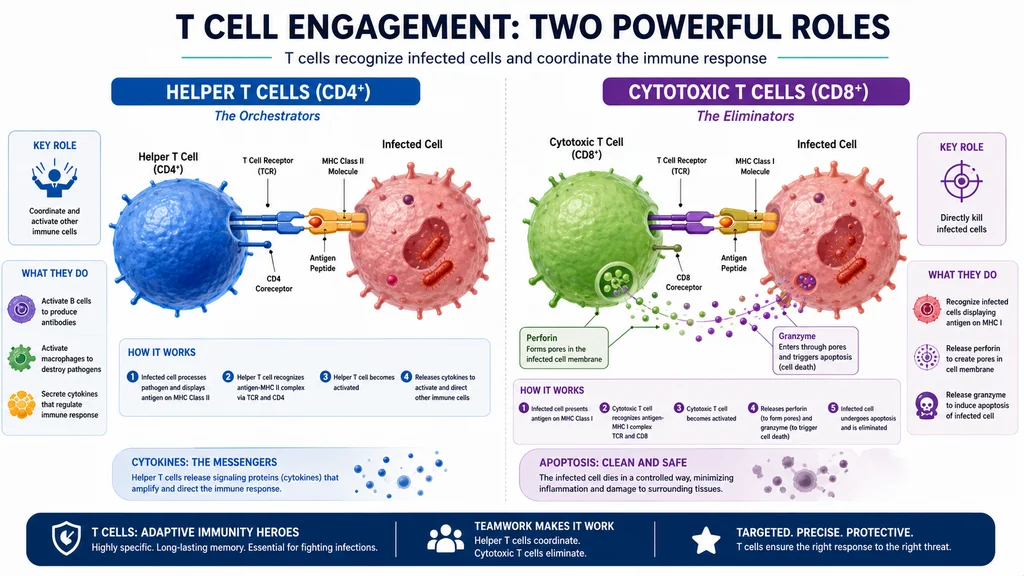
The cell-mediated immune response is the branch of adaptive immunity that uses T lymphocytes to destroy infected cells, cancer cells, and foreign tissue. Unlike humoral immunity, it targets intracellular threats directly. Top alternatives: T-cell immunity, cellular adaptive response, cytotoxic T-cell immunity, CD8+ T-cell response, and delayed-type hypersensitivity.
You’re studying for your immunology exam, and your brain is swimming. B cells, T cells, antibodies, MHC molecules, cytokines. It’s a lot to keep straight. But here’s the thing about the cell-mediated immune response: once you understand it, it actually makes perfect sense.
While humoral immunity uses antibodies to target threats outside your cells (like bacteria floating in your blood), cell-mediated immunity is the part of your immune system that goes after the bad guys hiding inside your cells . It uses specialized T cells to seek out and destroy virus-infected cells, cancer cells, and transplanted tissue . Think of it as the immune system’s special forces team that gets called in when the problem is inside the house rather than at the front door.
Whether you’re a medical student, biology major, or just someone who wants to understand how your body fights off viruses, knowing the ins and outs of the cell-mediated immune response is essential. Let’s break it down.
Understanding T-Cell Activation
1. T cells cannot recognize free antigens directly
Example: Use this when explaining why viruses hide inside cells.
Meaning: Antigens must be presented on MHC molecules for T cells to recognize them .
2. Antigen-presenting cells display fragments on MHC molecules
Example: Use this when describing how macrophages capture and present antigens.
Meaning: Think of the MHC molecule as a “silver platter” holding the antigen fragment .
3. T-cell receptors bind to specific antigen-MHC complexes
Example: Use this when discussing T-cell specificity.
Meaning: Each T-cell receptor is uniquely shaped to recognize a specific antigen .
4. CD4 cells are helper T cells that coordinate responses
Example: Use this when identifying different T-cell types.
Meaning: CD4 is typically found on helper T cells that activate other immune cells .
5. CD8 cells are cytotoxic T cells that kill infected cells
Example: Use this when discussing the effector cells of cell-mediated immunity.
Meaning: CD8 is found on cytotoxic T cells that directly destroy infected cells .
6. T-cell activation requires both antigen binding and costimulation
Example: Use this when explaining why T cells don’t activate on their own.
Meaning: Two signals are needed to fully activate a T cell.
7. Clonal expansion produces many identical T cells
Example: Use this when describing how the immune system amplifies its response.
Meaning: Selected T cells divide rapidly to create an army of cells .
8. Memory T cells provide long-lasting immunity
Example: Use this when explaining why you stay immune after an infection.
Meaning: Memory T cells remain in reserve for future encounters .
9. Helper T cells release cytokines to guide the response
Example: Use this when discussing coordination of the immune system.
Meaning: Signaling molecules called cytokines direct other immune cells .
10. Th1 cells activate macrophages and support cellular immunity
Example: Use this when explaining different helper T-cell subtypes.
Meaning: Th1 cells strengthen the cell-mediated response .
11. Th2 cells interact mainly with B cells
Example: Use this when contrasting Th1 and Th2 roles.
Meaning: Th2 cells stimulate antibody production from B cells .
12. Suppressor T cells downregulate the response
Example: Use this when explaining how the immune system turns off.
Meaning: Suppressor T cells inhibit the immune response once an infection is controlled .
Cytotoxic T-Cell Function
1. Cytotoxic T cells kill infected cells directly
Example: Use this when describing how viruses are eliminated.
Meaning: These cells destroy infected cells before viruses can replicate .
2. Perforins punch holes in target cell membranes
Example: Use this when explaining the mechanism of T-cell killing.
Meaning: Perforin molecules create pores in infected cells.
3. Granzymes enter cells through perforin pores
Example: Use this when describing how cytotoxic T cells kill.
Meaning: Granzymes are enzymes that trigger cell death .
4. Cytotoxic T cells induce apoptosis in target cells
Example: Use this when discussing programmed cell death.
Meaning: Infected cells are “programmed” to die in an orderly way .
5. Each cytotoxic T cell can kill multiple targets
Example: Use this when emphasizing their efficiency.
Meaning: One T cell can destroy many infected cells.
6. They are essential for antiviral immunity
Example: Use this when explaining why they matter.
Meaning: T cells are critical for controlling viral infections .
7. Cancer cells are also targeted by cytotoxic T cells
Example: Use this when discussing immune surveillance.
Meaning: The immune system can recognize and destroy abnormal cells.
8. Fas ligand-Fas interaction triggers cell death
Example: Use this when explaining alternative killing mechanisms.
Meaning: Direct contact between cells can trigger apoptosis .
9. Cytotoxic T cells recognize antigen on MHC class I
Example: Use this when explaining the specificity of killing.
Meaning: CD8 cells recognize antigens presented on MHC class I molecules .
10. They are called CD8-positive T cells
Example: Use this when identifying them by surface markers.
Meaning: CD8 is the characteristic marker on cytotoxic T cells .
11. They mediate rejection of transplanted tissues
Example: Use this when explaining transplant rejection.
Meaning: Cytotoxic T cells recognize foreign tissue as abnormal .
12. Interferons enhance cytotoxic T-cell activity
Example: Use this when discussing cytokine amplification.
Meaning: Cytokines from other cells strengthen the response .
Helper T-Cell Function
1. Helper T cells coordinate both cellular and humoral immunity
Example: Use this when describing their central role.
Meaning: They orchestrate the entire adaptive immune response .
2. CD4 cells recognize antigens on MHC class II
Example: Use this when explaining their recognition mechanism.
Meaning: Helper T cells see antigen on MHC class II molecules .
3. Helper T cells activate B cells for antibody production
Example: Use this when discussing cooperation between immune cells.
Meaning: B cells need T-cell help for most protein antigens .
4. They release cytokines that guide other immune cells
Example: Use this when explaining how they coordinate responses.
Meaning: Cytokines act as signaling molecules .
5. Th1 cells support cell-mediated immunity
Example: Use this when discussing inflammatory responses.
Meaning: Th1 cells promote destruction of intracellular pathogens .
6. Th2 cells support antibody-mediated immunity
Example: Use this when contrasting Th1 and Th2 responses.
Meaning: Th2 cells promote humoral immunity against extracellular pathogens .
7. They activate macrophages to kill ingested pathogens
Example: Use this when discussing macrophage function.
Meaning: T-cell cytokines enhance macrophage killing capacity .
8. Helper T cells are critical for immunity to tuberculosis
Example: Use this when discussing intracellular bacterial infections.
Meaning: Mycobacterium infections require cell-mediated immunity .
9. They promote proliferation of cytotoxic T cells
Example: Use this when explaining how the response amplifies.
Meaning: Helper T cells provide signals for T-cell growth .
10. Cytokines include interferon-gamma and IL-2
Example: Use this when listing important signaling molecules.
Meaning: These are key cytokines involved in T-cell responses.
11. T-cell-B-cell cooperation involves direct contact
Example: Use this when describing the mechanism of help.
Meaning: Physical interaction between cells is required .
12. Helper T cells can differentiate into memory cells
Example: Use this when discussing long-term immunity.
Meaning: Memory helper T cells provide faster future responses .
Antigen Presentation
1. Antigen-presenting cells capture and process pathogens
Example: Use this when describing how immunity starts.
Meaning: Professional APCs capture and break down antigens .
2. Dendritic cells are the most efficient APCs
Example: Use this when discussing antigen presentation.
Meaning: Dendritic cells excel at activating T cells .
3. Macrophages also function as antigen-presenting cells
Example: Use this when describing the roles of phagocytes.
Meaning: Macrophages can process and present antigens .
4. MHC molecules display antigen fragments on cell surfaces
Example: Use this when explaining how T cells see antigens.
Meaning: MHC molecules act as antigen display platforms .
5. MHC class I presents antigens to CD8 T cells
Example: Use this when explaining the division of labor.
Meaning: Class I is recognized by cytotoxic T cells .
6. MHC class II presents antigens to CD4 T cells
Example: Use this when explaining the division of labor.
Meaning: Class II is recognized by helper T cells .
7. Antigens from inside the cell use MHC class I
Example: Use this when explaining viral antigen presentation.
Meaning: Viruses inside cells present their antigens on class I .
8. Antigens from outside the cell use MHC class II
Example: Use this when explaining how extracellular antigens are handled.
Meaning: Phagocytosed antigens are presented on class II .
9. MHC molecules must match for T-cell recognition
Example: Use this when discussing transplant compatibility.
Meaning: T cells recognize self-MHC plus foreign antigen .
10. B cells can also act as antigen-presenting cells
Example: Use this when describing B-cell functions.
Meaning: B cells capture antigens and present them to T cells .
11. T-cell receptors bind both peptide and MHC
Example: Use this when explaining T-cell specificity.
Meaning: TCR recognizes the combination of antigen plus MHC .
12. Cross-presentation allows some APCs to use both pathways
Example: Use this when discussing specialized presentation.
Meaning: Some dendritic cells can present on both class I and class II .
Cytokines in Cell-Mediated Immunity
1. Interleukin-2 promotes T-cell proliferation
Example: Use this when explaining T-cell growth.
Meaning: IL-2 is a key growth factor for T cells.
2. Interferon-gamma activates macrophages
Example: Use this when describing macrophage activation.
Meaning: IFN-gamma enhances macrophage killing capacity .
3. Cytokines signal through specific cell receptors
Example: Use this when explaining how cytokines work.
Meaning: Target cells have receptors for specific cytokines.
4. TNF-alpha contributes to inflammation
Example: Use this when discussing inflammatory responses.
Meaning: TNF-alpha is important for immune defense and inflammation.
5. Macrophage chemotactic factor attracts phagocytes
Example: Use this when describing how cells are recruited.
Meaning: This factor brings macrophages to infection sites .
6. Migration inhibition factor holds cells at the site
Example: Use this when explaining how immune cells stay in place.
Meaning: MIF prevents macrophages from migrating away .
7. Cytokines can have positive and negative effects
Example: Use this when discussing immune regulation.
Meaning: Some cytokines enhance while others suppress responses.
8. IL-12 promotes Th1 differentiation
Example: Use this when explaining how T-cell subsets form.
Meaning: IL-12 pushes T cells toward a Th1 phenotype.
9. IL-4 promotes Th2 differentiation
Example: Use this when explaining alternative pathways.
Meaning: IL-4 pushes T cells toward a Th2 phenotype.
10. Cytokine balance determines immune response type
Example: Use this when discussing immune regulation.
Meaning: The cytokine environment shapes the nature of the response.
11. T-cell exhaustion can occur in chronic infections
Example: Use this when explaining immune failure.
Meaning: Overstimulated T cells can become exhausted .
12. Cytokine storms can cause tissue damage
Example: Use this when discussing harmful immune responses.
Meaning: Excessive cytokines can lead to pathology .
Antigen Recognition
1. T-cell receptors are membrane-bound molecules
Example: Use this when explaining how T cells detect antigens.
Meaning: TCR is permanently attached to the T-cell surface .
2. TCR diversity is generated through gene rearrangement
Example: Use this when explaining T-cell specificity.
Meaning: Recombination creates millions of different receptors .
3. Each T-cell expresses one unique receptor
Example: Use this when discussing T-cell clonality.
Meaning: Each T cell is specific for a single antigen .
4. The TCR complex includes CD3 molecules
Example: Use this when explaining signaling mechanisms.
Meaning: CD3 transmits signals after antigen recognition .
5. Coreceptors like CD4 and CD8 assist in recognition
Example: Use this when discussing MHC restriction.
Meaning: CD4 and CD8 bind to MHC molecules .
6. TCR-MHC interaction is highly specific
Example: Use this when explaining the specificity of adaptive immunity.
Meaning: Only certain peptides fit certain TCRs.
7. Antigen recognition initiates intracellular signaling
Example: Use this when describing T-cell activation.
Meaning: TCR engagement triggers signal transduction.
8. Signaling leads to T-cell activation and proliferation
Example: Use this when explaining the T-cell response.
Meaning: Signals trigger gene expression and cell division.
9. Helper T cells need costimulatory signals
Example: Use this when explaining why T cells need multiple signals.
Meaning: Costimulation prevents inappropriate activation .
10. Cytotoxic T cells require less costimulation
Example: Use this when comparing T-cell subsets.
Meaning: CD8 cells have different activation requirements.
11. Costimulation through CD28 is important
Example: Use this when explaining T-cell activation mechanisms.
Meaning: CD28-B7 interaction provides necessary signals .
12. Inhibitory receptors like CTLA-4 regulate T cells
Example: Use this when explaining immune regulation.
Meaning: CTLA-4 dampens T-cell responses .
Immunity to Intracellular Pathogens
1. Cell-mediated immunity targets viruses inside infected cells
Example: Use this when explaining why T cells are essential.
Meaning: Antibodies cannot reach viruses inside cells .
2. Bacteria like Mycobacterium require cellular immunity
Example: Use this when discussing intracellular bacteria.
Meaning: Mycobacterium tuberculosis survives inside macrophages .
3. Fungi can also trigger cell-mediated responses
Example: Use this when describing other pathogens.
Meaning: Some fungi are controlled by T-cell immunity.
4. Protozoan parasites may require cellular immunity
Example: Use this when discussing parasitic infections.
Meaning: Some parasites live inside host cells.
5. T cells are critical for controlling tuberculosis
Example: Use this when discussing a major disease.
Meaning: TB requires strong cellular immunity .
6. Viral infections are controlled by cytotoxic T cells
Example: Use this when explaining antiviral defense.
Meaning: T cells kill infected cells to stop viral replication .
7. Latent viruses require ongoing immune surveillance
Example: Use this when discussing chronic infections.
Meaning: T cells keep latent viruses in check.
8. Immunocompromised people are vulnerable to intracellular pathogens
Example: Use this when explaining clinical importance.
Meaning: T-cell defects lead to susceptibility .
9. T-cell immunity is enhanced by vaccination
Example: Use this when discussing vaccine strategies.
Meaning: Vaccines can stimulate cellular immunity.
10. Some vaccines prioritize T-cell responses
Example: Use this when discussing vaccine design.
Meaning: Certain diseases need cellular immunity for protection.
11. Intracellular pathogens hide from antibodies
Example: Use this when explaining the advantage of cell-mediated immunity.
Meaning: Pathogens inside cells avoid antibody detection.
12. T cells recognize infected cells by altered surface markers
Example: Use this when explaining how infected cells are detected.
Meaning: Infected cells display foreign antigens on MHC .
Delayed-Type Hypersensitivity
1. DTH is a cell-mediated immune reaction
Example: Use this when discussing hypersensitivity types.
Meaning: DTH is caused by T cells, not antibodies .
2. Contact dermatitis is an example of DTH
Example: Use this when providing a common example.
Meaning: Poison ivy reactions are delayed-type hypersensitivity .
3. Tuberculin skin testing detects T-cell memory
Example: Use this when discussing diagnostic tests.
Meaning: Skin tests measure cell-mediated immunity to tuberculosis .
4. DTH reactions take 24-48 hours to develop
Example: Use this when explaining the “delayed” part.
Meaning: T-cell reactions are slower than antibody reactions .
5. Macrophages are the primary cells in DTH lesions
Example: Use this when describing DTH histology.
Meaning: Macrophages accumulate at the site of DTH reactions .
6. Cytokines recruit inflammatory cells to the site
Example: Use this when explaining DTH mechanisms.
Meaning: Chemokines and cytokines attract immune cells .
7. DTH can cause tissue damage in some diseases
Example: Use this when discussing pathology.
Meaning: Excessive DTH responses can damage tissues .
8. Type IV hypersensitivity includes DTH and contact dermatitis
Example: Use this when classifying hypersensitivity.
Meaning: DTH is a form of Type IV hypersensitivity .
9. Transplant rejection is partly DTH-mediated
Example: Use this when explaining transplant complications.
Meaning: T cells contribute to allograft rejection .
10. Autoimmune diseases can involve DTH mechanisms
Example: Use this when discussing autoimmune pathology.
Meaning: Self-reactive T cells can cause tissue damage .
11. DTH is a form of cell-mediated effector response
Example: Use this when discussing T-cell functions.
Meaning: Effector T cells cause the hypersensitivity response.
12. Desensitization can reduce DTH reactions
Example: Use this when discussing treatment.
Meaning: Gradual exposure can reduce sensitivity .
NK Cells and Other Non-T Effectors
1. Natural killer cells kill tumor and virus-infected cells
Example: Use this when describing innate cellular immunity.
Meaning: NK cells can destroy targets without prior sensitization .
2. NK cells are part of the innate immune system
Example: Use this when distinguishing from adaptive immunity.
Meaning: NK cells don’t require antigen presentation for activation.
3. NK cells are large granular lymphocytes
Example: Use this when identifying NK cells.
Meaning: They have distinct morphology under the microscope.
4. They have receptors that recognize missing self
Example: Use this when explaining NK cell activation.
Meaning: NK cells kill cells with reduced MHC expression.
5. Antibody-dependent cell-mediated cytotoxicity uses NK cells
Example: Use this when explaining antibody cooperation.
Meaning: NK cells kill antibody-coated target cells .
6. ADCC is an important antitumor mechanism
Example: Use this when discussing cancer immunity.
Meaning: Antibodies can direct NK cells to tumor cells .
7. NK cells are less specific than T cells
Example: Use this when comparing NK and T cells.
Meaning: They recognize broad patterns rather than specific antigens.
8. NK cells release perforins and granzymes like T cells
Example: Use this when explaining killing mechanisms.
Meaning: They use similar molecules to destroy target cells.
9. Cytokines can activate NK cells
Example: Use this when discussing NK cell regulation.
Meaning: IL-12 and interferon enhance NK cell function.
10. NK cells are important in viral defense early in infection
Example: Use this when explaining innate antiviral immunity.
Meaning: They provide early protection before T cells respond.
11. K cells are involved in ADCC
Example: Use this when discussing antibody-dependent killing.
Meaning: K cells have Fc receptors for antibodies .
12. NK cells can recognize stress-induced surface markers
Example: Use this when explaining how they detect abnormal cells.
Meaning: Stressed cells express molecules that activate NK cells .
Cellular Interactions and Cooperation
1. T-cell-B-cell cooperation is essential for most antibody responses
Example: Use this when discussing antibody production.
Meaning: T helper cells help B cells make antibodies to proteins .
2. Macrophages bridge innate and adaptive immunity
Example: Use this when describing the immune system connection.
Meaning: Macrophages present antigens to T cells.
3. Dendritic cells are the most effective antigen presenters
Example: Use this when identifying the best APCs.
Meaning: Dendritic cells excel at activating T cells.
4. T-cell-macrophage interactions are mutually stimulatory
Example: Use this when explaining immune amplification.
Meaning: T cells activate macrophages, which in turn support T cells.
5. MHC-restricted recognition ensures T-cell specificity
Example: Use this when explaining how T cells work.
Meaning: T cells recognize antigen only on self-MHC .
6. B cells can act as antigen-presenting cells
Example: Use this when describing B-cell functions.
Meaning: B cells capture antigen and present it to T cells .
7. CD4 T cells help CD8 T cells develop
Example: Use this when explaining cytotoxic T-cell generation.
Meaning: Helper T cells support the development of killer T cells .
8. CD8 T cells also help activate B cells
Example: Use this when discussing T-cell roles.
Meaning: Some cytotoxic T cells can provide B-cell help.
9. Regulatory T cells control immune responses
Example: Use this when explaining immune regulation.
Meaning: Tregs suppress overactive immune responses .
10. IL-2 from helper T cells promotes T-cell growth
Example: Use this when explaining cytokine functions.
Meaning: IL-2 is a critical T-cell growth factor.
11. Contact-dependent signaling is important in cooperation
Example: Use this when explaining how cells communicate.
Meaning: Cells need physical contact for some interactions.
12. Immune synapse formation allows efficient signaling
Example: Use this when describing T-cell interactions.
Meaning: Specialized contact zones enhance communication.
Clinical Applications
1. Immunosuppressants target T cells in transplant patients
Example: Use this when discussing transplantation.
Meaning: Drugs like cyclosporine inhibit T-cell activation .
2. Autoimmune diseases result from T-cell dysregulation
Example: Use this when explaining autoimmune pathology.
Meaning: T cells can attack self-antigens in autoimmunity .
3. CD4 count monitors HIV progression
Example: Use this when discussing HIV/AIDS.
Meaning: HIV depletes CD4 helper T cells .
4. Cancer immunotherapy uses T-cell activation
Example: Use this when discussing cancer treatment.
Meaning: Checkpoint inhibitors enhance T-cell antitumor activity.
5. CAR-T cells are engineered to target cancer
Example: Use this when discussing modern cancer therapy.
Meaning: T cells are genetically modified to kill tumor cells.
6. Vaccines aim to generate memory T cells
Example: Use this when discussing vaccine design.
Meaning: Memory T cells provide long-term protection.
7. Immunodeficiency increases susceptibility to infections
Example: Use this when explaining clinical importance.
Meaning: T-cell defects lead to increased infection risk.
8. T-cell defects can be congenital or acquired
Example: Use this when discussing immune deficiencies.
Meaning: Both genetics and diseases can affect T cells.
9. Allergy can involve T-cell-mediated hypersensitivity
Example: Use this when discussing allergic reactions.
Meaning: Some allergies involve T-cell responses.
10. Corticosteroids suppress T-cell activation
Example: Use this when explaining treatment mechanisms.
Meaning: Steroids are immunosuppressive for T cells.
11. Chemotherapeutic agents can affect T-cell numbers
Example: Use this when discussing cancer treatment effects.
Meaning: Chemotherapy can cause immune suppression.
12. Thymus function decreases with age
Example: Use this when discussing immune aging.
Meaning: T-cell production declines as we age .
FAQ
What is the cell-mediated immune response?
The cell-mediated immune response is the branch of adaptive immunity that uses T lymphocytes to target and destroy cells that are infected with pathogens, cancerous, or foreign. It does not use antibodies like humoral immunity does .
What are the main types of T cells involved?
The main T cells are helper T cells (CD4 cells) that coordinate the response, and cytotoxic T cells (CD8 cells) that directly kill infected or abnormal cells .
How do T cells recognize antigens?
T cells cannot recognize free antigens directly. Instead, they recognize antigen fragments presented on major histocompatibility complex (MHC) molecules on the surface of antigen-presenting cells .
What is the difference between humoral and cell-mediated immunity?
Humoral immunity uses antibodies produced by B cells to neutralize extracellular pathogens, while cell-mediated immunity uses T cells to destroy cells that harbor intracellular pathogens, such as viruses or some bacteria .
How do cytotoxic T cells kill infected cells?
Cytotoxic T cells release molecules such as perforins, which create pores in the target cell membrane, and granzymes, which enter the cell to trigger apoptosis, or programmed cell death .
Conclusion
The cell-mediated immune response is your body’s internal defense system, targeting threats that hide inside your cells where antibodies can’t reach. Understanding the roles of helper T cells, cytotoxic T cells, antigen presentation, and cytokines reveals the incredible coordination of your immune system.
This type of immunity is crucial for fighting viral infections, controlling tuberculosis, and even combating cancer. From basic biology students to medical professionals, grasping the cell-mediated immune response explains how our bodies protect us from the most challenging pathogens.
Remember, it’s the T cells that make the difference when a virus has already entered your cells. They seek out, attack, and destroy the threat at its source.







3 thoughts on “ 50+ Best Cell-Mediated Immune Response Explanations for Students For 2026”