

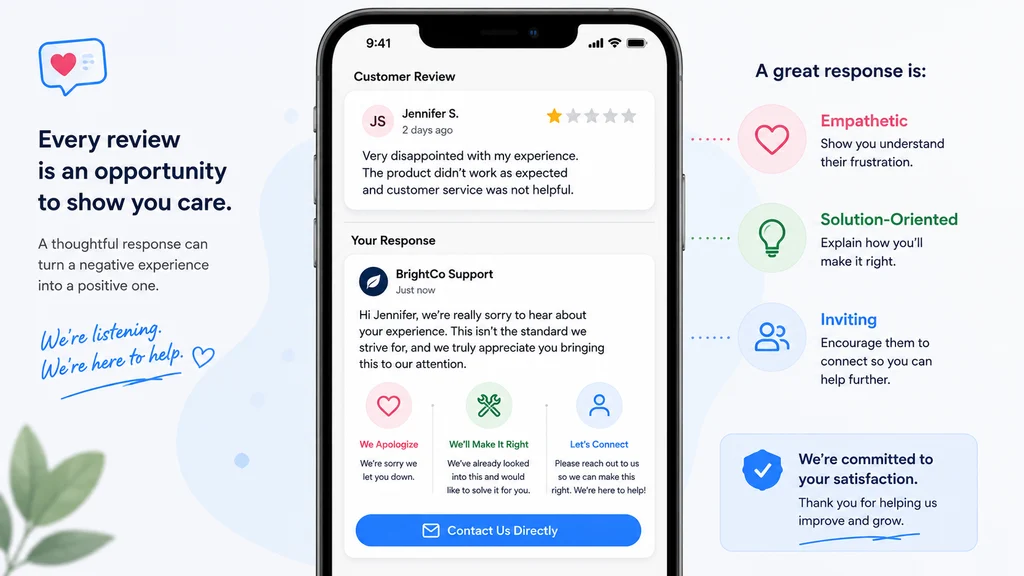
The best response to a bad review acknowledges the customer's frustration, apologizes sincerely, offers a solution, and invites private follow-up. This shows future customers you care about feedback and are committed to improvement . Top alternatives: Professional complaint handling, customer feedback resolution, negative review management, reputation recovery response, and service recovery communication.You’ve just received that notification. A one-star review. Your stomach drops, your face gets hot, and your first instinct is to type out a defensive reply explaining why the customer is wrong.
But here’s the thing about responding to bad reviews: that angry reply you want to write isn’t for the reviewer. It’s for every potential customer who will read it later . They’re watching to see how you handle criticism. They want to know if you’re the kind of business that listens, cares, and fixes problems.
The right response to a bad review example can actually strengthen your reputation more than a five-star review ever could . It shows you’re human, you’re accountable, and you’re dedicated to making things right. Whether you run a restaurant, an online store, or a service business, these response templates will help you turn complaints into opportunities.
Professional Responses
1. Thank you for sharing your feedback with us. We’re sorry to hear about your experience.
Example: Use this as your standard opening for any negative review.
Meaning: Starts with gratitude and empathy, showing you take their feedback seriously .
2. We sincerely apologize that your experience didn’t meet expectations.
Example: Use this when you need to acknowledge a clear service failure.
Meaning: Expresses genuine regret without necessarily admitting full fault .
3. This isn’t the standard we aim to provide, and we’re disappointed too.
Example: Use this to align with the customer’s feelings about a poor experience.
Meaning: Shows you hold yourself to high standards and share their disappointment .
4. We take all comments seriously and are reviewing this with our team.
Example: Use this when you need time to investigate what happened.
Meaning: Demonstrates accountability and commitment to improvement .
5. We’d appreciate the opportunity to make things right.
Example: Use this to open the door for resolution.
Meaning: Shows proactive willingness to solve the problem .
6. Please contact us directly so we can discuss this further.
Example: Use this to move sensitive details to a private conversation.
Meaning: Allows you to resolve complex issues without public back-and-forth .
7. We’ve sent you a follow-up email to address your concerns directly.
Example: Use this when you already have their contact information.
Meaning: Shows you’re taking immediate action without asking them to do more work.
8. We’re implementing changes to prevent this from happening again.
Example: Use this when the complaint reveals a genuine system issue.
Meaning: Demonstrates you’re learning from feedback and improving .
9. Thank you for bringing this to our attention. Your feedback helps us improve.
Example: Use this to reframe criticism as a gift.
Meaning: Shows gratitude for the opportunity to grow .
10. We value your business and are committed to ensuring a positive experience.
Example: Use this to reaffirm your dedication to customer satisfaction.
Meaning: Ends on a positive, forward-looking note .
11. I’m the owner, and this is not the business I want to run.
Example: Use this for especially serious complaints where personal accountability matters.
Meaning: Shows genuine personal investment in fixing problems .
12. We’d love to show you what we’re about on a different day.
Example: Use this when the customer had an off experience but the issue isn’t systemic.
Meaning: Invites them to give you another chance .
Empathetic Responses
1. I read your review and I’m genuinely sorry for what happened.
Example: Use this when the customer clearly had a painful experience.
Meaning: Shows you understand the emotional impact of their complaint .
2. I completely understand why you’d feel that way.
Example: Use this to validate their feelings before offering a solution.
Meaning: Makes the customer feel heard and understood .
3. That shouldn’t have happened, and we’re sorry it did.
Example: Use this for clear-cut mistakes with no excuse.
Meaning: Direct acknowledgment without defensiveness .
4. Your frustration is completely justified given what you experienced.
Example: Use this when the customer’s anger is understandable.
Meaning: Validates their emotions without blaming anyone .
5. I can only imagine how disappointing that must have been.
Example: Use this for situations where you wish you could undo the experience.
Meaning: Shows deep empathy and understanding .
6. You deserved better than what you received.
Example: Use this to acknowledge the gap between expectation and reality.
Meaning: Humble admission that you fell short .
7. We dropped the ball, and there’s no excuse for that.
Example: Use this for clear failures where you take full responsibility.
Meaning: Direct ownership of mistakes .
8. I’m worried to hear that an issue is preventing you from using our product.
Example: Use this instead of “I’m sorry” to signal action-oriented concern.
Meaning: “Worry” implies you’ll do something about it .
9. Your experience doesn’t match the one we want anyone to have.
Example: Use this to align your intentions with their expectations.
Meaning: Shows you care about the outcome for all customers .
10. I know “won’t be returning” is probably where you are right now.
Example: Use this when a customer says they won’t come back.
Meaning: Acknowledges their pain without trying to change their mind immediately .
11. That evening deserved better, and so did you.
Example: Use this for special occasions like anniversaries or birthdays.
Meaning: Acknowledges the importance of what they were celebrating .
12. I’m truly sorry we let you down.
Example: Use this as a simple, heartfelt closing.
Meaning: Direct personal apology without excuses.
Service-Failure Responses
1. I’m sorry your order took longer than promised.
Example: Use this for shipping or delivery delays.
Meaning: Acknowledges the frustration of waiting .
2. We’ve refunded your shipping cost and are reviewing our courier’s performance.
Example: Use this when shipping delays are caused by third-party issues.
Meaning: Takes responsibility and provides compensation .
3. We’ve sent a replacement today and flagged the issue with our supplier.
Example: Use this for product quality complaints.
Meaning: Shows immediate action to fix the problem .
4. Losing a reservation is inexcusable. We’re overhauling how we log reservations.
Example: Use this for booking or scheduling errors.
Meaning: Addresses the root cause openly .
5. We didn’t respond to your emails, and that’s on us.
Example: Use this for customer service failures.
Meaning: Acknowledges communication gaps .
6. A damaged order is bad. A week of silence from our team is worse.
Example: Use this for compounded failures.
Meaning: Acknowledges that multiple things went wrong .
7. We’re adding clearer care instructions to our packaging.
Example: Use this when customers miss important product information.
Meaning: Takes responsibility for making information more accessible .
8. We’re looking at making delivery times clearer before checkout.
Example: Use this when customers misunderstand shipping windows.
Meaning: Improves transparency based on feedback .
9. We’re reviewing our fulfillment process to prevent this.
Example: Use this for mistakes in order processing.
Meaning: Shows systemic improvement .
10. We’ll fix it today. Not look into it, not escalate it. Fix it.
Example: Use this for promises that need immediate action.
Meaning: Direct commitment to resolution .
11. We appreciate the honest feedback. It helps us improve our shipping process.
Example: Use this when feedback leads to process changes.
Meaning: Shows that feedback creates positive change .
12. We’ve updated packaging to prevent damage reported here.
Example: Use this when multiple customers have the same issue.
Meaning: Demonstrates you listen to recurring feedback .
Disagreement Responses
1. We’ve checked our records and can’t find an order matching these details.
Example: Use this when you can’t verify the customer’s claim.
Meaning: States facts neutrally without calling them a liar .
2. Our product page and care label both recommend hand washing.
Example: Use this when a customer damages a product by not following instructions.
Meaning: States facts while softening the blame .
3. This description doesn’t match anything we can find on our end.
Example: Use this for suspicious or potentially fake reviews.
Meaning: Calmly presents your side without confrontation .
4. If there’s something we missed, please reach out so we can understand.
Example: Use this to keep the door open despite disagreement.
Meaning: Leaves room for the customer to provide more information .
5. We’d genuinely like to resolve this if there’s been a mix-up.
Example: Use this for potential order confusion.
Meaning: Offers help even if you’re not sure it’s your responsibility .
6. I’ve checked your order and it arrived on day 12 of the stated window.
Example: Use this when a customer complains about timing that was clearly communicated.
Meaning: Corrects misinformation while acknowledging their frustration .
7. The facts are on the record for anyone reading.
Example: Use this when you need to set the record straight publicly.
Meaning: Preserves your reputation while staying professional .
8. We know that estimate is easy to miss when you’re keen to get your order.
Example: Use this to soften a correction with empathy.
Meaning: Gives the customer an out while protecting your record .
9. Our door and our ears are genuinely open if you’d like to discuss further.
Example: Use this to end a disagreement on a positive note.
Meaning: Invites further conversation without conceding facts .
10. We’d welcome the opportunity to understand more about your visit.
Example: Use this for situations where the complaint seems inaccurate.
Meaning: Shows willingness to learn rather than win the argument .
11. If the review was intended for another store, we’d appreciate it being updated.
Example: Use this when a review seems mistaken.
Meaning: Gently suggests they might have the wrong business .
12. We aim to provide a consistent and positive experience, so it’s disappointing to hear this.
Example: Use this when you disagree but want to stay professional.
Meaning: States your standards while acknowledging their complaint .
Solution-Oriented Responses
1. Please DM us your order number, and we’ll prioritize a replacement.
Example: Use this to offer a specific solution privately.
Meaning: Makes it easy for customers to get help .
2. We would like to make this right. Please email support@company.com.
Example: Use this to move the conversation to private channels.
Meaning: Allows for detailed resolution without public airing .
3. We’ll arrange a replacement or refund as quickly as possible.
Example: Use this for product issues.
Meaning: Gives customers a clear choice and timeline .
4. If you’d like to discuss this further, please feel free to contact us.
Example: Use this to invite private follow-up.
Meaning: Keeps the conversation open .
5. Please reach out to me personally at owner@company.com with your order number.
Example: Use this to offer personal attention.
Meaning: Shows you’re accessible and accountable .
6. We’d be happy to offer a discount or discuss a replacement.
Example: Use this when the customer may be partly at fault.
Meaning: Offers good will without full refund .
7. I’d be happy to help you resolve this.
Example: Use this as a positive opening statement.
Meaning: Moves from apology to action .
8. We’ll work with you to find a solution that works for everyone.
Example: Use this for complex complaints.
Meaning: Shows willingness to collaborate on resolution .
9. Please reply to the email we’ve just sent to arrange your refund.
Example: Use this to initiate the process without waiting for them.
Meaning: Shows proactive problem-solving .
10. We’re looking into it and will follow up with you directly.
Example: Use this when you need more time to investigate.
Meaning: Sets expectations while taking action .
11. I’ll fix it today and will follow up with you directly.
Example: Use this for clear, simple issues.
Meaning: Promises immediate action .
12. If you’re happy to share a bit more detail, please contact us directly.
Example: Use this when the complaint is vague.
Meaning: Asks for information to solve the problem .
Courteous Responses
1. Thank you for taking the time to share your feedback.
Example: Use this as your opening for any negative review.
Meaning: Shows appreciation even for negative feedback .
2. We sincerely appreciate you bringing this to our attention.
Example: Use this to acknowledge the value of their input.
Meaning: Reframes criticism as a favor .
3. Thank you for your honest feedback. It helps us improve.
Example: Use this to show you value transparency.
Meaning: Treats feedback as a gift .
4. We value your business and hope to have the opportunity to serve you better.
Example: Use this to close your response positively.
Meaning: Leaves the door open for future business .
5. Thank you for letting us know. We’re sorry for the trouble.
Example: Use this as a simple, direct opening.
Meaning: Shows appreciation and apology together .
6. Honest reviews are extremely helpful for other merchants.
Example: Use this when asking customers to update a revised review.
Meaning: Shows you value feedback for the community .
7. We really appreciate you taking the time to share your experience.
Example: Use this to start on a positive note.
Meaning: Shows you don’t just ignore negative feedback .
8. Thank you for the detail. That shouldn’t have happened.
Example: Use this to acknowledge specific complaints.
Meaning: Shows you read carefully and agree .
9. We appreciate your patience as we work through this issue.
Example: Use this when resolution takes time.
Meaning: Acknowledges their role in the process .
10. Thanks again for choosing us, and we hope to see you again.
Example: Use this to close on an optimistic note.
Meaning: Shows you want their business despite the issue .
11. We truly appreciate the opportunity to make this right.
Example: Use this when you’re grateful for a second chance.
Meaning: Shows humility and appreciation .
12. Your contribution helps us improve every day.
Example: Use this when thanking them for feedback.
Meaning: Makes their feedback feel valuable .
Direct and Honest Responses
1. I’m genuinely sorry. We dropped the ball entirely.
Example: Use this for clear, undeniable mistakes.
Meaning: Direct apology without excuses .
2. There’s no defense for any of it.
Example: Use this when multiple things went wrong.
Meaning: Acknowledges the full scope of the failure .
3. You’re right, and we should have done better.
Example: Use this when the customer makes a valid point.
Meaning: Agrees fully with their complaint .
4. That’s frustrating, especially when you needed it for a specific date.
Example: Use this for time-sensitive issues.
Meaning: Shows you understand the urgency .
5. We know that’s easy to miss, so we’re fixing it.
Example: Use this when information was technically available but unclear.
Meaning: Takes responsibility for clarity .
6. A damaged order is bad. A week of silence is worse.
Example: Use this for compounded failures.
Meaning: Acknowledges the severity of their experience .
7. I know “won’t be returning” is probably where you are.
Example: Use this when a customer says they’re leaving.
Meaning: Shows you understand their finality .
8. This is not the business I want to run.
Example: Use this to take personal accountability.
Meaning: Shows you’re committed to improvement .
9. We’re adding clearer care instructions. That’s our fault.
Example: Use this when the customer missed important information.
Meaning: Takes responsibility for clarity issues .
10. It arrived on day 12 of the stated window. But I get why it felt slow.
Example: Use this to correct with understanding.
Meaning: States facts with empathy .
11. I’d be worried too if that happened to me.
Example: Use this to show genuine understanding.
Meaning: Builds connection through shared feeling .
12. That’s not the experience we want anyone to have.
Example: Use this to close a complaint.
Meaning: Shows your commitment to better outcomes .
FAQ
What is the best way to respond to a bad review?
The best response thanks the customer, acknowledges their frustration, apologizes, offers a solution, and invites private follow-up. Keep it short and professional .
Should I apologize even if I don’t think I’m wrong?
Yes. You’re apologizing for their experience, not necessarily admitting fault. An empathetic apology like “I’m sorry this happened to you” acknowledges their feelings without taking blame .
How long should my response to a bad review be?
Three to five sentences is usually enough. The response should be professional and show you read their feedback, but not overly detailed .
What if the review is fake or from someone who never shopped with me?
State the facts neutrally and offer to investigate further. You can also flag the review with the platform if it violates their policies .
Should I offer compensation for every bad review?
Not necessarily. Offer compensation when you’re genuinely at fault. For minor issues or misunderstandings, a professional apology and invitation to discuss further may suffice .
Conclusion
Your response to a bad review is a public statement about your business. It tells every potential customer who reads it exactly what they can expect if something goes wrong. A thoughtful, professional reply can actually strengthen your reputation more than ignoring the complaint ever could .
Remember, you’re not just writing to the reviewer. You’re writing to every future customer who’s deciding whether to trust your business. When you respond with empathy, accountability, and a clear path to resolution, you’re showing them that you care. And that matters more than any five-star review.
Save this guide, adapt these examples to your brand voice, and start turning complaints into opportunities. The next time a bad review comes in, you’ll be ready.







4 thoughts on “150+ Best Response to Bad Review Examples for Every Situation For 2026”