

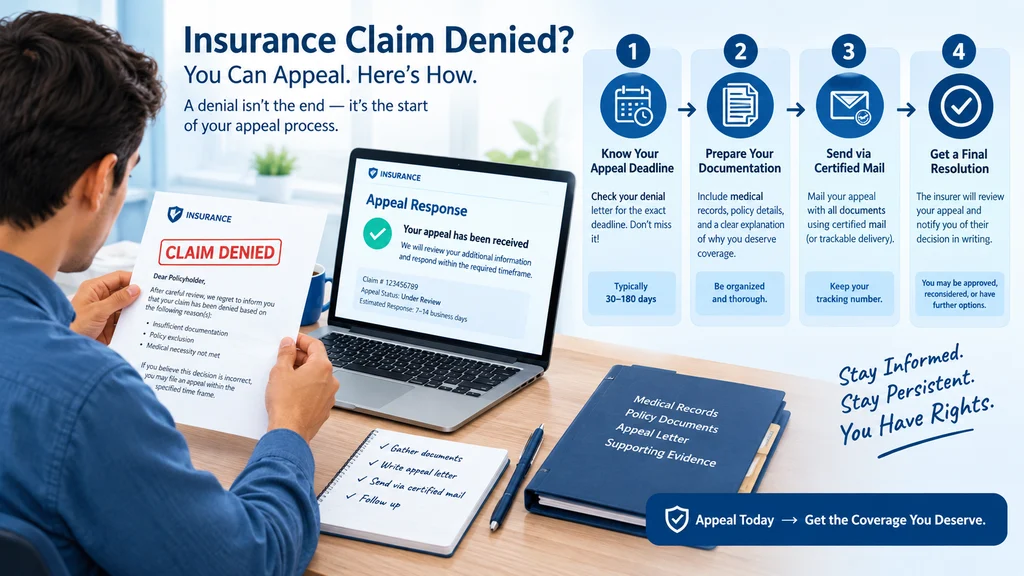
The best response to an insurance company involves reviewing the denial letter, gathering all documentation, writing a clear factual response, and sending it via certified mail. Always note appeal deadlines and maintain a professional tone. Top alternatives: claim denial appeal, insurance company response letter, policyholder dispute process, reserve rights response, and complaint resolution procedure.
Whether you’re dealing with a claim denial, a reservation of rights letter, or a request for information, having the right response strategy is essential. From acknowledging receipt of your claim within required timeframes to building a credible appeal, these strategies will help you navigate the process .
Claim Denial Responses
1. Review the denial letter thoroughly before responding
Example: Use this when you first receive a denial letter.
Meaning: Read every line carefully to understand the specific reason for denial .
2. Find the appeal deadline and mark it on your calendar
Example: Use this immediately after receiving a denial.
Meaning: Missing the deadline can forfeit your right to appeal .
3. Compare the denial language to your actual policy wording
Example: Use this to build your response case.
Meaning: Insurers may misinterpret or misapply policy exclusions .
4. Write a response that takes apart each argument they made
Example: Use this when crafting your appeal letter.
Meaning: Credibly analyze their basis for denial and prove them wrong .
5. Close your response with a clear demand for payment
Example: Use this to end your appeal letter.
Meaning: Put the ball back in their court with “We’ve complied with all requests, please confirm coverage” .
6. Send your response via certified mail with return receipt
Example: Use this for all important correspondence.
Meaning: Creates a paper trail proving you met the deadline .
7. Include a dedicated folder with all relevant documentation
Example: Use this when compiling your appeal packet.
Meaning: An organized, complete file strengthens your case .
8. Maintain a professional and calm tone throughout
Example: Use this in all written correspondence.
Meaning: Avoid emotional language; stick to the facts .
9. Ask for an extension if you need more time to respond
Example: Use this when you can’t meet the deadline.
Meaning: Communicate early to avoid defaulting on the timeline.
10. Request additional information if their denial is vague
Example: Use this when the denial lacks specific policy references.
Meaning: Insurers must provide detailed reasons for denial .
11. Acknowledge receipt of the denial within the required timeframe
Example: Use this for formal correspondence.
Meaning: Insurers must acknowledge claims within 30 days in most states .
12. Consider legal representation for complex denials
Example: Use this when the legal details get complicated.
Meaning: Insurance policies are dense; attorneys can interpret fine print .
Reservation of Rights Responses
1. Don’t ignore a reservation of rights letter
Example: Use this when you receive this notice.
Meaning: Many risk managers do nothing, but active response is strongly recommended .
2. Draft a response disagreeing with the reservation
Example: Use this to protect your position.
Meaning: There’s no requirement to respond, but it’s highly recommended to preserve your rights .
3. Compare the letter language to your policy wording
Example: Use this during your initial review.
Meaning: Check if their reservation is actually supported by policy terms .
4. Reserve all your rights in your response letter
Example: Use this when you respond to their reservation.
Meaning: Include language that you’re reserving your own rights under the policy .
5. A well-thought-out response can save you money
Example: Use this to motivate a timely reply.
Meaning: In many jurisdictions, you must specifically disagree to reject cost recovery .
6. Continue cooperating with the insurer despite disputes
Example: Use this when coverage is in dispute.
Meaning: Failure to cooperate can be a breach and result in loss of coverage .
7. Don’t make admissions without discussing with an attorney
Example: Use this before sending any response.
Meaning: Admissions can prejudice your position .
8. A response should be factual and avoid emotional language
Example: Use this when drafting your letter.
Meaning: Stick to facts to avoid drawing negative inferences .
9. Understand your obligations in claims management
Example: Use this when navigating coverage disputes.
Meaning: Know your contractual obligations even during disagreements .
10. Respond within a reasonable time to avoid prejudice
Example: Use this when deciding when to reply.
Meaning: Timely responses prevent the insurer from claiming you waived your rights.
11. Consider whether you need to escalate to external review
Example: Use this when you’re not satisfied with their response.
Meaning: In many jurisdictions, you can request an external review .
12. Document all communications in your claim file
Example: Use this for record-keeping.
Meaning: Creates a complete record of your response efforts .
Complaint Resolution Responses
1. Contact your insurance broker first for assistance
Example: Use this when you’re dissatisfied with service.
Meaning: Brokers work on your behalf and represent your interests .
2. File a formal complaint in writing with the Complaints Officer
Example: Use this when the broker can’t resolve the issue.
Meaning: Written complaints create a formal record and timeline .
3. Include your policy number and detailed facts in your complaint
Example: Use this when submitting a formal complaint.
Meaning: Specific details (facts, dates, times) help process your complaint .
4. The Complaints Officer should acknowledge within 5 business days
Example: Use this to verify your complaint was received.
Meaning: Expect written acknowledgment within a reasonable period .
5. The insurer has 10 business days to process your complaint
Example: Use this when expecting a resolution.
Meaning: Final response should be provided within this timeframe .
6. Request escalation to an external organization if unsatisfied
Example: Use this when you can’t resolve the complaint internally.
Meaning: You can request transmission to an external regulator or ombudsman .
7. Know the Financial Ombudsman’s six-month deadline for final response
Example: Use this when considering external escalation.
Meaning: You need to complain within six months of receiving the final response letter .
8. An insurance company is required to provide a written final response
Example: Use this to understand your rights.
Meaning: You’re entitled to a written, reasoned final response .
9. The external ombudsman is free for consumers
Example: Use this when considering outside help.
Meaning: The Financial Ombudsman Service is a free, independent body .
10. Take your complaint to your state’s Department of Insurance
Example: Use this when you need regulatory help.
Meaning: State regulators ensure insurance companies act in good faith .
11. Explain why you’re unhappy with the resolution
Example: Use this when appealing to external bodies.
Meaning: Provide your final response letter and reason for escalation .
12. Expect the insurer to send you a summary resolution for minor complaints
Example: Use this when you have a straightforward issue.
Meaning: Complaints resolved within 3 days get a summary resolution communication .
Timely Response Requirements
1. Insurance companies must acknowledge claims within 30 days
Example: Use this to know your rights.
Meaning: Regulated timeframes require acknowledgment or payment within 30 days .
2. An appropriate reply is required within 30 days of communication
Example: Use this when you’ve sent correspondence.
Meaning: Insurers must respond to all pertinent communications .
3. Provide the insurer with necessary claim forms promptly
Example: Use this when you first notify them of a claim.
Meaning: Insurers must give you forms, instructions, and assistance within 30 days .
4. You have a contractual obligation to cooperate with the insurer
Example: Use this when they’re investigating your claim.
Meaning: Failure to cooperate can be a breach resulting in loss of coverage .
5. Don’t make any offers without the insurer’s prior consent
Example: Use this when you want to settle.
Meaning: Insurers need to approve any settlement or indemnity offers .
6. Insurers can reserve rights if you act without their consent
Example: Use this to understand the risks of unauthorized actions.
Meaning: If you admit liability without approval, they may reserve their rights .
7. Under your policy, you must provide full cooperation and assistance
Example: Use this when working on a claim.
Meaning: Policy terms require your full cooperation .
8. Respond in a timely fashion to avoid escalation
Example: Use this when you receive correspondence.
Meaning: Delays can cause matters to escalate and invite regulatory criticism .
9. The insurer should respond within 25 business days to a Claim Notice
Example: Use this in policy contract situations.
Meaning: Standard response timeframe for acknowledging or denying coverage .
10. If the insurer needs more info, they’ll request it in writing
Example: Use this when they ask for additional details.
Meaning: They should provide reasonable detail in their request .
11. Timeframes restart after the insurer receives additional information
Example: Use this when submitting more documentation.
Meaning: The clock for their response begins again after they get the info .
12. Use commercially reasonable efforts to respond promptly
Example: Use this in policy language contexts.
Meaning: Both parties should work to meet litigation or response deadlines .
Request for Additional Information Responses
1. Give yourself enough time to draft a suitable response
Example: Use this when you receive an information request.
Meaning: Allow time for the insurer to consider your response .
2. Stick to the facts as much as possible
Example: Use this when drafting your response.
Meaning: Avoid emotive language and overly detailed responses .
3. Avoid sending overly lengthy responses unless essential
Example: Use this when preparing your reply.
Meaning: Overly detailed correspondence can prolong the issue unnecessarily .
4. Don’t make admissions of liability without prior discussion
Example: Use this before drafting a response.
Meaning: Get insurer approval before admitting any responsibility .
5. Include a clear request for confirmation of coverage
Example: Use this to close your response letter.
Meaning: Close with: “Please immediately let us know if this is covered” .
6. If you have a tight timeframe, mark your communication as urgent
Example: Use this when deadlines are approaching.
Meaning: Urgent markings help get faster responses .
7. Don’t try to rectify mistakes without prior consent
Example: Use this before making any offers to fix things.
Meaning: It won’t always be appropriate to offer remedies .
8. Provide all relevant documents to the extent possible
Example: Use this when they request documentation.
Meaning: Give them what they need to assess the claim .
9. Don’t send any correspondence without reference to your insurer
Example: Use this before sending letters.
Meaning: They may reserve rights if you act without their knowledge .
10. Set out complaint timescales when acknowledging the complaint
Example: Use this when replying to a complaint.
Meaning: This saves you being chased and manages expectations .
11. Inform the client if you can’t meet the indicated timeframe
Example: Use this when you need more time.
Meaning: Proactive communication prevents frustration .
12. Keep the insurer involved throughout the process
Example: Use this for all claim-related activities.
Meaning: Insurers don’t like surprises, and they must “buy in” to any strategy .
Policyholder Rights Communication
1. You have the right to a written response to your complaint
Example: Use this when you haven’t received a reply.
Meaning: You’re entitled to a written, reasoned final response .
2. You can request your complaint be transmitted to an external organization
Example: Use this when you’re not satisfied with the insurer’s response.
Meaning: External review is available in many jurisdictions .
3. Insurance companies are required to act in “good faith”
Example: Use this when the insurer treats you unfairly.
Meaning: They must handle claims honestly and fairly .
4. You have the right to dispute an ambiguous denial
Example: Use this when the denial is vague.
Meaning: All insurers have an appeals process for claim denials .
5. You can sue for breach of contract or bad faith
Example: Use this when the insurer won’t respond to your appeal.
Meaning: Lawsuits are possible when insurers violate policy terms .
6. The insurer must provide clear reasons for denial
Example: Use this when you receive a vague denial.
Meaning: They must specify reasons for any denial or declinature .
7. You are not required to respond to a reservation of rights letter
Example: Use this when deciding whether to reply.
Meaning: There’s no requirement, but response is strongly recommended .
8. You can escalate to your state’s Department of Insurance
Example: Use this when the insurer is acting unfairly.
Meaning: State regulators can investigate and assist with complaints .
9. You can seek independent legal advice about conflicts of interest
Example: Use this when you suspect a conflict.
Meaning: It may be preferable to cease acting and advise the client to seek independent advice .
10. You have the right to submit an appeal with documentation
Example: Use this when building your appeal case.
Meaning: An organized, complete appeal strengthens your position .
11. Insurers must provide a final response within 8 weeks of a complaint
Example: Use this when waiting for a resolution.
Meaning: In the UK, a Final Response must be sent within 8 weeks .
12. You have six months to escalate to the Ombudsman after final response
Example: Use this when considering external escalation.
Meaning: Know the deadline to preserve your right to escalate .
FAQ
What is a response insurance company?
Response Insurance Company is an insurance provider that offers property and casualty coverage, primarily automobile insurance. It was established in 1985 and is part of the Kemper Corporation Group .
How long does an insurance company have to respond to a claim?
Most states require insurance companies to acknowledge a claim or pay it within 30 days of notification . They must also respond to other pertinent communications within 30 days .
What should I do if my claim is denied?
Review the denial letter carefully, note the appeal deadline, gather all documentation, and write a factual response addressing each reason for denial. Send it via certified mail and keep copies of everything .
What is a reservation of rights letter?
It’s a notice that the insurer has reserved its rights to limit or deny coverage for a claim. While you don’t have to respond, it’s highly recommended to send a response disagreeing with the reservation .
When should I hire a lawyer for an insurance dispute?
If the denial is complex, the insurer is acting in bad faith, you suspect they’re using confusing language, or the claim involves significant financial stakes. Attorneys can interpret policy language and build a strong counter-argument .
Conclusion
Responding to an insurance company doesn’t have to be intimidating. The key is understanding your rights, knowing the timelines, and building a factual, well-documented case. Whether you’re appealing a denial, responding to a reservation of rights, or filing a formal complaint, preparation and professionalism make all the difference.
Remember, insurers have legal experts on their side, but you have rights too. Read every letter carefully, track every deadline, and don’t be afraid to escalate if you’re being treated unfairly. In many cases, a well-crafted response can save you thousands .
Save this guide, share it with someone who needs it, and approach your next insurance interaction with confidence.
.







One thought on “150+ Best Response Insurance Company Strategies for Policyholders For 2026”