

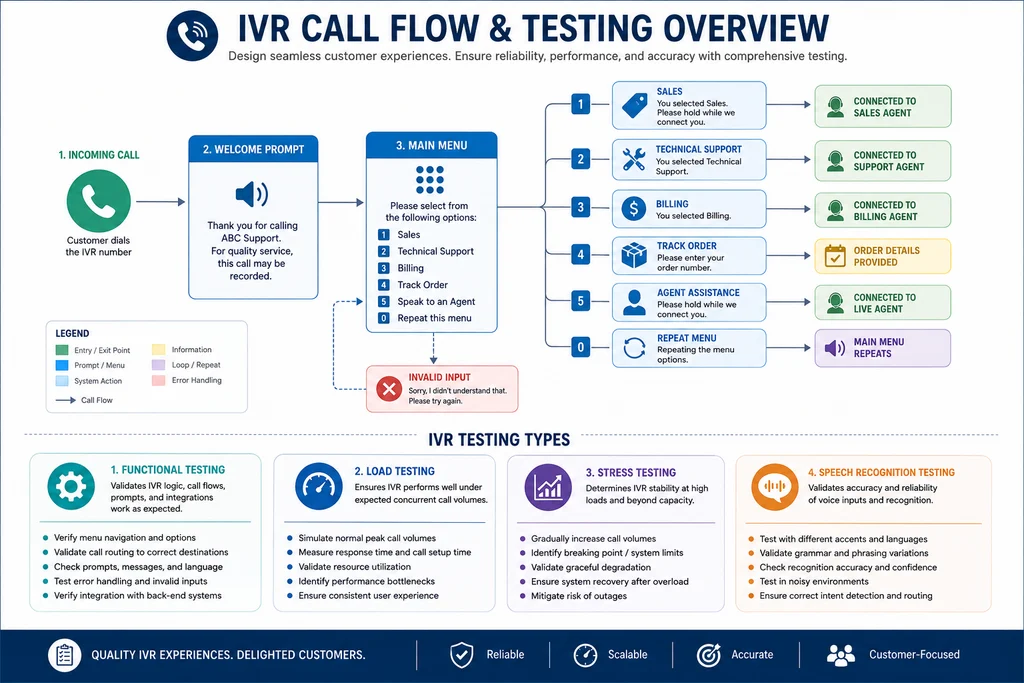
Interactive voice response testing validates that your IVR system correctly routes callers, processes inputs, and completes customer journeys without errors . It involves simulating real world call scenarios to catch issues before they impact customers. Top alternatives: IVR quality assurance, Voice response system validation, Automated call flow testing, Speech recognition testing, and IVR performance monitoring.
We’ve all been there. You call a customer service line, navigate through endless menus, and somehow end up in the wrong department. Or worse, the system doesn’t understand what you’re saying and disconnects you. It’s frustrating, right?
That’s exactly why interactive voice response testing matters. Your IVR system is often the first impression customers have of your business. If it fails, they don’t just get annoyed, they take their business elsewhere. Studies show that organizations using automated testing can reduce IVR testing time by up to 90% while improving defect detection rates .
The thing is, traditional manual testing just doesn’t cut it anymore. With AI powered IVRs becoming more common and customers shifting between channels, interactive voice response testing needs to be smarter, faster, and more comprehensive . Whether you’re launching a new system or updating an existing one, having a solid testing strategy is non negotiable.
Functional Testing Responses
1. Test every possible call path and menu option in your IVR flow
Example: Use this to ensure all menu options route callers correctly.
Meaning: Verifies that each branch of your IVR tree functions as expected.
2. Verify that DTMF inputs are recognized and processed correctly
Example: Use this when testing touch tone responses.
Meaning: Ensures dual tone multi frequency signals work properly .
3. Validate speech recognition accuracy across different accents and dialects
Example: Use this before launching a multilingual IVR system.
Meaning: Tests that diverse callers are understood .
4. Confirm that the IVR correctly routes callers to the right department
Example: Use this to test routing logic.
Meaning: Ensures customers reach the right resources.
5. Test error handling for invalid inputs and system glitches
Example: Use this for boundary testing.
Meaning: Verifies graceful recovery from errors .
6. Verify that prompts are clear, concise, and easy to understand
Example: Use this during user experience testing.
Meaning: Ensures customers can follow instructions .
7. Test the system’s ability to handle barge in interruptions
Example: Use this for natural conversation testing.
Meaning: Verifies the system can handle interruptions .
8. Validate that the IVR provides accurate account or order information
Example: Use this for transactional testing.
Meaning: Ensures data retrieval is correct .
9. Test the system’s response to silence or dead air
Example: Use this for edge case testing.
Meaning: Verifies proper handling of unresponsive callers.
10. Confirm that the system respects timeouts and reprompts correctly
Example: Use this for timing validation.
Meaning: Ensures the system waits appropriately for input.
11. Test the integration with CRM and backend systems
Example: Use this for end toend testing.
Meaning: Verifies data flows correctly between systems .
12. Validate that the system can handle warm transfers to live agents
Example: Use this for hybrid IVR testing.
Meaning: Ensures smooth transitions to human support.
Regression Testing Responses
1. Run your full regression suite after every IVR update or change
Example: Use this when deploying any system modification.
Meaning: Catches new defects introduced by changes .
2. Use known good audio recordings for deterministic regression tests
Example: Use this to test exact scenarios repeatedly.
Meaning: Ensures consistent, repeatable results .
3. Validate that prompt changes haven’t broken routing logic
Example: Use this when updating menu wording.
Meaning: Even small wording changes can affect routing .
4. Confirm that model updates haven’t altered speech recognition behavior
Example: Use this after STT or LLM updates.
Meaning: New models can change behavior unexpectedly .
5. Test with the exact same caller audio from previous production calls
Example: Use this for precise regression testing.
Meaning: Compares current performance against known baselines .
6. Verify that infrastructure changes haven’t introduced latency issues
Example: Use this after migrating to cloud platforms.
Meaning: New infrastructure can affect performance .
7. Check that routing changes haven’t broken business hours logic
Example: Use this when modifying time based rules.
Meaning: Time based routing changes often introduce errors .
8. Validate that codec or telephony provider changes maintain quality
Example: Use this after switching providers.
Meaning: Different providers can affect call quality .
9. Run regression tests automatically on every code deployment
Example: Use this in CI/CD pipeline integration.
Meaning: Catches issues before they reach production .
10. Schedule recurring regression tests independent of deployments
Example: Use this for continuous monitoring.
Meaning: Catches external factors that degrade performance .
11. Test that new configurations haven’t broken compliance requirements
Example: Use this for regulated industries.
Meaning: Maintains regulatory standards.
12. Document all regression test results for audit and improvement
Example: Use this for maintaining quality records.
Meaning: Tracks system performance over time.
Load Testing Responses
1. Gradually introduce incoming calls to measure system capacity
Example: Use this to determine your IVR’s limits.
Meaning: Steadily increases load to find the breaking point .
2. Test how the system performs under expected peak traffic volumes
Example: Use this before high traffic seasons like holidays.
Meaning: Ensures the system can handle normal peaks .
3. Measure latency, dropped calls, and timeout rates under load
Example: Use this for performance benchmarking.
Meaning: Identifies degradation under pressure.
4. Simulate traffic spikes from product launches or promotional campaigns
Example: Use this when expecting sudden volume increases.
Meaning: Tests worst case scenario preparedness.
5. Verify that the system scales horizontally to handle increased volume
Example: Use this for cloud based IVR systems.
Meaning: Ensures automatic scaling works.
6. Test the impact of high volume on speech recognition accuracy
Example: Use this when recognition accuracy is critical.
Meaning: Load can affect recognition quality.
7. Measure the system’s ability to maintain call quality under stress
Example: Use this for quality assurance.
Meaning: Ensures audio quality remains acceptable.
8. Validate that the IVR can handle the maximum expected concurrent calls
Example: Use this to confirm capacity planning.
Meaning: Ensures resources meet demand.
9. Check that the system doesn’t drop calls at the authentication step
Example: Use this for secure IVR testing.
Meaning: Security steps are often overload points .
10. Test with both voice and DTMF inputs simultaneously
Example: Use this for mixed mode testing.
Meaning: Tests system multitasking ability.
11. Verify that queue management works during high volume periods
Example: Use this for customer experience testing.
Meaning: Ensures callers aren’t abandoned.
12. Document baseline performance metrics for future comparison
Example: Use this for ongoing monitoring.
Meaning: Tracks performance trends over time.
Stress Testing Responses
1. Push call volume beyond expected capacity to find the breaking point
Example: Use this for capacity planning.
Meaning: Answers what happens when things go wrong .
2. Determine at what threshold calls start dropping under pressure
Example: Use this to establish safety margins.
Meaning: Identifies your system’s ceiling .
3. Test if the system degrades gracefully or fails catastrophically
Example: Use this for contingency planning.
Meaning: Graceful degradation is better than sudden failure .
4. Verify that error messages are helpful during system overload
Example: Use this for user experience testing.
Meaning: Even in failure, guidance matters.
5. Simulate extreme traffic scenarios beyond normal expectations
Example: Use this for worst case planning.
Meaning: Prepares for the unexpected.
6. Test the system’s ability to recover after being overwhelmed
Example: Use this for resilience testing.
Meaning: Recovery speed matters.
7. Verify that monitoring alerts trigger during stress conditions
Example: Use this for operations testing.
Meaning: Ensures teams are notified.
8. Test backend system integration under extreme load
Example: Use this for end to end stress testing.
Meaning: Backend systems can fail first.
9. Validate that failover systems activate when primary systems fail
Example: Use this for disaster recovery testing.
Meaning: Redundancy must work.
10. Test the impact of network latency combined with high load
Example: Use this for realistic stress scenarios.
Meaning: Real world conditions add complexity.
11. Verify that the system maintains data integrity under extreme conditions
Example: Use this for transactional testing.
Meaning: Data corruption must be prevented.
12. Document stress test results for capacity planning and scaling
Example: Use this for long term planning.
Meaning: Informs infrastructure investments.
Soak Testing Responses
1. Run the system at sustained high load for 12 to 24 hours
Example: Use this before major launches.
Meaning: Surfaces problems that short tests miss .
2. Test for memory leaks that accumulate over extended periods
Example: Use this for long duration testing.
Meaning: Memory leaks cause gradual failure .
3. Identify gradual latency increases that develop over hours
Example: Use this to catch performance degradation.
Meaning: Some issues only appear over time .
4. Check for connection timeouts that occur after extended operation
Example: Use this for stability testing.
Meaning: Connection handling can degrade with time.
5. Verify that the system doesn’t degrade after 8 hours of continuous use
Example: Use this for reliability testing.
Meaning: Systems should maintain performance over time.
6. Test for routing accuracy drift over extended periods
Example: Use this for precision testing.
Meaning: Accuracy should remain consistent.
7. Verify that audio quality remains consistent over long calls
Example: Use this for quality assurance.
Meaning: Call quality shouldn’t degrade.
8. Check that the system can sustain high volume throughout peak seasons
Example: Use this for seasonal readiness.
Meaning: Long term sustainability matters.
9. Test the impact of extended high load on infrastructure resources
Example: Use this for capacity planning.
Meaning: Reveals hidden resource constraints.
10. Validate that error rates don’t increase over time
Example: Use this for reliability validation.
Meaning: Error rates should remain stable.
11. Schedule soak tests before major launches or infrastructure changes
Example: Use this for pre launch validation.
Meaning: Catches issues before they reach customers.
12. Document soak test results for historical performance tracking
Example: Use this for trend analysis.
Meaning: Tracks system stability over time.
Speech Recognition Testing Responses
1. Test speech recognition accuracy with speakers from different regions
Example: Use this before launching in new markets.
Meaning: Regional accents affect recognition .
2. Validate performance with background noise at different levels
Example: Use this for real world testing.
Meaning: Callers are often in noisy environments .
3. Test the system’s ability to understand various speech patterns
Example: Use this for inclusivity testing.
Meaning: Different people speak differently .
4. Verify recognition accuracy for different age groups and genders
Example: Use this for demographic coverage.
Meaning: Voice characteristics vary widely.
5. Test with callers who have speech impediments or accents
Example: Use this for accessibility testing.
Meaning: Ensures the system works for everyone.
6. Validate that the system can handle overlapping speech and interruptions
Example: Use this for natural conversation testing.
Meaning: Real conversations aren’t neat.
7. Test recognition accuracy at different volume levels and distances
Example: Use this for hardware compatibility.
Meaning: Phone quality varies.
8. Verify that the system correctly handles domain specific vocabulary
Example: Use this for industry specific IVR.
Meaning: Industry terms must be recognized.
9. Test the system with multiple languages and dialects
Example: Use this for multilingual support.
Meaning: Language support requires testing.
10. Validate that recognition accuracy improves with domain adaptation
Example: Use this for optimization testing.
Meaning: Adaptation can improve accuracy by nearly 19% .
11. Test the impact of poor network conditions on speech recognition
Example: Use this for mobile or remote call testing.
Meaning: Network quality affects recognition.
12. Document recognition accuracy scores for continuous monitoring
Example: Use this for ongoing quality assurance.
Meaning: Tracks performance and improvements.
Experience Testing Responses
1. Run automated calls every 5 or 10 minutes in production
Example: Use this for continuous monitoring.
Meaning: Catches failures before customers do .
2. Test the IVR from the customer’s perspective, not just internally
Example: Use this for customer centric validation.
Meaning: Reveals issues internal testing misses .
3. Follow actual customer journeys from start to finish
Example: Use this for journey based testing.
Meaning: Tests the full experience, not just parts.
4. Route alerts directly to on call engineers when tests fail
Example: Use this for operations monitoring.
Meaning: Ensures fast response to issues .
5. Test across different channels like voice, chat, and SMS
Example: Use this for omnichannel testing.
Meaning: Ensures consistency across touchpoints .
6. Simulate real world caller diversity in your tests
Example: Use this for realistic quality assurance.
Meaning: Tests with various accents and backgrounds .
7. Validate that the IVR maintains context across channel transitions
Example: Use this for omnichannel validation.
Meaning: Context shouldn’t be lost .
8. Test with different device types like landlines, mobile, and VoIP
Example: Use this for device diversity testing.
Meaning: Each device type can behave differently .
9. Verify that the system handles different time zones and regions
Example: Use this for global system testing.
Meaning: Time and region affect routing.
10. Test the system’s performance during actual peak hours
Example: Use this for real world validation.
Meaning: Lab conditions don’t reflect reality.
11. Use real production calls to identify hidden issues
Example: Use this for continuous improvement.
Meaning: Real calls reveal real problems.
12. Monitor abandonment and transfer rates to identify friction points
Example: Use this for user experience optimization.
Meaning: High abandonment indicates issues .
Automation Responses
1. Automate IVR testing to reduce testing time by up to 90%
Example: Use this for efficiency gains.
Meaning: Automation dramatically speeds testing .
2. Eliminate the risk of human error through automated testing
Example: Use this for accuracy improvement.
Meaning: Automation is more reliable .
3. Create test suites that run on every code deployment
Example: Use this for CI/CD integration.
Meaning: Tests run automatically with each change .
4. Use AI powered testing to simulate diverse customer behavior
Example: Use this for comprehensive coverage.
Meaning: AI can create varied scenarios .
5. Implement test definitions that document call flow paths
Example: Use this for documentation.
Meaning: Tests double as documentation .
6. Use automated testing to validate both voice and DTMF inputs
Example: Use this for complete coverage.
Meaning: Tests all input types .
7. Run automated tests in parallel to speed up validation
Example: Use this for faster feedback.
Meaning: Parallel execution saves time .
8. Configure automated tests for different environments like staging and prod
Example: Use this for full lifecycle testing.
Meaning: Tests everywhere, every time.
9. Use automated testing to validate prompts, routing, and integration
Example: Use this for comprehensive coverage.
Meaning: Covers all system components.
10. Set up automated reporting to track test results over time
Example: Use this for trend analysis.
Meaning: Tracks progress and identifies patterns.
11. Reallocate resources from manual testing to high priority tasks
Example: Use this for resource optimization.
Meaning: Frees up teams for more valuable work .
12. Document automated test results for compliance and audits
Example: Use this for regulatory requirements.
Meaning: Provides auditable records.
CI/CD Integration Responses
1. Integrate IVR tests into your GitHub Actions or similar CI pipeline
Example: Use this for automated quality gates.
Meaning: Tests run on every pull request .
2. Configure pipeline triggers to run on pull requests targeting main branches
Example: Use this for PR validation.
Meaning: Prevents bad code from merging .
3. Define test suites as collections of test cases and scenarios
Example: Use this for organized testing.
Meaning: Creates structured test collections .
4. Gate merges on test results, failing builds when critical tests fail
Example: Use this for quality control.
Meaning: Prevents broken code from deploying .
5. Use automation actions to launch evaluations that call your IVR’s phone number
Example: Use this for live testing.
Meaning: Tests the actual live system.
6. Configure test personas to simulate different caller types
Example: Use this for varied testing.
Meaning: Different callers have different behaviors .
7. Define evaluation metrics like workflow verification and compliance checks
Example: Use this for comprehensive validation.
Meaning: Tests both functionality and compliance .
8. Test with multiple languages, background noise levels, and interruption behaviors
Example: Use this for realistic testing.
Meaning: Covers real world variations .
9. Run scheduled tests independent of code deployments
Example: Use this for continuous monitoring.
Meaning: Catches external degradation .
10. Configure alert thresholds for immediate notification on test failures
Example: Use this for operations readiness.
Meaning: Teams are notified right away .
11. Document test run IDs and results for audit and investigation
Example: Use this for quality records.
Meaning: Provides traceable test history.
12. Report results back to PRs with dashboard links for detailed investigation
Example: Use this for developer feedback.
Meaning: Makes debugging easier .
Manual Testing Responses
1. Have real people interact with your IVR to uncover subjective issues
Example: Use this when automation isn’t enough.
Meaning: Humans catch what automation misses .
2. Test with diverse accents, dialects, and speaking styles
Example: Use this for user experience validation.
Meaning: Ensures inclusivity for all callers .
3. Evaluate prompt clarity and emotional impact on callers
Example: Use this for quality assessment.
Meaning: Emotional impact matters .
4. Identify unexpected disconnects and information mismatches
Example: Use this for edge case discovery.
Meaning: Finds issues automation might miss .
5. Assess the usability of menu structures and navigation
Example: Use this for user experience testing.
Meaning: Navigation should be intuitive .
6. Test with callers who have different levels of technical comfort
Example: Use this for user diversity testing.
Meaning: Not everyone is tech savvy.
7. Evaluate the effectiveness of error handling and recovery
Example: Use this for user experience validation.
Meaning: Errors should be handled gracefully.
8. Test the system’s ability to handle complex or unusual requests
Example: Use this for boundary testing.
Meaning: Not every call is straightforward.
9. Assess the system’s performance with non native speakers
Example: Use this for accessibility testing.
Meaning: Language ability varies.
10. Test the system’s ability to handle calls from noisy environments
Example: Use this for real world simulation.
Meaning: Background noise is common.
11. Evaluate the emotional impact of prompts and system responses
Example: Use this for customer experience testing.
Meaning: Systems should feel human and helpful.
12. Document manual test findings for automation improvement
Example: Use this for continuous improvement.
Meaning: Manual findings inform automation.
Omnichannel Testing Responses
1. Test transitions between voice IVR and digital chat channels
Example: Use this for omnichannel validation.
Meaning: Customers move between channels .
2. Verify that IVR context carries over to chatbots and live agents
Example: Use this for journey testing.
Meaning: Context shouldn’t be lost during transitions .
3. Test the system with journeys that start on one channel and end on another
Example: Use this for cross channel validation.
Meaning: Modern customers use multiple channels.
4. Verify that the system maintains consistent logic across all channels
Example: Use this for consistency testing.
Meaning: All channels should behave the same.
5. Test how well the system handles channel escalation and deescalation
Example: Use this for flexible journey testing.
Meaning: Customers should be able to move between channels.
6. Validate that the IVR can retrieve context from previous channel interactions
Example: Use this for seamless experience testing.
Meaning: Prevents re explaining issues .
7. Test the system’s ability to handle warm transfers between channels
Example: Use this for handoff testing.
Meaning: Transfers should be smooth.
8. Verify that the system recognizes returning customers across channels
Example: Use this for personalization testing.
Meaning: Identifies and personalizes experiences.
9. Test with scenarios that involve both automated and human support
Example: Use this for hybrid journey testing.
Meaning: Blends automation with human help.
10. Validate that the system maintains customer data consistency across channels
Example: Use this for data integrity testing.
Meaning: Data should be consistent.
11. Test the system’s ability to handle complex cross channel use cases
Example: Use this for comprehensive testing.
Meaning: Complex cases need coverage.
12. Document omnichannel test scenarios for regression testing
Example: Use this for ongoing validation.
Meaning: Prevents cross channel regressions.
LLM Powered IVR Testing Responses
1. Test LLM powered IVRs with scenarios that simulate diverse callers
Example: Use this for conversational AI validation.
Meaning: LLMs behave differently from traditional IVRs .
2. Validate that the system maintains conversation context throughout calls
Example: Use this for AI quality assurance.
Meaning: Context retention is critical.
3. Test the system’s ability to handle open ended questions and complex requests
Example: Use this for AI capability testing.
Meaning: LLMs handle complex conversations.
4. Verify that the system generates responses based on customer sentiment
Example: Use this for personalized experience testing.
Meaning: Sentiment aware responses improve experience .
5. Test with adversarial scenarios, interruptions, and jailbreak attempts
Example: Use this for security testing.
Meaning: LLMs need safety testing .
6. Validate that the system correctly uses tools and backend APIs
Example: Use this for integration testing.
Meaning: Tool calls must work correctly .
7. Test the system’s ability to handle toxicity and abusive language
Example: Use this for content safety testing.
Meaning: Systems need to handle difficult interactions .
8. Verify that the system’s responses are consistent and on brand
Example: Use this for quality control.
Meaning: Brand voice should be maintained.
9. Test with different AI model versions to catch behavior drift
Example: Use this for continuous monitoring.
Meaning: Model updates change behavior .
10. Validate that the system complies with regulatory requirements
Example: Use this for compliance testing.
Meaning: Regulation applies to AI systems .
11. Test the system with custom personas and scenario instructions
Example: Use this for targeted validation.
Meaning: Personas simulate real callers .
12. Document LLM specific test results for model governance
Example: Use this for AI governance.
Meaning: Tracks AI performance over time.
FAQs
What is interactive voice response testing?
Interactive voice response testing validates that your IVR system correctly routes callers, processes inputs, and completes customer journeys without errors. It involves simulating real world call scenarios to identify issues before they reach customers .
Why should I automate IVR testing?
Automated IVR testing can reduce testing time by up to 90% while improving defect detection rates. It eliminates the risk of human error and frees up teams to focus on high priority tasks .
What’s the difference between load testing and stress testing for IVR?
Load testing measures how well your IVR performs under expected high traffic volumes. Stress testing pushes call volume beyond expected capacity to find the system’s breaking point and see how it fails .
How often should I test my IVR system?
IVR testing should be continuous rather than periodic. Test after every system update, before high traffic events, and maintain ongoing monitoring to catch issues before they impact customers .
What is omnichannel IVR testing?
Omnichannel IVR testing validates that your IVR works correctly across multiple communication channels like voice, chat, email, and SMS, and that context is maintained when customers transition between channels .
Conclusion
Interactive voice response testing isn’t just about finding bugs. It’s about ensuring that every customer who calls your business has a smooth, frustration free experience. Whether you’re running functional tests, load tests, stress tests, or speech recognition tests, each type serves a specific purpose in your quality assurance strategy.
The key is to think beyond just verifying that the system works. Test from the customer’s perspective. Simulate real world conditions. Automate where you can, but don’t forget the human touch when it matters. And with LLM powered IVRs becoming more common, your testing strategy needs to evolve to handle the unique challenges these systems present.







8 thoughts on “150+ Best Interactive Voice Response Testing Strategies for Quality Assurance For 2026”