

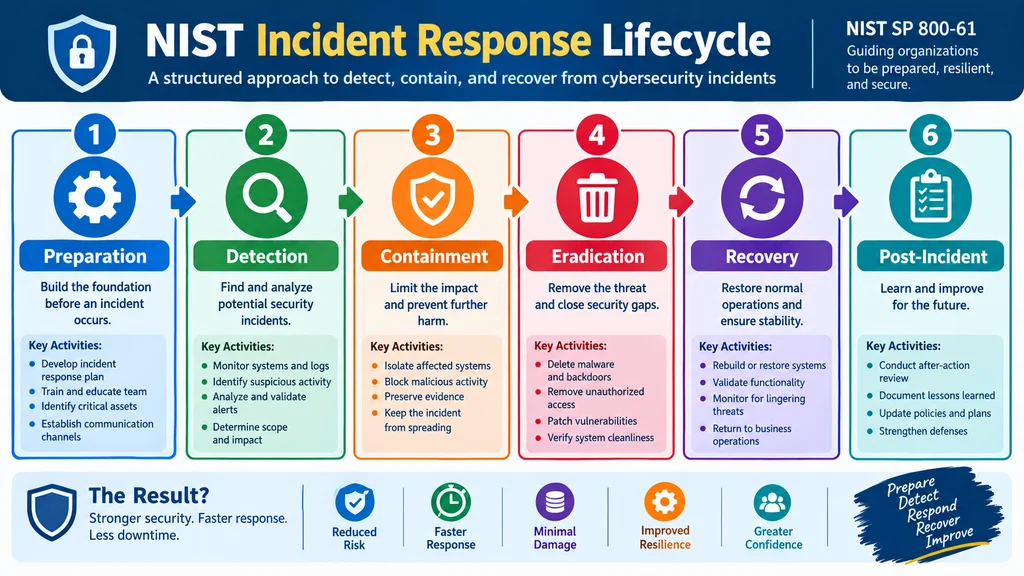
The best incident response procedures follow a structured lifecycle that includes preparation, detection and analysis, containment, eradication and recovery, and post-incident activity. These steps minimize damage and ensure rapid recovery from security incidents. Top alternatives: incident management process, security breach response plan, IR workflow, threat response guidelines, and cybersecurity incident handling framework.
You’re sitting at your desk when the alert comes in. A suspicious login from an unfamiliar location. Your heart starts racing. Your mind goes blank. What do you do first? Who do you call? How do you stop the attacker before they get to your sensitive data?
Your security incident response procedures are the difference between a minor blip and a catastrophic breach. A well-documented and rehearsed plan gives you a clear path through the chaos . It helps your team act fast, coordinate effectively, and prevent small problems from becoming major disasters .
Whether you’re dealing with ransomware, data exfiltration, or compromised credentials, having solid incident response procedures isn’t just a good idea, it’s business-critical . Organizations with mature IR programs respond faster, recover more fully, and suffer less damage than those who try to wing it.
Preparation Procedures
1. Develop an incident response plan that provides a roadmap for your organization
Example: Use this when building your foundational IR documentation.
Meaning: Your plan should describe the structure of your incident response capability, define roles and responsibilities, and outline how the program fits into your overall organization .
2. Distribute the incident response plan to all designated personnel
Example: Use this during plan rollout to ensure team members know where to find critical information.
Meaning: Everyone who might need the plan should have access, and they should know their specific responsibilities .
3. Conduct regular tabletop exercises, not just annually
Example: Use this to test your team’s ability to execute under pressure.
Meaning: Quarterly exercises test whether the plan actually works, while annual exercises just test whether a plan exists .
4. Create scenario-specific playbooks for common incident types
Example: Use this to prepare for the attacks you’re most likely to face.
Meaning: Build playbooks for ransomware, credential compromise, data exfiltration, insider threats, and supply chain attacks .
5. Document severity classifications with objective criteria
Example: Use this to ensure consistent incident categorization across your team.
Meaning: If two analysts can look at the same incident and classify it differently, your criteria aren’t specific enough .
6. Establish communication protocols for stakeholders
Example: Use this to define who gets notified, when, and through what channel.
Meaning: Clear communication expectations prevent confusion during the chaos of an active incident .
7. Pre-negotiate external incident response retainers
Example: Use this to ensure you can get help when you need it most.
Meaning: Negotiating a contract during an active SEV-1 breach costs precious time you don’t have .
8. Map critical assets and identify log coverage gaps
Example: Use this to understand what you can and can’t monitor.
Meaning: You need an accurate asset inventory and a clear view of log coverage before an incident starts .
9. Integrate IR metrics into board-level risk reporting
Example: Use this to show leadership how incident response affects business risk.
Meaning: When leadership sees MTTD trends alongside financial exposure estimates, security investment decisions improve .
10. Maintain a living playbook library with regular reviews
Example: Use this to ensure your procedures stay current.
Meaning: Each playbook should be reviewed after every relevant incident, not just written once .
11. Designate a lead for recovery operations
Example: Use this to ensure clear decision-making during complex incidents.
Meaning: Recovery operations involve many people doing many different tasks at once, so a designated project lead is essential .
12. Protect the incident response plan from unauthorized disclosure
Example: Use this to safeguard sensitive procedural information.
Meaning: Your plan contains critical information that could be useful to attackers .
Detection and Analysis Procedures
1. Monitor multiple detection layers simultaneously
Example: Use this when reviewing security alerts across different tools.
Meaning: Combine signature-based detection, behavioral anomalies (UEBA), and threat intelligence feeds .
2. Validate and classify incidents objectively
Example: Use this when an alert first comes in.
Meaning: Determine if it’s a true positive, what assets are affected, and what the potential business impact is .
3. Document everything in a decision log from the start
Example: Use this to maintain a legally defensible record of your actions.
Meaning: Courts and regulators may read your documentation, so treat it as a legal document .
4. Collect forensic data during the detection phase
Example: Use this to preserve evidence for later analysis.
Meaning: Pull memory dumps of active processes and records of network activity before they’re lost .
5. Look for key indicators of compromise
Example: Use this when investigating potential threats.
Meaning: Check for unusual network traffic, failed login attempts, or suspicious activity in tools like PowerShell .
6. Correlate alerts to identify attack patterns
Example: Use this to see the bigger picture of an ongoing attack.
Meaning: Single alerts may not tell the whole story; connecting them reveals the attacker’s campaign .
7. Involve your CSIRT or security team immediately
Example: Use this when you’re not sure if it’s a real incident.
Meaning: Don’t try to handle it alone. Get experts involved as early as possible .
8. Determine whether the incident involves regulated data
Example: Use this to understand your legal obligations.
Meaning: Incidents involving personal information may require reporting to oversight organizations and affected individuals .
9. Use automated tools to reduce mean time to detect
Example: Use this to speed up alert triage.
Meaning: AI-driven tools can correlate signals across large datasets faster than any human team .
10. Check DNS and proxy logs for suspicious outbound requests
Example: Use this to identify command-and-control connections.
Meaning: Attackers often hide communication in DNS traffic or unusual outbound connections .
11. Create a timeline of events
Example: Use this to understand the scope of the incident.
Meaning: A clear timeline helps you identify when the attacker first gained access and what they’ve done since .
12. Assess the potential for business impact
Example: Use this to prioritize your response efforts.
Meaning: Not all incidents are equal; focus on those that could harm your business most .
Containment Procedures
1. Isolate compromised systems immediately
Example: Use this when you’ve confirmed a system is compromised.
Meaning: Block switch ports or use firewall rules to stop all inbound and outbound traffic .
2. Quarantine affected endpoints in a restricted VLAN
Example: Use this to prevent lateral movement.
Meaning: Isolate compromised systems to stop attackers from moving to other parts of your network .
3. Revoke VPN and remote access for compromised accounts
Example: Use this to cut off attacker access.
Meaning: If attackers have credentials, revoking their access prevents further damage .
4. Reset passwords for all compromised accounts immediately
Example: Use this to stop attackers from using stolen credentials.
Meaning: Start with known compromised accounts, then expand as needed .
5. Block suspicious domains at the DNS level
Example: Use this to prevent outbound communication to command-and-control servers.
Meaning: DNS-level blocking can stop attacks even when other controls fail .
6. Apply deny rules to firewalls from known malicious IPs
Example: Use this to block attacker infrastructure.
Meaning: Blocking known bad IP addresses at the network level stops attacks before they reach your systems .
7. Disable unnecessary features like PowerShell remoting
Example: Use this to reduce attack surface during an incident.
Meaning: Attackers often exploit built-in tools; disabling unnecessary features limits their options .
8. Revoke API keys and session tokens in cloud environments
Example: Use this to stop attackers who’ve gained access through compromised services.
Meaning: Cloud credentials are more than just passwords; revoke all forms of access .
9. Coordinate containment with external providers
Example: Use this when your organization uses managed security services.
Meaning: Agreements with external providers should clarify roles and responsibilities before an incident occurs .
10. Escalate incidents as needed
Example: Use this when an incident exceeds your team’s capacity.
Meaning: Some incidents require escalation to leadership or external experts .
11. Document all containment actions taken
Example: Use this to preserve evidence and maintain accountability.
Meaning: Everything you do during containment becomes part of the legal record .
12. Maintain communication throughout containment
Example: Use this to keep stakeholders informed.
Meaning: While technical response is critical, keeping leadership and stakeholders informed is equally important .
Eradication Procedures
1. Remove malware, backdoors, and unauthorized changes
Example: Use this to clean compromised systems.
Meaning: Eradication means completely removing the attacker’s presence, not just containing it .
2. Patch exploited vulnerabilities immediately
Example: Use this to close the door attackers used.
Meaning: Finding and fixing the root cause is essential to prevent reinfection .
3. Verify that all attacker footholds are removed
Example: Use this to ensure complete eradication.
Meaning: Missing one backdoor means the attacker can return .
4. Use forensic evidence to guide eradication
Example: Use this to find everything the attacker touched.
Meaning: Your investigation should identify all compromised resources, not just the most obvious ones .
5. Don’t boil the ocean; limit response scope
Example: Use this to ensure eradication can be completed within 24 hours.
Meaning: Focus on what matters most rather than trying to fix everything at once .
6. Consolidate eradication tasks
Example: Use this to rapidly remediate all compromised resources at once.
Meaning: A consolidated operation makes it difficult for attackers to adapt and maintain persistence .
7. Use existing tools you already deployed
Example: Use this to avoid learning new tools during an emergency.
Meaning: Don’t try to deploy and learn new tools during an active incident unless absolutely necessary .
8. Avoid tipping off the adversary if possible
Example: Use this to maintain an advantage during eradication.
Meaning: Attackers typically monitor your communications .
9. Consider using a non-production environment for sensitive communications
Example: Use this when discussing operational details.
Meaning: Most attackers don’t monitor all communications, but they may monitor key channels .
10. Involve legal counsel during eradication, especially for data breaches
Example: Use this to ensure compliance with legal obligations.
Meaning: Legal considerations impact containment actions, notification requirements, and evidence handling .
11. Preserve evidence integrity for potential legal action
Example: Use this to maintain options for prosecution.
Meaning: Only work on copies and snapshots; preserve originals as evidence .
12. Pre-verify that eradication steps won’t cause business disruption
Example: Use this to plan your recovery.
Meaning: In OT and manufacturing environments, restoring safe operations must be prioritized .
Recovery Procedures
1. Restore systems from clean backups
Example: Use this to bring systems back online.
Meaning: Clean backups ensure you’re not reintroducing the threat .
2. Monitor for reinfection or lateral movement
Example: Use this during the recovery phase to detect any remaining threats.
Meaning: Recovery isn’t complete until you’re sure the attacker is gone .
3. Gradually reintroduce systems into production
Example: Use this to manage risk during recovery.
Meaning: Bringing systems back online gradually allows you to detect any issues before they cause widespread problems .
4. Maintain enhanced monitoring on recovered systems
Example: Use this to catch attackers trying to re-enter through the same vector.
Meaning: Configure temporary custom correlation rules targeting the specific IOCs from the incident .
5. Ensure your recovery operation can be executed within 24 hours or less
Example: Use this to minimize business disruption.
Meaning: Plan for a weekend to account for contingencies and corrective actions .
6. Avoid long-term security investments during recovery
Example: Use this to stay focused on immediate priorities.
Meaning: Defer big new security systems until after the recovery operation is complete .
7. Reset only known compromised passwords first
Example: Use this to prioritize your recovery efforts.
Meaning: Start with affected accounts, then expand to all user passwords in a staged and controlled manner .
8. Have a clear recovery plan with limited scope
Example: Use this to keep recovery on track.
Meaning: Work closely with technical teams to build a clear plan and avoid scope creep .
9. Maintain stakeholder communications throughout recovery
Example: Use this to manage expectations.
Meaning: Provide timely updates to organizational stakeholders .
10. Consider bringing in external expertise if your team is overwhelmed
Example: Use this when you need additional capacity or skills.
Meaning: Managing major incidents is very challenging and new to many professionals .
11. Document the recovery process for lessons learned
Example: Use this to improve future recovery efforts.
Meaning: Build and continually improve role-specific handbooks for SecOps, even if it’s your first incident .
12. Verify services are fully restored before declaring completion
Example: Use this to ensure recovery is truly complete.
Meaning: An incident is considered resolved once services are fully restored and no further user impact remains .
Post-Incident Procedures
1. Conduct an after-action review within 72 hours of incident closure
Example: Use this to capture lessons while they’re fresh.
Meaning: Delayed reviews produce sanitized accounts rather than honest assessments .
2. Perform root cause analysis
Example: Use this to understand what enabled the attack.
Meaning: Was it a system misconfiguration, human error, or outdated software? .
3. Write a comprehensive incident report
Example: Use this to document the incident for leadership and compliance.
Meaning: Include cause, timeline, cost, and remediation steps .
4. Feed confirmed attacker TTPs back into your detection pipeline
Example: Use this to improve your ability to detect similar attacks.
Meaning: Update your threat intelligence based on what you learned .
5. Update your playbooks based on what worked and what failed
Example: Use this to improve future response.
Meaning: Your procedures should evolve with each incident .
6. Conduct a detection gap analysis
Example: Use this to identify monitoring improvements.
Meaning: What did you miss, and how can you catch it next time? .
7. Track MTTD and MTTR as primary metrics
Example: Use this to measure your team’s performance.
Meaning: These figures inform security investment decisions more reliably than incident counts alone .
8. Integrate IR metrics into board-level risk reporting
Example: Use this to demonstrate improvement to leadership.
Meaning: Show how incident response maturity reduces overall business risk .
9. Update your security awareness training based on findings
Example: Use this to prevent similar incidents.
Meaning: If employees were a vulnerability, improve training .
10. Share threat intelligence with trusted peers
Example: Use this to help others avoid the same attack.
Meaning: Threat intelligence sharing through bodies like CSIRTs helps the entire community .
11. Review and update your incident response plan
Example: Use this to ensure your IRP stays current.
Meaning: Plan updates should happen at least annually or after significant changes .
12. Conduct a post-incident review with all stakeholders
Example: Use this to foster a culture of continuous improvement.
Meaning: Include everyone involved to get a complete picture of what happened .
Communication Procedures
1. Define exactly who gets notified for each severity level
Example: Use this to ensure the right people are informed.
Meaning: Include contact information, channels, and timelines .
2. Establish clear communication channels before an incident occurs
Example: Use this to avoid scrambling during a crisis.
Meaning: Your primary Slack workspace may be compromised; have out-of-band channels ready .
3. Assign a single point of contact for communication
Example: Use this to prevent conflicting messages.
Meaning: A single focus point is tremendously helpful for keeping track of things .
4. Escalate incidents through predefined chains
Example: Use this when your team can’t handle an incident alone.
Meaning: Know who to call and when, including your local FBI field office and cloud providers .
5. Maintain a communication plan for leadership and board reporting
Example: Use this to keep executives informed.
Meaning: Executive and board-level communications can be challenging if not practiced or anticipated .
6. Use the Traffic Light Protocol for sharing information
Example: Use this to ensure the audience knows what’s expected without asking every time.
Meaning: TLP helps share information safely with different audiences .
7. Coordinate with external providers and partners
Example: Use this to ensure your vendors are ready if an incident occurs.
Meaning: Put your vendors and partners on the same page with your strategy .
8. Engage legal counsel early in the planning process
Example: Use this to ensure compliance with notification requirements.
Meaning: Legal counsel should be involved during incidents involving data breaches .
9. Pre-identify contacts before incidents occur
Example: Use this to save time during a crisis.
Meaning: Store contacts in your IRP, don’t search for them during a breach .
10. Schedule post-incident reviews within 72 hours
Example: Use this to capture honest assessments.
Meaning: When timelines are short, people tell the truth .
11. Provide timely updates to organizational stakeholders
Example: Use this to manage expectations during recovery.
Meaning: Don’t wait until recovery is complete to communicate .
12. Document communication actions for legal and compliance purposes
Example: Use this to maintain a record of notifications.
Meaning: You may need to prove that you notified the right people at the right time .
FAQ
What are incident response procedures?
Incident response procedures are documented, repeatable processes that guide teams through the stages of a security incident, from detection to recovery. They cover what to do, who to contact, and how to communicate.
What are the main phases of incident response?
The standard lifecycle includes Preparation, Detection and Analysis, Containment, Eradication and Recovery, and Post-Incident Activity. This follows the widely used NIST framework .
Why are tabletop exercises important?
Tabletop exercises test whether your team can execute the IR plan under pressure. Organizations that test quarterly respond 40% faster during real incidents .
What should an incident response plan include?
An IRP should include roles and responsibilities, severity classifications, communication protocols, specific playbooks, asset inventory, and escalation chains .
How often should incident response procedures be updated?
Update procedures after significant organizational changes, after major threat landscape shifts, and immediately after lessons learned from incidents or exercises .
Conclusion
Your incident response procedures are your lifeline when the worst happens. Having a documented, rehearsed plan isn’t just good cybersecurity practice, it’s business survival .
The organizations that respond best to incidents are those that treat incident response as an organizational capability, not just a technical function. They integrate IR into their daily operations, conduct regular tabletop exercises, and continuously improve based on lessons learned .
Remember, incidents are inevitable. The question isn’t if you’ll face one, but when . Being prepared with solid procedures, a well-trained team, and clear communication channels means you can respond fast, recover quickly, and emerge stronger.
Start building your incident response program today. Use these procedures as your foundation, tailor them to your organization, and practice them regularly. When the real thing happens, you’ll be ready.








12 thoughts on “200+ Best Incident Response Procedures for Cybersecurity Teams For 2026”