

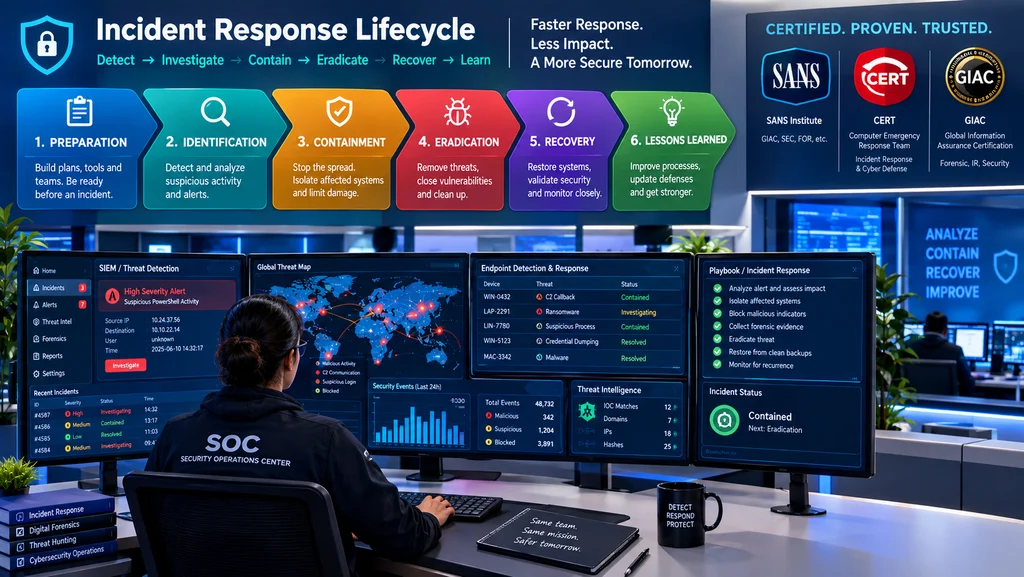
An incident response course teaches you how to detect, contain, and recover from cybersecurity threats before they destroy your organization. The best courses cover the full lifecycle: preparation, identification, containment, eradication, recovery, and lessons learned. Top alternatives: SANS SEC504, CERT Incident Response Process, GIAC GCIH certification, OffSec IR-200, and Cybrary Incident Response and Advanced Forensics.It’s 3 AM and your phone won’t stop buzzing. A ransomware attack is spreading through your company’s network, and everyone is looking at you to fix it. Do you know what to do first? Can you identify the scope, contain the damage, and recover systems without making things worse?
That’s exactly why incident response courses exist. Whether you’re a SOC analyst, a system administrator, or a security professional trying to level up, an incident response course gives you the structured framework and hands-on skills to handle chaos with confidence. These courses teach you the six-phase incident handling process, from preparation and identification to containment, eradication, recovery, and post-incident review .
The demand for skilled incident responders has never been higher. Organizations are desperate for professionals who can stop breaches, preserve evidence, and get systems back online fast. An incident response course isn’t just training. It’s a career investment that could save your company millions.
Core Course Structure Insights
1. Incident response courses cover the full lifecycle from preparation to lessons learned
Example: Use this when evaluating whether a course covers everything you need.
Meaning: The complete PICERL framework includes preparation, identification, containment, eradication, recovery, and lessons learned .
2. Preparation is the only phase that happens before an incident occurs
Example: Use this when emphasizing the importance of proactive planning.
Meaning: Everything that makes response faster depends on pre-incident work like team structure and playbooks .
3. Identification involves both detection and triage stages
Example: Use this when explaining how courses teach alert prioritization.
Meaning: Detection flags potential incidents while triage confirms if they’re real threats worth escalating .
4. Containment stops the incident from worsening through isolation and blocking
Example: Use this when describing how courses teach damage limitation.
Meaning: Short-term containment isolates threats while long-term containment stabilizes the environment .
5. Eradication removes everything the attacker installed or changed
Example: Use this when explaining the difference between containment and eradication.
Meaning: Containment stops the bleeding while eradication closes the wound by removing malware and persistence mechanisms .
6. Recovery returns affected systems to production from known-good states
Example: Use this when discussing how courses teach system restoration.
Meaning: The goal is restoring normal operations without data loss, ideally from clean backups .
7. Lessons learned is the final phase that prevents future incidents
Example: Use this when explaining why post-incident review matters.
Meaning: This phase documents what worked and what didn’t to improve future response .
8. Courses teach team structure with defined roles before incidents occur
Example: Use this when evaluating whether a course covers organizational readiness.
Meaning: CSIRT roles include Incident Commander, Technical Lead, Communications Lead, and Legal/Compliance .
9. Playbooks are pre-written procedures for specific incident types
Example: Use this when describing practical tools courses provide.
Meaning: Playbooks for ransomware, credential compromise, and data exfiltration force calm decision-making .
10. Communication plans are essential for managing different audiences
Example: Use this when explaining the non-technical skills courses teach.
Meaning: Technical responders, executives, legal, and regulators all need different information .
11. Tooling readiness means having acquisition and analysis tools before incidents
Example: Use this when evaluating hands-on components of courses.
Meaning: Courses emphasize having live acquisition tools, disk imaging, and SIEM access ready .
12. Severity tiers help prioritize response based on impact
Example: Use this when explaining how courses teach triage decisions.
Meaning: Critical incidents get immediate response while low-priority alerts wait .
Hands-On Skills Responses
1. Live acquisition tools like Velociraptor and KAPE are taught in advanced courses
Example: Use this when looking for courses with practical tool training.
Meaning: These tools capture volatile evidence before it’s lost .
2. Disk imaging capability is essential for forensic preservation
Example: Use this when evaluating whether a course covers evidence handling.
Meaning: Creating forensic images preserves evidence for later analysis .
3. Isolated analysis environments allow safe malware examination
Example: Use this when describing lab components of courses.
Meaning: Sandboxed environments prevent malware from spreading during analysis .
4. Log analysis and SIEM access are core technical skills taught
Example: Use this when assessing the technical depth of a course.
Meaning: Responders need to correlate events across hosts and networks .
5. Network traffic analysis helps identify attacker communications
Example: Use this when describing the network forensics component.
Meaning: Courses teach how to spot command-and-control traffic and data exfiltration .
6. Endpoint investigation covers Windows, Linux, and macOS systems
Example: Use this when evaluating cross-platform coverage.
Meaning: Attackers target multiple operating systems so responders need broad skills .
7. Malware analysis skills help understand attacker tools and objectives
Example: Use this when describing the threat intelligence component.
Meaning: Analyzing malware reveals how attackers operate and what they want .
8. Threat hunting is taught as a proactive detection skill
Example: Use this when looking for courses that go beyond reactive response.
Meaning: Hunting actively searches for threats that automated tools miss .
9. Cloud incident response covers AWS, Azure, and hybrid environments
Example: Use this when evaluating modern infrastructure coverage.
Meaning: Cloud-specific response skills are increasingly essential .
10. Digital forensics supports legal and regulatory requirements
Example: Use this when describing evidence preservation techniques.
Meaning: Proper forensics ensures evidence is admissible in legal proceedings .
11. Crisis communication is taught as a critical soft skill
Example: Use this when evaluating the non-technical curriculum.
Meaning: Coordinating with executives, legal, and PR during incidents is essential .
12. Ransomware-specific playbooks are included in modern courses
Example: Use this when looking for current threat coverage.
Meaning: Ransomware requires specialized response and recovery strategies .
Certification Path Responses
1. GIAC Certified Incident Handler (GCIH) validates practical incident handling skills
Example: Use this when seeking industry-recognized credentials.
Meaning: The GCIH certification requires passing a hands-on exam with real tools .
2. CERT Incident Response Process Certificate from Carnegie Mellon is highly respected
Example: Use this when evaluating academic and government-recognized certifications.
Meaning: This certificate prepares you for CSIRT membership with practical exercises .
3. OffSec Certified Incident Responder (OSIR) focuses on foundational skills
Example: Use this when starting your incident response career.
Meaning: IR-200 prepares learners for SOC and incident response team roles .
4. SANS SEC504 prepares you for the GCIH certification
Example: Use this when looking for comprehensive training with certification pathway.
Meaning: This course covers hacker tools, techniques, and incident handling .
5. CIRRS certification from Tonex emphasizes recovery and resilience
Example: Use this when focusing on business continuity aspects.
Meaning: This program covers playbooks, ransomware preparedness, and crisis communication .
6. Certifications demonstrate commitment and validate hands-on skills
Example: Use this when explaining the value of credentials to employers.
Meaning: Certification exams test practical ability, not just theoretical knowledge .
7. GIAC certifications are globally recognized in cybersecurity
Example: Use this when evaluating the prestige of credentials.
Meaning: SANS and GIAC are respected throughout the industry .
8. Certification paths often require completing specific courses first
Example: Use this when planning your training roadmap.
Meaning: SEC504 training prepares you for the GCIH exam .
9. Some certifications require periodic renewal to stay current
Example: Use this when considering long-term credential maintenance.
Meaning: The CERT certificate does not expire while GIAC certifications have renewal requirements .
10. Certification exams include hands-on lab components
Example: Use this when preparing for practical assessments.
Meaning: CyberLive exams test real skills with real tools .
11. Certifications can lead to salary increases and career advancement
Example: Use this when justifying training investment.
Meaning: Certified incident handlers earn significantly more than non-certified peers .
12. Multiple certification paths exist for different career stages
Example: Use this when planning professional development.
Meaning: Foundational courses for beginners, advanced courses for experienced professionals .
Professional Development Responses
1. Incident response courses build skills that are immediately applicable
Example: Use this when explaining the practical value of training.
Meaning: Students take skills back to their organizations and use them right away .
2. Training prepares you for roles in Security Operations Centers
Example: Use this when describing career outcomes.
Meaning: SOC analysts are the front line of incident detection and response .
3. Incident handling skills are in high demand across industries
Example: Use this when discussing job market opportunities.
Meaning: Every organization needs professionals who can respond to breaches .
4. Courses help organizations build and benchmark their CSIRT capabilities
Example: Use this when explaining organizational benefits.
Meaning: Training helps teams improve communication and align with best practices .
5. Interactive exercises and role-playing improve retention
Example: Use this when evaluating course delivery methods.
Meaning: Hands-on scenarios teach better than lectures alone .
6. Group training options allow teams to learn together
Example: Use this when considering organizational training.
Meaning: Private onsite training builds team cohesion and shared procedures .
7. Self-paced online courses offer flexibility for working professionals
Example: Use this when balancing training with job responsibilities.
Meaning: Online delivery methods accommodate different schedules .
8. Advanced courses build on foundational knowledge
Example: Use this when planning your learning progression.
Meaning: Start with basics and advance to complex threat handling .
9. Courses updated regularly to address emerging threats
Example: Use this when evaluating currency of content.
Meaning: Modern courses include ransomware, cloud, and AI-related threats .
10. Incident response skills complement other cybersecurity disciplines
Example: Use this when explaining career versatility.
Meaning: Understanding response helps with roles in threat hunting, forensics, and security architecture .
11. Training improves organizational cyber resilience
Example: Use this when justifying training budgets to leadership.
Meaning: Better response capabilities reduce downtime and data loss .
12. Continuous learning is essential as attack techniques evolve
Example: Use this when explaining why ongoing training matters.
Meaning: Threats change constantly so responders must keep learning .
Course Selection Responses
1. Choose courses that match your current skill level
Example: Use this when selecting between beginner and advanced options.
Meaning: Foundational courses exist for newcomers while advanced courses target experienced professionals .
2. Verify that courses cover the full incident response lifecycle
Example: Use this when evaluating curriculum completeness.
Meaning: A comprehensive course addresses all six phases of response .
3. Look for hands-on lab components in course descriptions
Example: Use this when prioritizing practical experience.
Meaning: Labs reinforce learning and build muscle memory .
4. Check if the course prepares you for industry certifications
Example: Use this when aligning training with credentials.
Meaning: Many courses map directly to certification exams .
5. Consider the reputation and experience of the training provider
Example: Use this when comparing options.
Meaning: SANS, CERT, and OffSec are respected industry leaders .
6. Evaluate whether the course covers modern threats like ransomware and cloud attacks
Example: Use this when assessing currency of content.
Meaning: Modern courses address current attack vectors .
7. Check delivery methods to find what fits your learning style
Example: Use this when choosing between online, in-person, or hybrid options.
Meaning: Self-paced, instructor-led, and onsite training all have advantages .
8. Consider whether the course includes team or group training options
Example: Use this when training multiple staff members.
Meaning: Group discounts and private sessions are available from many providers .
9. Look for courses that teach both technical and soft skills
Example: Use this when preparing for comprehensive incident response roles.
Meaning: Communication and coordination are as important as technical ability .
10. Check prerequisites to ensure you’re prepared
Example: Use this when planning your learning path.
Meaning: Basic networking and OS knowledge are common requirements .
11. Consider the time commitment and format of the course
Example: Use this when fitting training into your schedule.
Meaning: Courses range from 2-day workshops to multi-week programs .
12. Read reviews and testimonials from past participants
Example: Use this when evaluating course quality.
Meaning: Feedback from peers helps gauge real-world value.
FAQ
What is an incident response course?
An incident response course teaches cybersecurity professionals how to detect, contain, and recover from security incidents. It covers the full response lifecycle including preparation, identification, containment, eradication, recovery, and lessons learned .
Who should take an incident response course?
These courses are ideal for SOC analysts, system administrators, security practitioners, incident handlers, and anyone responsible for responding to cybersecurity incidents .
How long does an incident response course take?
Courses range from 2-day workshops to multi-week programs. Self-paced online options offer flexibility while instructor-led courses provide structured learning .
Do I need prerequisites before taking an incident response course?
Most courses recommend basic networking knowledge, familiarity with Linux and Windows, and foundational cybersecurity understanding. Advanced courses may require prior experience .
What certifications can I earn from incident response courses?
Popular certifications include GIAC Certified Incident Handler (GCIH), CERT Incident Response Process Certificate, and OffSec Certified Incident Responder (OSIR) .
Conclusion
An incident response course is more than just training. It’s preparation for the moments that define careers. When systems go down and everyone looks to you for answers, having the right framework and hands-on skills makes all the difference.
The best courses combine theory with practice, teaching you not just what to do but how to do it under pressure. From SANS and CERT to OffSec and GIAC, there are world-class options for every skill level and career stage.
Save this guide for your next training decision. Share it with your team. And remember, in cybersecurity, preparation isn’t optional. It’s everything. So invest in your skills, get certified, and be ready when the call comes.







4 thoughts on “ 150+ Best Incident Response Course Insights for Cybersecurity Professionals For 2026”