

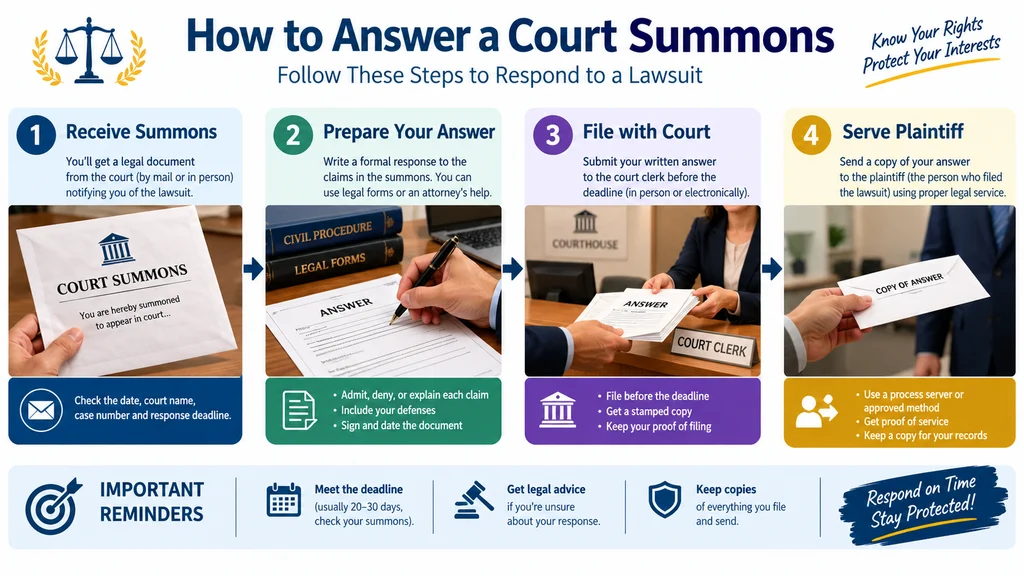
The best written summons response template helps you formally answer a lawsuit by admitting, denying, or stating lack of knowledge to each claim. You must file your response within the deadline (typically 20-30 days) to avoid a default judgment. Top alternatives: Answer to Complaint form, Civil Summons Response, Debt Collection Answer Template, Court Summons Reply Letter, and Defendant’s Response to Summons.
You open your mailbox and there it is. A thick envelope from the court. Your heart stops. You’re being sued.
That sinking feeling is completely normal. But here’s the thing that most people don’t realize: receiving a summons doesn’t mean you’ve already lost. It means the legal process has started, and you have the power to respond. The written summons response template you use in the next few weeks could completely change the outcome of your case.
Whether you’re dealing with a debt collection lawsuit, a contract dispute, or any other civil matter, responding to the summons is your chance to tell your side of the story . And if you don’t respond? The court may enter a default judgment against you, meaning you lose automatically .
The good news? You don’t always need a lawyer to answer a summons. Many people successfully handle this step on their own, especially in civil cases like debt collection . Let’s break down everything you need to know about creating a written summons response template.
- Basic Summons Response Templates
1. General Answer to Civil Summons
Example: Use this template when you’re responding to any civil lawsuit, including contract disputes or personal injury claims.
Meaning: A comprehensive answer that addresses each numbered paragraph in the plaintiff’s complaint .
2. Debt Collection Answer Template
Example: Use this when a debt collector or creditor is suing you over an unpaid account.
Meaning: Specifically designed for consumer debt cases with relevant defenses like statute of limitations .
3. Pro Se Summons Response (Self-Represented)
Example: Use this when you’re representing yourself without a lawyer.
Meaning: Includes language showing you’re appearing on your own behalf.
4. Motion to Dismiss Instead of Answer
Example: Use this when you believe the lawsuit has no legal basis or you weren’t properly served.
Meaning: Challenges the legal sufficiency of the complaint before filing a formal answer .
5. Simple Denial Response
Example: Use this when you deny every allegation in the complaint and have no affirmative defenses.
Meaning: A straightforward answer that forces the plaintiff to prove their case .
6. Summary of the Case Response
Example: Use this when you need to provide context about the nature of the case and your relationship to it.
Meaning: A detailed overview included with your formal answer .
7. Notice of Appearance Instead of Full Answer
Example: Use this when you want to participate in the case but aren’t ready to file a complete answer.
Meaning: Lets the court and plaintiff know you’re involved in the proceedings .
8. Cross-Complaint Response
Example: Use this when you want to sue the plaintiff back for related claims.
Meaning: Combines an answer with a lawsuit against the person suing you .
9. Court Form Answer
Example: Use this when your local court provides pre-printed answer forms.
Meaning: Official forms that meet all local procedural requirements .
10. Affirmative Defense Focused Answer
Example: Use this when you have specific legal defenses that would defeat the plaintiff’s claims.
Meaning: Focuses on defenses like statute of limitations or improper service .
11. Lack of Knowledge Answer
Example: Use this when you genuinely don’t know if an allegation is true or false.
Meaning: Allows you to deny allegations you can’t verify .
12. Combined Answer and Counterclaim
Example: Use this when you have claims against the plaintiff that are related to the case.
Meaning: Answers the complaint while asserting your own legal claims .
- Court Caption and Heading Responses
1. Court Name and State
Example: Use this as the top section of your summons response template.
Meaning: Identifies the specific court handling the case .
2. Case Number and Type
Example: Use this to reference the specific lawsuit you’re responding to.
Meaning: Links your response to the correct case file .
3. Plaintiff and Defendant Information
Example: Use this to clearly identify both parties involved in the lawsuit.
Meaning: Named parties as listed on the summons .
4. Case Caption with Plaintiff(s)
Example: Use this to list all plaintiffs suing you.
Meaning: Shows who filed the complaint against you .
5. Case Caption with Defendant(s)
Example: Use this to list all defendants being sued.
Meaning: Includes yourself and any other defendants .
6. Judicial District Information
Example: Use this to specify which judicial district the case is in.
Meaning: Identifies the geographic jurisdiction .
7. Attorney or Self-Represented Designation
Example: Use this to indicate whether you have legal representation.
Meaning: Shows the court if you’re representing yourself .
8. Filing Date and Party Details
Example: Use this to date your response properly.
Meaning: Ensures your response is timely filed .
9. Court Administrator Contact Information
Example: Use this to include the court’s address for filing.
Meaning: Provides necessary filing details .
10. Case Type Designation
Example: Use this to specify what kind of case it is (e.g., debt collection, eviction, etc.).
Meaning: Categorizes the lawsuit for court processing .
11. Addresses for Service
Example: Use this to include where the plaintiff’s attorney can be reached.
Meaning: Ensures proper service of your response .
12. Filing Deadline Acknowledgment
Example: Use this to confirm you understand and will meet the deadline.
Meaning: Shows the court you’re aware of the time limit .
1. Admit the allegation
Example: Use this when you agree with a specific statement in the complaint.
Meaning: You are confirming that part of the plaintiff’s case is true .
2. Deny the allegation
Example: Use this when you disagree with a specific statement in the complaint.
Meaning: You are contesting that part of the plaintiff’s case .
3. Lack sufficient knowledge to admit or deny
Example: Use this when you truly don’t know if an allegation is true.
Meaning: This is treated as a denial under the law .
4. Admit in part and deny in part
Example: Use this when part of an allegation is true but part is false.
Meaning: Allows for nuanced responses to multi-part claims .
5. Deny allegation and state your version
Example: Use this when you want to explain your side of the story.
Meaning: Goes beyond a simple denial to provide context .
6. Admit the claim is legally insufficient
Example: Use this when the plaintiff’s claim doesn’t meet legal requirements.
Meaning: Challenges the legal basis of the claim .
7. Deny due to lack of evidence
Example: Use this when the plaintiff hasn’t provided enough proof.
Meaning: Forces the plaintiff to produce evidence in court .
8. Deny due to mistaken identity
Example: Use this when you’re not the person the plaintiff is suing.
Meaning: Addresses cases where the wrong person was named .
9. Admit a portion of damages but not all
Example: Use this when you agree you owe something but not the full amount.
Meaning: Disputes the amount of damages claimed .
10. Deny and request strict proof
Example: Use this when you want the plaintiff to prove every element of their claim.
Meaning: Puts the burden of proof squarely on the plaintiff .
11. Admit the claim but assert payment was made
Example: Use this when you owe money but already paid it.
Meaning: Admits the underlying debt but asserts it’s been satisfied.
12. Deny based on the Statute of Limitations
Example: Use this when too much time has passed for the plaintiff to sue.
Meaning: A powerful affirmative defense that can defeat the case entirely .
- Affirmative Defenses Responses
1. Statute of Limitations has expired
Example: Use this when the plaintiff waited too long to file the lawsuit.
Meaning: The case is barred because the legal deadline passed .
2. Failure to state a claim upon which relief can be granted
Example: Use this when the complaint doesn’t legally justify the lawsuit.
Meaning: Challenges the legal sufficiency of the complaint .
3. Lack of proper service of the summons and complaint
Example: Use this when you weren’t properly notified of the lawsuit.
Meaning: Challenges the court’s jurisdiction over you .
4. The debt was already paid or satisfied
Example: Use this when you’ve already resolved the underlying obligation.
Meaning: The plaintiff has no valid claim because it’s been satisfied.
5. Unclean hands or equitable estoppel
Example: Use this when the plaintiff acted unfairly or misled you.
Meaning: The plaintiff is barred from seeking relief due to their own conduct.
6. The plaintiff lacks standing to sue
Example: Use this when the plaintiff has no legal right to bring the lawsuit.
Meaning: Questions whether the plaintiff is the proper party to sue .
7. The claim is barred by a release or settlement
Example: Use this when you previously settled the claim.
Meaning: The matter was already resolved and cannot be relitigated.
8. Accord and satisfaction
Example: Use this when you already reached an agreement to resolve the dispute.
Meaning: The claim was already settled through an agreement.
9. Duress or coercion
Example: Use this when you were forced into agreeing to something.
Meaning: Any agreement or contract was made under pressure.
10. Fraud or misrepresentation by the plaintiff
Example: Use this when the plaintiff lied or misled you.
Meaning: The plaintiff’s claims are based on fraudulent behavior.
11. Breach of the implied covenant of good faith
Example: Use this when the plaintiff acted in bad faith.
Meaning: The plaintiff failed to deal fairly or honestly.
12. The defendant was in the military service
Example: Use this when you’re protected under the Servicemembers Civil Relief Act.
Meaning: Provides special legal protections for active duty service members .
1. Reservation of the right to amend this Answer
Example: Use this when you may need to add more defenses later.
Meaning: Preserves your right to update your response .
2. Demand for strict proof of each allegation
Example: Use this when you want the plaintiff to prove everything.
Meaning: Forces the plaintiff to provide evidence for each claim .
3. Reservation of the right to file a Motion to Dismiss
Example: Use this when you’re considering a motion but want to preserve your rights.
Meaning: Keeps your legal options open .
4. Demand for a jury trial
Example: Use this when you want a jury to decide your case.
Meaning: Requests a jury instead of just a judge .
5. Challenge to the court’s subject matter jurisdiction
Example: Use this when you believe the court doesn’t have legal authority over the case.
Meaning: Questions the court’s power to hear the case .
6. Challenge to the court’s personal jurisdiction
Example: Use this when you believe the court doesn’t have authority over you.
Meaning: Questions whether the court can require you to participate .
7. Improper venue
Example: Use this when the case was filed in the wrong location.
Meaning: The court isn’t geographically correct for this case .
8. Failure to join an indispensable party
Example: Use this when someone else must be part of the case.
Meaning: A required party hasn’t been included .
9. Lack of capacity to sue or be sued
Example: Use this when a party lacks legal capacity.
Meaning: A party doesn’t have the legal ability to participate .
10. Frivolous or malicious prosecution
Example: Use this when the plaintiff’s case lacks merit or was filed to harass.
Meaning: The lawsuit was filed for improper purposes .
11. Set-off or recoupment
Example: Use this when the plaintiff owes you money.
Meaning: Your damages should be reduced by what the plaintiff owes you .
12. Waiver or estoppel
Example: Use this when the plaintiff gave up their rights.
Meaning: The plaintiff cannot bring the claim because they already waived it .
- File and Serve Responses
1. File the original Answer with the court
Example: Use this as the first step after completing your response.
Meaning: Submit the original to the court clerk’s office .
2. Keep a file-stamped copy for your records
Example: Use this to prove you filed on time.
Meaning: The court stamps it with the filing date .
3. Serve a copy on the plaintiff or plaintiff’s attorney
Example: Use this to provide the required notice to the other side.
Meaning: The law requires you to share your response .
4. File by mail with the correct court address
Example: Use this when you can’t file in person.
Meaning: Mail it to the court administrator’s office .
5. File in person at the clerk’s office
Example: Use this to ensure immediate filing and get proof.
Meaning: Hand-deliver your response to the court .
6. File online if available
Example: Use this when the court has e-filing capabilities.
Meaning: Many courts now accept electronic filing .
7. Use certified mail for serving the plaintiff
Example: Use this to prove delivery to the plaintiff.
Meaning: Provides proof of service with a receipt .
8. Use first-class mail for service
Example: Use this as a standard service method.
Meaning: Ordinary mail is often acceptable .
9. Hand delivery to the plaintiff’s attorney
Example: Use this for immediate service.
Meaning: Personal delivery to the attorney’s office .
10. Service by fax or email if allowed
Example: Use this when the court permits electronic service.
Meaning: Some courts accept fax or email service .
11. Certificate of Service
Example: Use this to prove you served the plaintiff.
Meaning: A sworn statement that you provided the required notice .
12. File within the deadline
Example: Use this to avoid default judgment.
Meaning: Most states give 20-30 days to respond .
- Consequences of Not Responding Responses
1. Default judgment will be entered against you
Example: Use this warning when explaining why responding is critical.
Meaning: The plaintiff automatically wins if you don’t respond .
2. You will lose the case without getting to tell your side
Example: Use this to emphasize the importance of responding.
Meaning: You forfeit your right to defend yourself .
3. The court may award everything the plaintiff asked for
Example: Use this when explaining the risk of not responding.
Meaning: You could owe the full amount claimed .
4. Wage garnishment can follow a default judgment
Example: Use this to show real-world consequences.
Meaning: Money can be taken directly from your paycheck .
5. Bank account levies are possible
Example: Use this when explaining how judgments are enforced.
Meaning: Your bank accounts can be frozen or taken .
6. Liens can be placed on your property
Example: Use this when discussing property consequences.
Meaning: Your property can be claimed to satisfy the judgment .
7. Credit damage from judgment
Example: Use this when discussing long-term consequences.
Meaning: A judgment can severely hurt your credit score.
8. Debt collection is easier for creditors
Example: Use this when explaining why you should respond.
Meaning: Default judgments make debt collection much easier.
9. You might lose defenses you could have used
Example: Use this when explaining why to respond.
Meaning: Failing to respond can waive your rights .
10. Legal fees and court costs may be added
Example: Use this when discussing what you might owe.
Meaning: You could owe the plaintiff’s legal costs .
11. Difficulty appealing the decision
Example: Use this when explaining why to respond.
Meaning: Default judgments are harder to challenge.
12. You may be able to set aside a default judgment
Example: Use this when discussing options if you missed the deadline.
Meaning: Courts can cancel default judgments in limited circumstances .
Getting Legal Help Responses
1. Consult a lawyer if possible
Example: Use this when recommending professional help.
Meaning: Lawyers can protect your rights and improve outcomes .
2. Contact legal aid organizations
Example: Use this when you need free or low-cost help.
Meaning: Legal aid provides assistance to those who qualify .
3. Use self-help resources at the courthouse
Example: Use this when you need guidance on forms.
Meaning: Court clerks can direct you to available resources .
4. Look for answer forms online
Example: Use this when you can’t find forms locally.
Meaning: Many courts provide forms on their websites .
5. Contact the court administrator for information
Example: Use this when you need procedural guidance.
Meaning: The court administrator can provide forms and information .
6. Request a fee waiver if you can’t pay filing fees
Example: Use this when you can’t afford court costs.
Meaning: Courts can waive fees for those who qualify .
7. Get advice from a free legal clinic
Example: Use this when you need legal advice but can’t afford a lawyer.
Meaning: Some organizations offer free legal consultations .
8. Ask for an interpreter if needed
Example: Use this when you need help with language.
Meaning: Courts must provide interpreters in many cases .
9. Talk to the opposing party about a settlement
Example: Use this when you want to avoid court.
Meaning: You can often settle a case instead of fighting it .
10. Request more time to file your answer
Example: Use this when you need extra time to prepare.
Meaning: Courts often grant extensions if requested .
11. Consider bankruptcy as an option in debt cases
Example: Use this when debt is overwhelming.
Meaning: Bankruptcy can stop lawsuits and protect assets .
12. Don’t ignore the summons
Example: Use this as the most important reminder.
Meaning: Ignoring a lawsuit only makes things worse .
FAQ
What is a written summons response template?
A written summons response template is a pre-formatted document you use to answer a lawsuit. It helps you respond to each claim in the complaint and assert any defenses you have. In debt collection cases, it’s called an Answer .
How long do I have to respond to a summons?
The deadline depends on your state and court. In most cases, you have 20 to 30 days from the date you were served . The summons will tell you exactly how many days you have .
What should I include in my response?
Your response must address each numbered paragraph in the complaint. You can admit, deny, or state you don’t have enough information to respond . You can also include affirmative defenses like the statute of limitations .
What happens if I don’t respond to a summons?
If you fail to respond on time, the court can enter a default judgment against you. This means the plaintiff automatically wins, and you could face wage garnishment, bank levies, or property liens .
Do I need a lawyer to respond to a summons?
No, you can respond without a lawyer in many civil cases, debt collection cases . However, getting legal help is always recommended if you can afford it .
Conclusion
Receiving a summons is stressful, but it doesn’t have to be the end of the world. The key is to take action, not to ignore it. A written summons response template gives you a clear structure to follow, even if you’re representing yourself.
Remember these critical steps: Read the complaint carefully, prepare your answer by admitting or denying each allegation, file your response with the court by the deadline, and serve a copy on the plaintiff . If you miss the deadline, you could face a default judgment .
Don’t let fear stop you from responding. The court system has procedures in place for people to defend themselves. Use the templates and guidance available, meet your deadlines, and protect your rights. You can do this.







7 thoughts on “150+ Best Written Summons Response Template Options for Every Situation For 2026”