

The best NPS survey response rate strategies combine smart timing, channel selection, and audience targeting. Top alternatives: Feedback collection optimization, customer response improvement, survey completion boosting, NPS participation enhancement, and response rate maximization techniques.You send out your NPS survey, refresh the dashboard, and watch. Two responses. Then three. Then silence.
We’ve all been there. You’re trying to understand what your customers actually think, but they’re just not responding. The problem with a low NPS survey response rate isn’t just a small sample, it’s a biased one. The customers who don’t respond are often your most at-risk accounts, quietly heading for the door while your score looks better than it really is .
The right NPS survey response rate strategies can transform your feedback program. Whether you’re in B2B SaaS, ecommerce, or retail, these strategies will help you earn the responses you need to make better decisions .
Channel Selection Responses
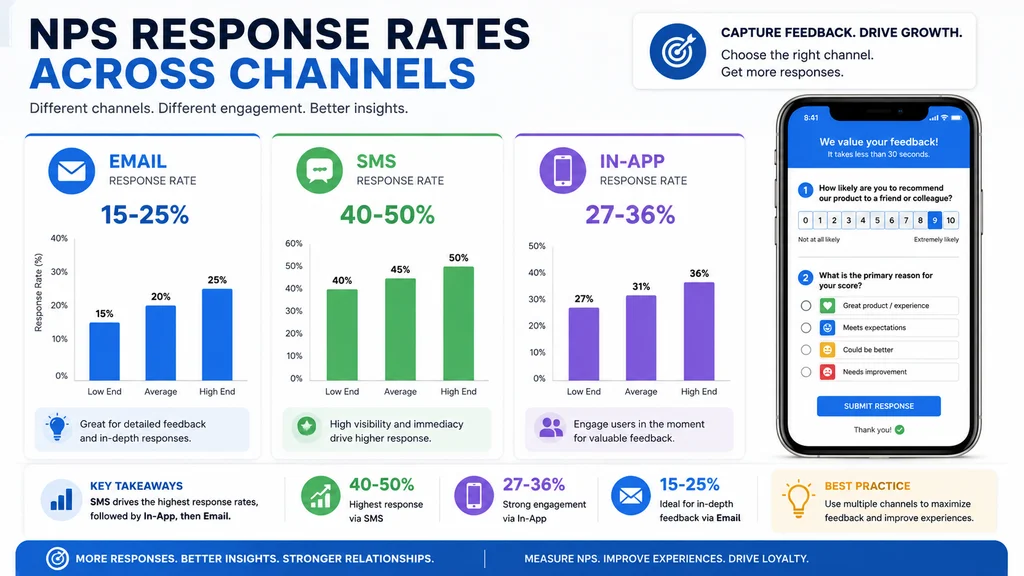
1. Use SMS for response rates up to 50%
Example: Choose SMS when you need high engagement from mobile-first customers.
Meaning: SMS consistently outperforms email for NPS collection .
2. Send in-app surveys for 27-36% response rates
Example: Use in-app surveys for customers actively using your product.
Meaning: In-app captures feedback while the experience is fresh .
3. Use email for 15-25% response rates
Example: Send email surveys for relationship tracking with your customer base.
Meaning: Email remains reliable but underperforms other channels .
4. Embed questions in email for better results
Example: Put the NPS question directly in the email body.
Meaning: Embedded questions reduce friction and increase completion .
5. Avoid email links that send customers away
Example: Use hyperlinked text instead of buttons that trigger spam filters.
Meaning: Links to external surveys can decrease response rates .
6. Match the channel to customer behavior
Example: Survey customers where they already engage with your brand.
Meaning: Channel relevance drives participation .
7. Use website pop-ups for 8-15% response rates
Example: Add pop-up surveys for website visitors.
Meaning: Pop-ups capture feedback but have lower engagement .
8. Mobile SDK surveys achieve about 16% response
Example: Use mobile SDK for app-based customer feedback.
Meaning: Mobile channels work well for app users .
9. Test different distribution methods over time
Example: Experiment with various channels to find what works.
Meaning: Audience behavior should guide your channel choice .
10. Use transactional channels for higher engagement
Example: Send surveys through the same channel where transactions occur.
Meaning: Transactional surveys achieve 8-12 points higher response rates .
11. Avoid sending reminders through the same channel
Example: Use email for reminders after in-app invitations.
Meaning: Cross-channel reminders avoid annoying customers .
12. Consider WhatsApp for certain audiences
Example: Use messaging apps for younger or international customers.
Meaning: Emerging channels can outperform traditional methods .
Timing and Frequency Responses
1. Send surveys Tuesday through Thursday between 9-11 AM
Example: Schedule NPS emails to hit inboxes mid-week mornings.
Meaning: Mid-week mornings consistently achieve higher open and completion rates .
2. Use the recipient’s local time zone for sends
Example: Send surveys at 10 AM in each customer’s time zone.
Meaning: Time zone intelligence significantly boosts open rates .
3. Send transactional surveys immediately after events
Example: Trigger surveys right after support tickets close or purchases complete.
Meaning: Fresh experiences lead to higher quality feedback .
4. Send relational surveys quarterly or biannually
Example: Use regular intervals for relationship tracking surveys.
Meaning: Regular intervals track trends without causing fatigue .
5. Avoid Mondays due to inbox overload
Example: Never send surveys on Monday mornings.
Meaning: Monday inboxes are too full for survey attention .
6. Avoid Fridays when customers are winding down
Example: Skip Friday survey sends entirely.
Meaning: End-of-week priorities reduce survey engagement .
7. Avoid sending surveys before product usage
Example: Wait until customers have actually used your product.
Meaning: Customers need experience before giving meaningful feedback .
8. Suppress customers surveyed in the last 60-90 days
Example: Exclude recent survey respondents from new requests.
Meaning: Survey fatigue reduces response rates .
9. Rotate recipients to prevent fatigue
Example: Send surveys to different segments each quarter.
Meaning: Rotating recipients keeps your program fresh .
10. Coordinate survey schedules across teams
Example: Avoid sending multiple surveys from different departments.
Meaning: Coordinated sends prevent overwhelming customers .
11. Align surveys with renewal or review cycles
Example: Send surveys around contract renewal times.
Meaning: Strategic timing captures meaningful sentiment .
12. Send one reminder 3-7 days after initial invite
Example: Follow up once with non-responders.
Meaning: A single reminder can boost response by up to 14% .
Survey Design Responses
1. Keep surveys to two questions maximum
Example: Use only the core NPS question and one follow-up.
Meaning: Short surveys dramatically increase completion rates .
2. Complete surveys in under two minutes
Example: Tell customers the survey takes just one minute.
Meaning: Clear time expectations increase participation .
3. Use tap-friendly buttons for mobile respondents
Example: Replace sliders with easy-to-tap rating options.
Meaning: Mobile-friendly design prevents drop-off .
4. Use the standard 0-10 scale for consistency
Example: Stick to the original NPS format.
Meaning: Consistency allows benchmark comparisons .
5. Add one optional open-ended question only
Example: Ask “Why?” as the single follow-up.
Meaning: One optional question gathers context without overwhelming .
6. Avoid mandatory text fields that cause drop-off
Example: Make open-ended questions optional.
Meaning: Required text fields reduce completion rates .
7. Limit surveys to 3-5 questions maximum
Example: Keep surveys short for faster, cleaner data.
Meaning: Brevity improves response quality .
8. Use branding to build trust
Example: Add your logo and consistent design elements.
Meaning: Trustworthy surveys get higher completion .
9. Test surveys internally before sending
Example: Send surveys to employees first.
Meaning: Testing prevents technical issues .
10. Make surveys mobile-compatible
Example: Ensure surveys work on all devices.
Meaning: 45% of customers fill surveys on mobile .
11. Avoid slider-format rating scales
Example: Use buttons instead of sliders.
Meaning: Sliders cause frustration and drop-off .
12. Test surveys across browsers and email clients
Example: Check compatibility with Gmail, Outlook, and others.
Meaning: Compatibility issues hurt response rates .
Invitation and Messaging Responses
1. Personalize invite with customer’s name and context
Example: Reference their recent purchase or support interaction.
Meaning: Personalization increases survey relevance .
2. Tell customers how long the survey takes
Example: State “This takes just 1 minute” in the invite.
Meaning: Clear expectations increase participation .
3. Explain how feedback will be used
Example: Promise to read every comment and act on feedback.
Meaning: Customers respond when they feel heard .
4. Use genuine, not clickbait, subject lines
Example: Write “We’d love your feedback on your recent purchase.”
Meaning: Authentic subject lines build trust .
5. Include the sender’s name and photo
Example: Send from a real person with a photo.
Meaning: Personal sends increase trust and open rates .
6. Use hyperlinked text instead of buttons
Example: Link text like “Take our short survey” instead of images.
Meaning: Buttons can be blocked by email servers .
7. Avoid trigger words that hit spam filters
Example: Skip words like “free,” “urgent,” and “act now.”
Meaning: Spam triggers prevent emails from reaching customers .
8. Keep emails short and scannable
Example: Use brief paragraphs and clear headings.
Meaning: Scannable emails get more attention .
9. Make the CTA clear and prominent
Example: Use “Help us improve in 1 minute” as your CTA.
Meaning: Clear calls-to-action drive response .
10. Reference the specific interaction that triggered the survey
Example: Mention “following your recent support call” in the invite.
Meaning: Context makes surveys feel relevant .
11. Use a consistent, friendly tone
Example: Match your brand voice in all communications.
Meaning: Consistency builds recognition and trust .
12. Share results and actions taken from previous feedback
Example: Follow up to show changes made based on feedback.
Meaning: Demonstrating follow-through improves future response .
Audience Targeting Responses
1. Survey only relevant customers
Example: Skip customers who haven’t used your product recently.
Meaning: Irrelevant surveys waste customer goodwill .
2. Segment by product, plan, or usage
Example: Send different surveys to different customer segments.
Meaning: Relevance drives engagement .
3. Focus on your most valuable accounts
Example: Prioritize the 20% of customers who bring 80% of revenue.
Meaning: Response matters more for high-value accounts .
4. Segment by lifecycle stage
Example: Send onboarding surveys to new customers.
Meaning: Lifecycle context matters .
5. Update contact lists continuously
Example: Remove bounced emails and update changed contacts.
Meaning: Clean data improves deliverability .
6. Exclude accounts with recent survey responses
Example: Avoid sending to customers who responded in the last 90 days.
Meaning: Fresh responses are more valuable .
7. Segment by role or seniority
Example: Survey decision-makers differently than end-users.
Meaning: Different roles provide different perspectives .
8. Trigger surveys off events, not dates
Example: Send surveys after onboarding completion, not just every 30 days.
Meaning: Event-based timing boosts relevance and response .
9. Avoid sending to recently surveyed contacts
Example: Coordinate across departments to prevent overlap.
Meaning: Over-surveying causes fatigue .
10. Focus on active customers, not churned ones
Example: Survey customers who are still engaged.
Meaning: Active customers provide more actionable feedback .
11. Use the 80/20 rule for B2B accounts
Example: Focus survey efforts on high-revenue customers.
Meaning: Valuable accounts need more attention .
12. Clean audience data regularly
Example: Remove outdated or incorrect contact details.
Meaning: Data quality directly impacts response rates .
Incentive and Motivation Responses
1. Offer small discounts or rewards
Example: Provide a 10% discount code for survey completion.
Meaning: Incentives can boost response by 10-20 points .
2. Use raffle entries as incentives
Example: Enter respondents into a prize draw.
Meaning: Raffles motivate participation without bias .
3. Donate to charity for each response
Example: Promise a small donation per completed survey.
Meaning: Altruistic incentives appeal to some customers .
4. Avoid incentives for NPS unless rates are critically low
Example: Skip incentives if your response rate is above 15%.
Meaning: Incentives introduce bias and should be used carefully .
5. Make it clear feedback will improve the product
Example: State “Your feedback helps us build better products.”
Meaning: Customers respond when they see impact .
6. Follow up to show how feedback was used
Example: Share updates based on previous feedback.
Meaning: Showing results motivates future responses .
7. Use “we promise to read every comment”
Example: Include this assurance in your invitation.
Meaning: Feeling heard encourages participation .
8. Frame feedback as helping other customers
Example: “Help us improve for everyone who uses our product.”
Meaning: Altruistic framing can increase response .
9. Use social proof in your invitation
Example: “Thousands of customers have already shared their feedback.”
Meaning: Social proof can motivate participation .
10. Make completion feel exclusive or special
Example: “We’ve selected you to share your valuable insights.”
Meaning: Exclusivity can increase engagement .
11. Highlight the brevity of the survey
Example: “Just one question that takes 30 seconds.”
Meaning: Minimal time commitment increases response .
12. Emphasize customer appreciation
Example: “We truly value your opinion and business.”
Meaning: Feeling valued increases willingness to respond .
Follow-Up and Reminder Responses
1. Send one reminder 3-7 days after initial invite
Example: Follow up with non-responders after 5 days.
Meaning: One reminder is effective; more can cause fatigue .
2. Avoid second reminders that cause fatigue
Example: Skip additional follow-ups.
Meaning: Diminishing returns make second reminders less effective .
3. Use reminders in a different channel
Example: Follow up via SMS if initial was email.
Meaning: Cross-channel reminders can catch different audiences .
4. Time reminders based on customer time zone
Example: Send reminders during local business hours.
Meaning: Timing affects open rates .
5. Personalize reminder messages
Example: Include the customer’s name and context.
Meaning: Personalization increases engagement .
6. Keep reminders brief and direct
Example: Use short, clear reminder messages.
Meaning: Brevity increases action .
7. Use reminders for non-responders only
Example: Skip reminders for those who already responded.
Meaning: Avoid bothering customers who already participated .
8. Skip reminders for transactional surveys
Example: Don’t follow up if customers saw the initial invite.
Meaning: Customers saw it and chose not to respond .
9. Use in-app nudges instead of email reminders
Example: Show a gentle reminder within your product.
Meaning: Contextual nudges can be more effective .
10. Test reminder timing for your audience
Example: Experiment with 3 vs 7 day intervals.
Meaning: Different audiences respond to different timing .
11. Thank customers who respond quickly
Example: Send a thank-you note to early responders.
Meaning: Recognition encourages future participation .
12. Track reminder performance over time
Example: Monitor which reminders get the most response.
Meaning: Data helps optimize your reminder strategy .
FAQ
What is a good NPS survey response rate?
A good NPS survey response rate depends on your channel. Email typically achieves 15-25%, SMS 40-50%, and in-app 27-36% . B2B programs average about 12.4%, while B2C can aim for 40% or higher .
Why is my NPS survey response rate so low?
Low response rates usually come from survey fatigue, channel mismatch, poor timing, or design issues . Check if you’re over-surveying, using the wrong channel, sending at bad times, or making surveys too long.
How can I improve my NPS response rate?
Improve by sending surveys mid-week mid-morning, keeping surveys to two questions, using the right channel, personalizing invitations, and sending one well-timed reminder .
Does channel choice affect NPS response rates?
Yes. SMS gets 40-50%, in-app gets 27-36%, and email gets 15-25%. Choose the channel where your customers are most active .
Should I offer incentives for NPS surveys?
Incentives can lift response rates by 10-20 points, but they introduce bias. Use them only if your rate is critically low (below 10%) and other tactics have failed .
Conclusion
Your NPS survey response rate tells you more than how many people replied. It tells you if your feedback program is actually working. When response rates are low, you’re not just getting a small sample, you’re getting a biased one where your most at-risk customers go silent .
The strategies here will help you earn responses from the customers who matter most. Focus on timing, channel relevance, survey design, and follow-up. Keep surveys short, send them at the right time, and show customers their feedback makes a difference.
Start with one improvement today, like moving from static sends to event-based triggers, and watch your response rates grow . When customers feel heard, they respond. And when they respond, you can build the business they actually want.






