

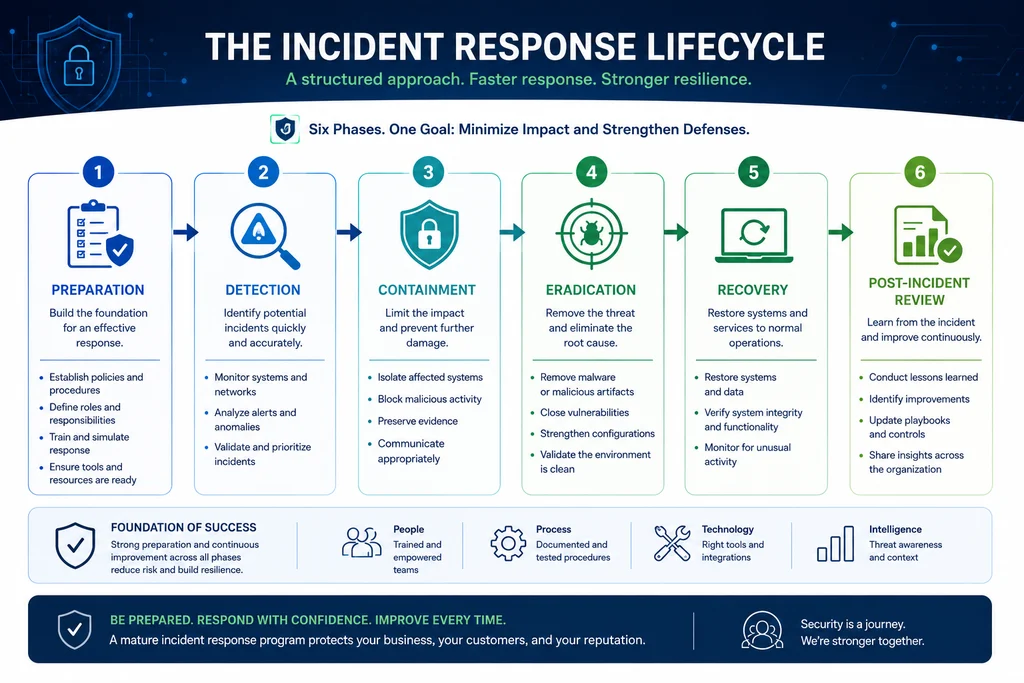
The best sample cyber incident response plan includes preparation, detection, containment, eradication, recovery, and post-incident review phases. These elements form a structured framework for handling security breaches. Top alternatives: IRP template, security breach response plan, cybersecurity playbook, incident management framework, and digital crisis response strategy.You’re sitting at your desk when the alert comes in. Suspicious network traffic. A possible breach. Your heart pounds as you realize this could be the moment your company has been preparing for, or the moment you realize you’re completely unprepared.
Every organization faces the threat of cyber incidents. The difference between a minor disruption and a catastrophic breach often comes down to one thing: having a sample cyber incident response plan ready to execute . A well-documented plan gives your team clear direction, defined roles, and proven procedures when every second counts .
Whether you’re building your first incident response plan or updating an existing one, having sample cyber incident response plan elements to draw from can save critical time and prevent costly mistakes . Let’s break down exactly what you need in your plan.
Preparation Phase Responses
1. Document your incident response policy and procedures
Example: Create a foundational document that governs all response activities.
Meaning: Clear policies establish authority, scope, and guiding principles for the entire response process .
2. Establish your incident response team
Example: Define roles including incident commander, communications lead, and technical responders.
Meaning: Designating specific responsibilities ensures coordinated action during a crisis .
3. Inventory critical assets and systems
Example: List all hardware, software, data, and cloud resources your organization depends on.
Meaning: Understanding your attack surface helps prioritize response efforts .
4. Create contact lists for internal and external stakeholders
Example: Compile phone numbers and emails for team members, legal counsel, and vendors.
Meaning: Quick access to contacts prevents delays during high-stress situations .
5. Develop detection and monitoring capabilities
Example: Deploy SIEM, EDR, and network monitoring tools.
Meaning: Visibility into your environment is essential for identifying threats early .
6. Conduct tabletop exercises regularly
Example: Simulate real attack scenarios to test your team’s readiness.
Meaning: Practice builds confidence and reveals gaps before a real incident occurs .
7. Maintain an asset inventory
Example: Document everything connected to your network, including cloud assets.
Meaning: You can’t protect what you don’t know exists .
8. Establish relationships with third-party vendors
Example: Identify forensic experts, legal counsel, and PR firms to engage during incidents.
Meaning: Having trusted partners on standby speeds up the response .
9. Create playbooks for common incident types
Example: Document specific procedures for ransomware, phishing, and data breaches.
Meaning: Playbooks reduce decision-making time during active attacks .
10. Implement logging and retention policies
Example: Ensure critical logs are collected and stored for forensic investigation.
Meaning: Logs are essential for understanding what happened and how far attackers got .
11. Establish a security awareness training program
Example: Train employees to recognize and report suspicious activities.
Meaning: Human error is a primary attack vector; education reduces risk .
12. Define service-level agreements for response
Example: Set expectations for containment, eradication, and recovery timelines.
Meaning: Clear SLAs help prioritize resources during multiple incidents .
Detection and Analysis Responses
1. Establish multiple detection sources
Example: Use endpoint, network, and cloud telemetry for comprehensive coverage.
Meaning: Redundant detection increases the chance of catching an intrusion early .
2. Implement a triage process for alerts
Example: Verify if an alert is a true positive before escalating.
Meaning: Efficient triage prevents analyst burnout and focuses on real threats .
3. Document every potential incident
Example: Record timestamped notes about suspicious activity as it’s discovered.
Meaning: Detailed documentation aids investigation and post-incident review .
4. Correlate alerts from multiple sources
Example: Use SIEM tools to connect events across your environment.
Meaning: Correlation helps identify patterns that indicate a coordinated attack .
5. Validate incidents before declaring them
Example: Confirm that suspicious activity is not a false positive.
Meaning: Premature escalation wastes resources and creates unnecessary panic .
6. Determine the scope of the incident
Example: Identify what systems, data, and users are affected.
Meaning: Understanding the blast radius guides containment decisions .
7. Use threat intelligence for validation
Example: Check suspicious IPs and domains against known threat actor databases.
Meaning: Threat intelligence helps confirm if an alert is part of a known campaign .
8. Assign a severity level to the incident
Example: Classify incidents as Critical, High, Medium, or Low.
Meaning: Severity levels determine the appropriate response and escalation timeline .
9. Capture volatile data before containment
Example: Collect memory dumps and network connections before isolating systems.
Meaning: Forensic data can be lost when systems are powered down .
10. Preserve evidence for legal and regulatory purposes
Example: Maintain chain of custody for forensic artifacts.
Meaning: Proper evidence handling is essential for legal proceedings or regulatory reporting .
11. Communicate early with key stakeholders
Example: Inform leadership and legal counsel about potential incidents.
Meaning: Early communication helps manage expectations and legal obligations .
12. Keep incident response logs
Example: Record every action taken during the investigation.
Meaning: Response logs provide a timeline for post-incident analysis .
Containment Strategies
1. Apply short-term containment quickly
Example: Immediately isolate affected systems to stop lateral movement.
Meaning: Fast action prevents attackers from spreading further .
2. Implement network segmentation
Example: Move compromised systems to restricted VLANs.
Meaning: Segmentation limits the attacker’s ability to reach other systems .
3. Revoke compromised credentials
Example: Disable accounts and reset passwords for affected users.
Meaning: Cutting off attacker access to legitimate accounts stops further intrusion .
4. Block malicious IPs and domains
Example: Add denial rules to firewalls for known command-and-control addresses.
Meaning: Network-level blocking disrupts attacker communication channels .
5. Preserve evidence before containment
Example: Capture forensic data before shutting down or disconnecting systems.
Meaning: Proper forensic collection is easier before containment .
6. Distinguish between short-term and long-term containment
Example: Use immediate measures to stop the bleeding and prepare for removal.
Meaning: Long-term containment allows continued operations during remediation .
7. Apply temporary patches
Example: Immediately close known vulnerabilities identified as the entry point.
Meaning: Quick fixes prevent the same attack vector from being reused .
8. Consider monitoring before complete containment
Example: Observe attacker behavior to gather intelligence before cutting them off.
Meaning: Understanding attacker objectives can inform better removal strategies .
9. Communicate containment actions clearly
Example: Notify affected teams and stakeholders about the plan.
Meaning: Transparency reduces confusion and prevents accidental interference .
10. Use automation for common containment tasks
Example: Automate quarantine of infected endpoints where possible.
Meaning: Automation speeds up response and reduces human error .
11. Keep detailed records of containment activities
Example: Document all actions taken and their outcomes.
Meaning: Records help refine future containment strategies .
12. Balance containment with business continuity
Example: Consider the impact on service availability before taking disruptive actions.
Meaning: The best containment strategy minimizes damage without halting essential operations .
Eradication Responses
1. Remove the root cause of the breach
Example: Delete malware, close exploited vulnerabilities, and eliminate attacker access.
Meaning: Removing the cause prevents recurrence .
2. Rebuild compromised systems from known-good images
Example: Reimage infected servers rather than attempting to clean them in place.
Meaning: Rebuilding ensures no backdoor or persistence mechanisms remain .
3. Rotate all potentially exposed credentials
Example: Change passwords and API keys for affected and related accounts.
Meaning: Credential rotation prevents attackers from maintaining access .
4. Update infrastructure as code templates
Example: Modify Terraform or CloudFormation to reflect security improvements.
Meaning: Infrastructure as code updates ensure long-term vulnerability fixes .
5. Patch exploited vulnerabilities
Example: Apply security updates to address the specific weakness used in the attack.
Meaning: Patching the entry point prevents the same attack from succeeding again .
6. Conduct a full vulnerability scan
Example: Scan for other weaknesses that could be exploited.
Meaning: Comprehensive scanning identifies additional risks .
7. Implement enhanced monitoring
Example: Increase logging and alerting during and after eradication.
Meaning: Tight monitoring helps detect any remaining activity .
8. Consult with third-party experts if needed
Example: Bring in specialized forensic investigators for complex cases.
Meaning: External experts can identify subtle attack vectors that internal teams might miss .
9. Remove suspicious processes and files
Example: Terminate malicious processes and delete unauthorized files.
Meaning: Active removal eliminates malware footprint from systems .
10. Verify eradication success
Example: Confirm that the threat is completely removed.
Meaning: Verification prevents false confidence before recovery .
11. Update detection rules
Example: Add indicators of compromise to detection tools.
Meaning: Updated rules help detect similar attacks in the future .
12. Document all eradication steps
Example: Record actions taken and their outcomes for future reference.
Meaning: Documentation helps refine future eradication strategies .
Recovery Responses
1. Restore systems in a controlled order
Example: Prioritize critical business functions for restoration.
Meaning: Controlled restoration prevents unintended consequences .
2. Validate system integrity before going live
Example: Check for signs of compromise before restoring production traffic.
Meaning: Recovery must not reintroduce threats .
3. Use clean backups for restoration
Example: Restore data and systems from verified, uncompromised backups.
Meaning: Clean backups prevent re-infection during recovery .
4. Monitor restored systems closely
Example: Watch for unusual behavior after systems come back online.
Meaning: Close monitoring catches any lingering threats .
5. Test functionality before full restoration
Example: Validate that applications work as expected after recovery.
Meaning: Testing prevents secondary incidents or outages .
6. Communicate recovery status to stakeholders
Example: Provide regular updates on restoration progress.
Meaning: Transparency maintains trust during the recovery phase .
7. Consider staged recovery
Example: Restore non-critical systems first to test restoration procedures.
Meaning: Staged recovery allows problems to be identified before critical systems are impacted .
8. Document all recovery actions
Example: Record steps taken and verification performed.
Meaning: Documentation helps refine future recovery procedures .
9. Identify and implement process improvements
Example: Update procedures based on lessons learned during recovery.
Meaning: Continuous improvement builds resilience .
10. Create a timeline of recovery milestones
Example: Track significant milestones in the restoration process.
Meaning: Timelines help measure performance and identify delays .
11. Prepare for possible reinfection
Example: Have a quick-response plan ready if signs return.
Meaning: Preparedness for secondary incidents saves time .
12. Restore trust with stakeholders
Example: Communicate transparently about the incident and recovery.
Meaning: Trust is maintained through honesty and accountability .
Post-Incident Review Responses
1. Conduct a blameless post-mortem
Example: Review what happened without assigning blame to individuals.
Meaning: Blameless reviews encourage honest feedback and learning .
2. Develop a detailed incident timeline
Example: Map out the events from initial compromise to full recovery.
Meaning: Timelines help identify delays and decision points .
3. Measure key response metrics
Example: Calculate dwell time, time to detect, and time to contain.
Meaning: Metrics reveal which phases need improvement .
4. Identify what worked and what didn’t
Example: Compare planned procedures to actual actions.
Meaning: Real-world experience identifies gaps in the plan .
5. Update playbooks and detection rules
Example: Incorporate lessons learned into incident response documentation.
Meaning: Updated playbooks make future responses more effective .
6. Share findings with the broader team
Example: Communicate insights from the post-mortem to all stakeholders.
Meaning: Shared knowledge builds organizational resilience .
7. Review legal and regulatory obligations
Example: Ensure all reporting requirements have been met.
Meaning: Regulatory compliance prevents additional penalties .
8. Identify root causes and systemic issues
Example: Look beyond the immediate attack to underlying vulnerabilities.
Meaning: Addressing root causes prevents recurrence .
9. Update the incident response plan
Example: Revise procedures based on post-mortem findings.
Meaning: A living plan improves with each incident .
10. Implement new detection rules
Example: Add rules to catch the specific attack techniques observed.
Meaning: Improved detection shortens future dwell time .
11. Schedule follow-up training
Example: Train team members on identified skill gaps.
Meaning: Training builds confidence and competence .
12. Celebrate what went well
Example: Acknowledge team members who performed effectively.
Meaning: Positive reinforcement builds morale and motivation .
Communication Responses
1. Establish a crisis communication plan
Example: Define how and when to communicate with internal and external stakeholders.
Meaning: Effective communication preserves trust and manages the narrative .
2. Identify internal communication channels
Example: Use a dedicated channel for incident-related updates.
Meaning: Centralized communication prevents confusion .
3. Notify leadership immediately on critical incidents
Example: Escalate to CISO and executive team based on severity.
Meaning: Executive awareness enables timely business decisions .
4. Coordinate with legal counsel on external communications
Example: Review all public statements with legal before release.
Meaning: Legal review prevents regulatory and liability issues .
5. Develop press release templates
Example: Prepare template statements for different incident scenarios.
Meaning: Templates speed up response while maintaining quality .
6. Notify customers and partners when required
Example: Communicate impact and actions taken to affected stakeholders.
Meaning: Transparency maintains trust during a crisis .
7. Establish communications with your Cloud Service Provider
Example: Share incident details with your CSP for mutual benefit.
Meaning: CSP cooperation can help stop attacks across shared infrastructure .
8. Use plain language in internal communications
Example: Avoid technical jargon when communicating with non-technical teams.
Meaning: Clear communication ensures everyone understands the situation .
9. Provide regular updates to stakeholders
Example: Schedule recurring briefings during active incidents.
Meaning: Regular updates prevent surprises and misinformation .
10. Maintain a communications log
Example: Record all internal and external communications about the incident.
Meaning: A log provides accountability and audit trail .
11. Consider a public-facing status page
Example: Use a status page for real-time updates to customers.
Meaning: Status pages provide transparency without overwhelming internal teams .
12. Engage customer support teams
Example: Prepare support teams with consistent messaging for customer inquiries.
Meaning: Consistent support messaging maintains customer confidence .
Legal and Regulatory Responses
1. Understand applicable breach notification laws
Example: Identify which regulations apply to your organization and data types.
Meaning: Compliance with notification laws avoids legal penalties .
2. Create a compliance matrix
Example: Document territorial scope of each regulation and affected data types.
Meaning: A compliance matrix helps legal teams determine notification requirements .
3. Engage legal counsel immediately
Example: Involve legal teams at the start of the incident.
Meaning: Early legal involvement protects attorney-client privilege .
4. Preserve evidence for legal proceedings
Example: Maintain chain of custody for forensic artifacts.
Meaning: Proper evidence preservation is essential for prosecution or defense .
5. Determine if the incident triggers regulatory reporting
Example: Evaluate if the breach involves personal data under GDPR, HIPAA, or other regulations.
Meaning: Regulatory notifications have strict timelines and penalties for delay .
6. Consider law enforcement engagement
Example: Evaluate whether to involve law enforcement in the investigation.
Meaning: Law enforcement provides specialized resources and coordination .
7. Review contractual obligations
Example: Check if the breach triggers contractual notification requirements.
Meaning: Contractual compliance prevents business partner lawsuits .
8. Prepare for potential litigation
Example: Document all actions and decisions for potential legal challenges.
Meaning: Detailed documentation protects the organization in court .
9. Coordinate with insurance providers
Example: File cyber insurance claims promptly as required.
Meaning: Timely reporting satisfies insurance policy requirements .
10. Address supply chain notification needs
Example: Notify partners whose systems may be impacted.
Meaning: Protecting the supply chain prevents secondary breaches .
11. Consider non-disclosure agreements for external partners
Example: Formalize NDAs with forensic vendors and other third parties.
Meaning: Confidentiality protects sensitive investigation details .
12. Document all regulatory communications
Example: Record all submissions and interactions with regulators.
Meaning: Documentation supports compliance and legal defense .
Business Continuity Responses
1. Integrate incident response with business continuity plans
Example: Ensure incident response coordinates with disaster recovery procedures.
Meaning: Alignment prevents conflicts between recovery strategies .
2. Define RTO and RPO for critical systems
Example: Establish recovery time and recovery point objectives.
Meaning: Clear objectives guide prioritization during recovery .
3. Identify critical business functions
Example: List processes that must be restored first.
Meaning: Prioritization limits business disruption .
4. Plan for extended outages
Example: Prepare for circumstances where recovery takes longer than expected.
Meaning: Contingency planning maintains operations through extended disruption .
5. Document alternative procedures
Example: Create manual workarounds for essential functions if systems are unavailable.
Meaning: Manual processes keep the business running during technical recovery .
6. Communicate with impacted business units
Example: Keep operations teams informed about restoration progress.
Meaning: Ongoing communication helps manage business impact .
7. Balance recovery speed with security
Example: Ensure restored systems are clean before bringing them back.
Meaning: Rushed recovery can reintroduce threats .
8. Use failover environments when available
Example: Switch to standby deployments while investigating the breach in primary systems.
Meaning: Failover maintains service availability .
9. Consider cloud-based continuity options
Example: Leverage cloud infrastructure for rapid scaling during recovery.
Meaning: Cloud flexibility accelerates restoration .
10. Test business continuity procedures regularly
Example: Validate that backup systems actually work.
Meaning: Untested procedures often fail when needed .
11. Involve business stakeholders in planning
Example: Include operations and finance teams in incident planning.
Meaning: Business input ensures plans address real needs .
12. Maintain updated communication for customers
Example: Keep customers informed about service availability.
Meaning: Transparent communication protects customer relationships .
FAQ
What is a sample cyber incident response plan?
A sample cyber incident response plan is a structured template that organizations use as a starting point to develop their own incident response procedures . It typically includes phases like preparation, detection, containment, eradication, recovery, and lessons learned .
What frameworks are commonly used for incident response plans?
The two most widely used frameworks are NIST SP 800-61 (which has four phases) and SANS Incident Response Framework (which has six steps) . Both provide practical, repeatable approaches to handling security incidents .
How often should an incident response plan be updated?
Review and update your plan at least annually, after every tabletop exercise, and after any real incident . Regular updates keep the plan relevant as threats and environments evolve .
How do you test an incident response plan?
Conduct tabletop exercises regularly . These are simulation drills where the team responds to a fictional attack scenario, helping identify gaps and build readiness .
What is the most important phase of incident response?
Preparation is the most critical phase because it determines how effectively you’ll handle every other phase . You cannot respond well to what you cannot see or have not planned for .
Conclusion
A sample cyber incident response plan is more than just a document. It’s your organization’s lifeline when the worst happens. The difference between a minor disruption and a catastrophic breach often comes down to whether you had a plan ready and practiced .
The best incident response plans are living documents that teams rehearse regularly . They define clear roles, establish communication protocols, and provide the structure needed to make quick decisions under pressure . Every incident should make your plan stronger through lessons learned and continuous improvement .
Don’t wait until the alert comes to build your plan. Start today with this sample cyber incident response plan as your foundation. The time you invest now will pay dividends when every second counts.







4 thoughts on “250+ Sample Cyber Incident Response Plan Elements for Every Security Team For 2026”