

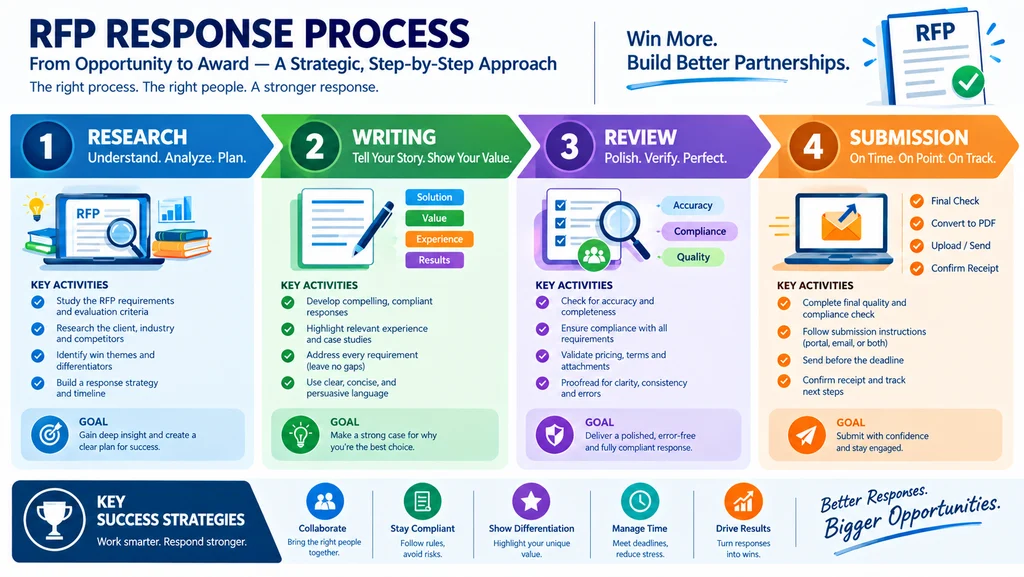
The best successful RFP response strategies combine thorough preparation, clear writing, and strategic differentiation. Winning proposals answer every requirement directly, showcase measurable value, and tell a compelling story. Top alternatives: winning proposal strategy, competitive bid response, RFP proposal optimization, contract win strategy, and persuasive bid writing.
You’ve spent weeks preparing. The deadline is tomorrow. Your team is exhausted. And then you hit submit on your RFP response, hoping for the best but knowing the competition is fierce.
Sound familiar? Whether you’re a small business owner chasing your first government contract, a sales director responding to enterprise procurement requests, or a consultant trying to win your next big client, the pressure of a successful RFP response is real. One wrong move, one missed requirement, one vague answer, and you’re out of the running before you even get a chance to shine.
The truth is, the difference between winning and losing often comes down to strategy, not just substance. A successful RFP response isn’t just about answering questions. It’s about understanding what the buyer really wants, speaking their language, and making their decision easy. Let’s dive into the strategies that actually work.
Preparation Strategies
1. Read the RFP at least three times before writing anything
Example: Use this when you first receive a complex RFP with multiple sections and requirements.
Meaning: Multiple readings ensure you catch hidden requirements and evaluation criteria .
2. Create a compliance matrix before you start writing
Example: Perfect for large RFPs with dozens of mandatory requirements.
Meaning: A compliance matrix ensures every requirement is addressed systematically .
3. Identify the evaluation criteria and scoring methodology
Example: Use this when the RFP includes specific scoring rubrics.
Meaning: Knowing how you’ll be scored helps you prioritize your response .
4. Research the buyer’s pain points and strategic priorities
Example: Ideal before responding to any RFP in a competitive industry.
Meaning: Understanding their challenges helps you tailor your solution .
5. Assemble your response team early and assign clear roles
Example: Use this for complex RFPs requiring input from multiple departments.
Meaning: Clear roles prevent duplication and ensure accountability .
6. Gather supporting documents and past performance data upfront
Example: Great for RFPs requiring case studies or references.
Meaning: Having evidence ready speeds up the writing process .
7. Attend any pre-bid meetings or Q&A sessions
Example: Use this when the buyer offers opportunities to ask questions.
Meaning: These sessions reveal insider information and clarify ambiguities .
8. Analyze competitor strengths and weaknesses
Example: Ideal when you know who else is bidding.
Meaning: Competitive intelligence helps you differentiate your response .
9. Create a detailed outline before writing full responses
Example: Use this for any RFP longer than 20 pages.
Meaning: An outline keeps your response organized and comprehensive .
10. Set internal deadlines well before the submission date
Example: Perfect for teams prone to last-minute rushes.
Meaning: Buffer time allows for review and refinement .
11. Assign a dedicated proposal manager for complex bids
Example: Use this for enterprise-level RFP responses.
Meaning: A single point of accountability keeps the process on track .
12. Build a content library of reusable proposal sections
Example: Ideal for organizations that respond to RFPs frequently.
Meaning: Reusable content saves time and maintains consistency .
Writing and Content Strategies
1. Answer every question directly and completely
Example: Use this for every RFP requirement, no matter how small.
Meaning: Incomplete answers are a common reason for disqualification .
2. Use the buyer’s language and terminology
Example: Perfect when the RFP uses specific industry jargon.
Meaning: Mirroring their language shows you understand their world .
3. Lead with your strongest differentiators
Example: Use this in executive summaries and key sections.
Meaning: Front-loading your best points captures attention immediately .
4. Quantify benefits with specific metrics
Example: Ideal for proposals that need to demonstrate ROI.
Meaning: Numbers make your value proposition concrete and credible .
5. Tell a story, don’t just list features
Example: Use this when explaining your approach or methodology.
Meaning: Stories are more memorable and persuasive than bullet points .
6. Customize every response to the specific RFP
Example: Use this even when you have strong boilerplate content.
Meaning: Generic responses signal a lack of genuine interest .
7. Use clear headings and formatting for easy navigation
Example: Perfect for lengthy proposals with multiple sections.
Meaning: Evaluators appreciate documents that are easy to score .
8. Include visuals, charts, and infographics where helpful
Example: Use this to explain complex processes or data.
Meaning: Visuals break up text and communicate information quickly .
9. Address risks and mitigation strategies proactively
Example: Ideal when the RFP asks about potential challenges.
Meaning: Showing you’ve thought about risks builds confidence .
10. Provide a clear implementation timeline
Example: Use this when the RFP requires a project plan.
Meaning: A realistic timeline demonstrates planning and competence .
11. Write an executive summary that sells your solution
Example: Perfect for the opening section of your proposal.
Meaning: The executive summary is often the most-read section .
12. Proofread meticulously for errors and inconsistencies
Example: Use this before every submission, no exceptions.
Meaning: Typos and errors undermine credibility instantly .
Client-Centric Strategies
1. Put yourself in the evaluator’s shoes
Example: Use this when reviewing your draft before submission.
Meaning: Seeing your response from their perspective reveals gaps .
2. Focus on outcomes, not activities
Example: Ideal when describing your methodology.
Meaning: Buyers care about results, not just what you’ll do .
3. Demonstrate understanding of their specific challenges
Example: Use this in the problem statement or executive summary.
Meaning: Showing you “get it” builds instant credibility .
4. Offer options and flexibility where appropriate
Example: Perfect when the RFP allows for alternative solutions.
Meaning: Flexibility shows you’re willing to work with their constraints .
5. Anticipate follow-up questions and address them
Example: Use this in sections where requirements are vague.
Meaning: Proactive answers reduce friction in the evaluation process .
6. Make it easy for them to choose you
Example: Use this as your guiding principle throughout writing.
Meaning: Remove barriers and objections before they arise .
7. Show you’ve done your homework on their industry
Example: Ideal for competitive markets where knowledge matters.
Meaning: Industry fluency signals expertise and credibility .
8. Address their unspoken concerns
Example: Use this when you sense hesitation points not explicitly stated.
Meaning: Anticipating concerns shows deep customer understanding .
9. Personalize your response to their organizational culture
Example: Perfect when you’ve researched the buyer’s values and style.
Meaning: Cultural fit is often an unstated evaluation criterion .
10. Make your pricing transparent and justifiable
Example: Use this when cost is a major evaluation factor.
Meaning: Clear pricing builds trust and simplifies comparison .
11. Offer references and case studies they can verify
Example: Ideal for RFPs requiring proof of past performance.
Meaning: Verifiable references add credibility to your claims .
12. Close with a clear call to action
Example: Use this at the end of your proposal.
Meaning: A strong close guides the evaluator toward next steps .
Differentiating Strategies
1. Identify what makes you uniquely qualified
Example: Use this in every RFP where competition is fierce.
Meaning: Differentiation is essential when multiple vendors meet requirements .
2. Highlight experience with similar projects or clients
Example: Perfect when you have relevant past performance.
Meaning: Familiarity with similar challenges reduces perceived risk .
3. Showcase your team’s credentials and expertise
Example: Ideal for RFPs where personnel qualifications matter.
Meaning: People buy from people they trust and respect .
4. Emphasize your unique methodology or approach
Example: Use this when you have a proprietary process.
Meaning: A distinctive approach sets you apart from competitors .
5. Offer value-added services at no extra cost
Example: Perfect when you want to sweeten the deal.
Meaning: Added value can tip the scales in your favor .
6. Demonstrate innovation and forward thinking
Example: Ideal for RFPs in fast-changing industries.
Meaning: Showing you’re ahead of the curve builds confidence .
7. Share success stories with measurable results
Example: Use this when the RFP asks for case studies.
Meaning: Specific examples prove your claims are credible .
8. Include testimonials from satisfied clients
Example: Perfect for building trust with evaluators.
Meaning: Third-party validation is more persuasive than self-promotion .
9. Show you understand and can mitigate their risks
Example: Ideal when the project has high stakes.
Meaning: Risk awareness demonstrates maturity and planning .
10. Demonstrate cultural alignment with their organization
Example: Use this when values and fit are important.
Meaning: Shared values create stronger partnerships .
11. Offer a pilot or phased approach to reduce risk
Example: Perfect for large contracts where trust is still building.
Meaning: A lower-risk entry point makes saying yes easier .
12. Be the vendor they want to work with
Example: Use this as your overarching goal.
Meaning: Likability and rapport matter in competitive evaluations .
Formatting and Presentation Strategies
1. Follow the RFP’s format requirements exactly
Example: Use this for every RFP with specific formatting instructions.
Meaning: Non-compliance can get you disqualified .
2. Use a clean, professional design template
Example: Ideal for proposals that will be visually evaluated.
Meaning: A polished look reinforces professionalism .
3. Keep paragraphs short and scannable
Example: Use this for every section of your proposal.
Meaning: Evaluators often skim; short paragraphs keep them engaged .
4. Use bullet points for lists and key information
Example: Perfect for highlighting features or benefits.
Meaning: Bullet points make information easier to digest .
5. Include a table of contents for longer proposals
Example: Use this for any RFP response over 30 pages.
Meaning: A table of contents helps evaluators navigate your document .
6. Number pages and use consistent headers
Example: Ideal for proposals requiring cross-referencing.
Meaning: Consistent formatting makes scoring easier .
7. Use color strategically to highlight key points
Example: Use this sparingly in printed or digital proposals.
Meaning: Color can draw attention to important information .
8. Ensure all attachments and appendices are included
Example: Perfect when the RFP requires supporting documents.
Meaning: Missing attachments can disqualify your response .
9. Check file format and submission requirements
Example: Use this before uploading or sending your proposal.
Meaning: Technical compliance is as important as content .
10. Submit before the deadline, never at the last minute
Example: Ideal for avoiding technical glitches.
Meaning: Early submission reduces stress and risk .
11. Keep a copy of everything you submit
Example: Use this for future reference and debriefing.
Meaning: Documentation helps with follow-up and improvement .
12. Request feedback if you don’t win
Example: Perfect for learning and improving future responses.
Meaning: Debriefs reveal weaknesses and opportunities .
Follow-Up Strategies
1. Send a confirmation email after submission
Example: Use this to confirm receipt and express continued interest.
Meaning: Professional follow-up keeps you top of mind .
2. Be responsive to any clarifying questions
Example: Ideal when the buyer reaches out after submission.
Meaning: Quick, thorough responses demonstrate reliability .
3. Offer to present or demo if given the opportunity
Example: Perfect when shortlisted for final evaluation.
Meaning: Presentations allow you to showcase your team and solution .
4. Follow up politely if you haven’t heard back
Example: Use this after the expected decision timeline passes.
Meaning: Gentle follow-up shows continued interest .
5. Request a debrief regardless of outcome
Example: Ideal for improving future RFP responses.
Meaning: Feedback is invaluable for growth .
6. Thank the evaluators for their time
Example: Use this in your follow-up communication.
Meaning: Gratitude leaves a positive impression .
7. Stay in touch even if you don’t win
Example: Perfect for building long-term relationships.
Meaning: Today’s loss can become tomorrow’s opportunity .
8. Ask what you could have done better
Example: Use this in a debrief request.
Meaning: Specific feedback helps you improve .
9. Keep the relationship warm for future opportunities
Example: Ideal when you want to be considered again.
Meaning: Relationships often outlast individual bids .
10. Analyze what worked and what didn’t
Example: Use this after every RFP response.
Meaning: Continuous improvement is key to long-term success .
11. Update your content library based on learnings
Example: Perfect after a debrief reveals gaps.
Meaning: Every response makes the next one better .
12. Celebrate wins and learn from losses
Example: Use this to maintain team morale and motivation.
Meaning: Both outcomes provide valuable lessons .
FAQ
What is a successful RFP response?
A successful RFP response is a proposal that meets all requirements, clearly communicates value, differentiates from competitors, and convinces the buyer to choose your solution. It’s compliant, compelling, and client-focused.
How long should an RFP response be?
Follow the RFP’s instructions. If no length is specified, aim for comprehensive but concise. Answer every question thoroughly without unnecessary filler.
What’s the most important part of an RFP response?
The executive summary is often the most-read section. It should capture your key differentiators and value proposition in a compelling way.
How do I make my RFP response stand out?
Focus on the buyer’s specific needs, quantify benefits, tell a compelling story, and demonstrate why you’re uniquely qualified. Differentiation is key in competitive bids.
What should I do if I don’t win?
Request a debrief to understand why you lost. Use the feedback to improve future responses. Stay in touch with the buyer for future opportunities.
Conclusion
Winning a successful RFP response isn’t about luck. It’s about strategy, preparation, and execution. The vendors who win consistently are the ones who understand their buyers, differentiate their solutions, and make the evaluation process easy.
Remember, every RFP is an opportunity to learn and improve. Even if you don’t win this time, the relationships you build and the feedback you receive make you stronger for the next bid. So keep refining your approach, keep telling your story, and keep showing up.
Save this guide for your next proposal. Share it with your team. And next time you hit submit on an RFP response, know that you’ve done everything you can to win. Now go get that contract







