

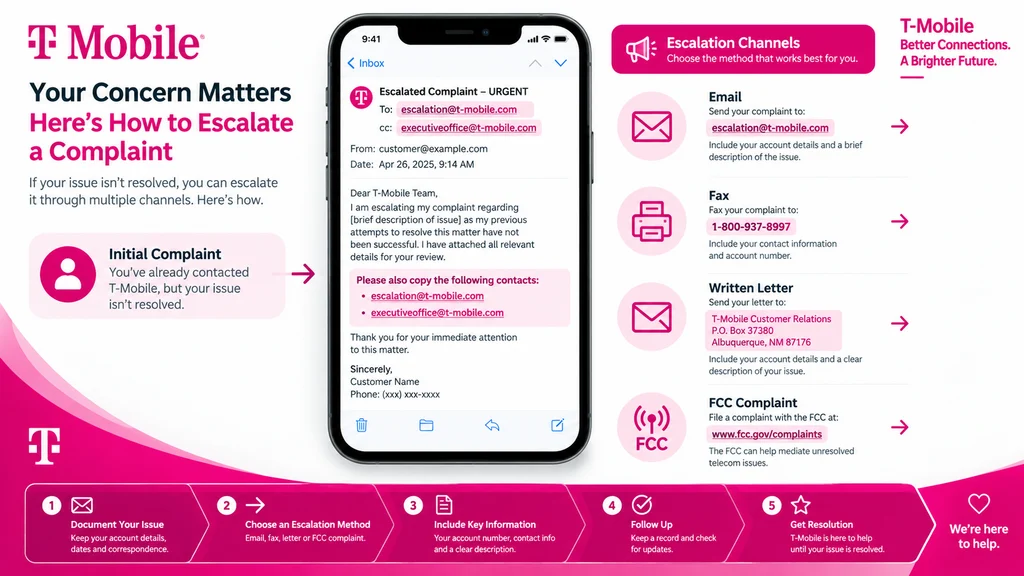
The T-Mobile Executive Response Team is a dedicated escalation group that handles unresolved customer complaints after standard support fails. You can reach them via email, fax, or written correspondence. Top alternatives: Office of the President, executive escalations, customer relations, corporate complaint resolution, and senior support team.
You’ve called customer service five times. You’ve been transferred to supervisors who promised to fix things but didn’t. Your bill is still wrong, your phone still doesn’t work, and you’re this close to losing it.
That’s when the T-Mobile Executive Response Team enters the chat. This is the team you contact when regular support has failed you. They’re the last line of defense before you file an FCC complaint or bail to another carrier. They have more authority, more resources, and more incentive to actually solve your problem.
But here’s the catch: finding the right contact info isn’t always easy. T-Mobile doesn’t exactly advertise it. That’s why we’ve put together this complete guide with 150+ insights on how to reach the Executive Response Team and get your issue resolved.
Contact Methods
1. Email: sprintexecutiveoffices@t-mobile.com
Example: Use this email for Sprint-related complaints that transferred to T-Mobile.
Meaning: Preferred method for written complaints according to official correspondence.
2. Written: T-Mobile Customer Relations, P.O. Box 37380, Albuquerque, NM 87176-7380
Example: Use this address for formal written complaints.
Meaning: Official mailing address for the Executive Response Team.
3. Written: Sprint, now part of T-Mobile Executive Response Team, P.O. Box 169014, Irving, TX 75016
Example: Use this address for legacy Sprint complaints.
Meaning: Dedicated address for former Sprint customer issues.
4. Fax: 1-866-347-8988
Example: Use this fax number for urgent written complaints.
Meaning: Alternative method for submitting formal documentation.
5. Email: Eliana.Lugo@T-Mobile.com
Example: Contact this executive liaison for escalation support.
Meaning: Direct email for an executive liaison.
6. Email: Roxanne.Garza@t-mobile.com
Example: Contact this executive liaison for escalation support.
Meaning: Alternative executive liaison contact.
7. Email: Martin.Gonzales104@t-mobile.com
Example: Reach out to this Executive Response representative.
Meaning: Direct contact for a specific response team member.
8. Convercent hotline: 1-800-335-7639
Example: Use this for ethical concerns or serious escalations.
Meaning: Corporate compliance and ethics hotline.
9. FCC Complaint: fcc.gov
Example: File here if the Executive Response Team doesn’t resolve your issue.
Meaning: Federal escalation that triggers mandatory executive response.
10. BBB Complaint: bbb.org
Example: File here when you need additional pressure.
Meaning: Better Business Bureau complaint that reaches executive level.
11. T-Mobile Community Forums
Example: Post publicly with @TeamT-Mobile tags for visibility.
Meaning: Public pressure that can trigger executive attention.
12. T-Force (Twitter/X): @TMobileHelp
Example: DM T-Force for social media escalations.
Meaning: Social media support team with escalation capabilities.
Response Time Insights
1. FCC complaints get responses within 30 days
Example: Use this timeline when you need a guaranteed response.
Meaning: T-Mobile has 30 days to respond to FCC complaints.
2. Executive Response Team usually calls directly for FCC complaints
Example: Expect a phone call rather than email.
Meaning: They prefer direct conversation for escalated issues.
3. Response can take 14 days or longer in some cases
Example: Be patient but document everything.
Meaning: Some complaints experience extended resolution timelines.
4. Follow up if you don’t hear back within a week
Example: Send a follow-up email referencing your case number.
Meaning: Proactive follow-up keeps your issue visible.
5. Social media complaints often get faster initial responses
Example: Use Twitter/X or Facebook for quicker acknowledgment.
Meaning: Public visibility can accelerate response.
6. Email responses may go to spam
Example: Check your spam folder regularly.
Meaning: Add T-Mobile email addresses to your contacts.
7. Phone calls may come from unknown numbers
Example: Answer calls even from unfamiliar area codes.
Meaning: Executive Response Team members call from various locations.
8. Response time varies by complaint complexity
Example: Simple billing issues resolve faster than device problems.
Meaning: More complex issues require more investigation.
9. Multiple complaints may slow resolution
Example: Stick to one channel for faster service.
Meaning: Duplicate complaints can confuse the process.
10. Documented calls get faster resolutions
Example: Keep recordings and reference numbers ready.
Meaning: Evidence speeds up investigation and resolution.
11. Initial response may just be acknowledgment
Example: Don’t panic if the first reply says they’re reviewing.
Meaning: Investigation takes time before resolution.
12. Escalated complaints get priority attention
Example: Mention previous unresolved attempts.
Meaning: History of failed support accelerates escalation.
Common Issues They Handle
1. Promotional pricing disputes
Example: Use when a promised discount wasn’t applied.
Meaning: Honoring advertised promotions.
2. Unauthorized account changes
Example: Use when your plan was changed without consent.
Meaning: Reversing unauthorized modifications.
3. Equipment return issues
Example: Use when a returned device still shows on your bill.
Meaning: Removing charges for returned equipment.
4. Billing errors and overcharges
Example: Use when your bill doesn’t match your agreement.
Meaning: Correcting billing discrepancies.
5. Trade-in credit problems
Example: Use when promised trade-in values weren’t applied.
Meaning: Ensuring fair trade-in processing.
6. Contract and plan disputes
Example: Use when terms weren’t honored.
Meaning: Enforcing agreed-upon contract terms.
7. Service quality issues
Example: Use after multiple failed attempts to fix coverage.
Meaning: Resolving persistent technical problems.
8. Account access problems
Example: Use when you can’t access your account or make changes.
Meaning: Restoring account access.
9. Warranty claim failures
Example: Use when a warranty exchange wasn’t processed.
Meaning: Resolving warranty-related billing issues.
10. Number porting problems
Example: Use when you can’t transfer your number.
Meaning: Facilitating number transfers.
11. Fraudulent charges
Example: Use when unauthorized charges appear.
Meaning: Investigating and removing fraud.
12. Early termination fee disputes
Example: Use when charged unfairly for cancellation.
Meaning: Reviewing termination charges.
What to Include in Your Complaint
1. Your account number and contact information
Example: Always start with identifying details.
Meaning: Helps them locate your account quickly.
2. A clear, concise summary of the issue
Example: Keep it brief but complete.
Meaning: Respects their time while providing context.
3. Timeline of events
Example: Include dates, times, and names of representatives.
Meaning: Establishes pattern and history.
4. Reference numbers from previous calls
Example: Include all case or ticket numbers.
Meaning: Shows you’ve already tried resolution.
5. Documentation of promises made
Example: Attach screenshots or transcripts.
Meaning: Provides evidence of commitments.
6. Specific resolution you’re seeking
Example: State exactly what would make it right.
Meaning: Gives them a clear goal.
7. Previous unsuccessful attempts
Example: List what you’ve already tried.
Meaning: Shows escalation is necessary.
8. Photos or screenshots of bills
Example: Visual evidence of discrepancies.
Meaning: Makes the issue easy to understand.
9. Names of representatives you’ve spoken with
Example: Reference specific interactions.
Meaning: Helps identify training issues.
10. Your preferred contact method and times
Example: Tell them when and how to reach you.
Meaning: Ensures successful follow-up.
11. Any recordings of calls
Example: Mention if you have recorded conversations.
Meaning: Strengthens your case significantly.
12. A calm, professional tone
Example: Keep emotions in check.
Meaning: Professional complaints get better responses.
Escalation Strategies
1. Start with regular customer service
Example: Give standard support a chance first.
Meaning: Executive team is for unresolved issues.
2. Ask for a supervisor if first attempt fails
Example: Request escalation before going higher.
Meaning: Supervisors have more authority.
3. Document everything from the start
Example: Keep notes on every interaction.
Meaning: Documentation strengthens your case.
4. Reference your history when contacting executive team
Example: Mention how many times you’ve tried.
Meaning: Shows escalation is justified.
5. File an FCC complaint for guaranteed response
Example: Use this when all else fails.
Meaning: FCC complaints trigger mandatory executive review.
6. Use BBB as additional pressure
Example: File with BBB for extra visibility.
Meaning: BBB complaints reach executive level.
7. Post publicly on social media
Example: Use T-Force or community forums.
Meaning: Public pressure accelerates resolution.
8. Contact executive liaisons directly
Example: Use the email addresses provided.
Meaning: Bypasses standard support queues.
9. Mention media involvement
Example: Reference that you’re documenting publicly.
Meaning: Increased visibility prompts action.
10. Request the Office of the President
Example: Ask specifically for this escalation.
Meaning: Highest level of customer complaint resolution.
11. Reference regulatory bodies
Example: Mention FCC, BBB, or state PUC.
Meaning: Regulatory pressure gets results.
12. Stay persistent but professional
Example: Follow up regularly without hostility.
Meaning: Persistence pays off.
FAQ
What is the T-Mobile Executive Response Team?
The Executive Response Team is a dedicated escalation group that handles unresolved customer complaints after standard customer support has failed. They have more authority to resolve complex issues.
How do I contact the T-Mobile Executive Response Team?
You can reach them via email at sprintexecutiveoffices@t-mobile.com, by written correspondence at P.O. Box 37380, Albuquerque, NM 87176-7380, or by fax at 1-866-347-8988.
How long does it take to get a response?
Response times vary, but FCC complaints require a response within 30 days. Social media escalations often get faster initial responses.
Should I file an FCC complaint?
Yes, if standard customer service and the Executive Response Team haven’t resolved your issue. FCC complaints trigger mandatory executive review and often result in resolution.
What issues does the Executive Response Team handle?
They handle billing disputes, promotional pricing issues, equipment return problems, trade-in credit issues, unauthorized account changes, and other unresolved complaints.
Conclusion
The T-Mobile Executive Response Team exists for one reason: to resolve issues that regular customer support can’t handle. If you’ve been stuck in a loop of calls, transfers, and broken promises, this is your path to a real solution.
The key is to be persistent, documented, and professional. Start with regular support, escalate to supervisors, and then reach out to the Executive Response Team with all your evidence ready. If that doesn’t work, the FCC and BBB are powerful allies.
Save this guide for when you need it. Share it with anyone fighting a T-Mobile battle. And remember, you have more power than you think when you know the right doors to knock on.






